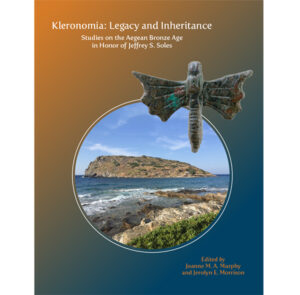
Joanne M.A. Murphy & Jerolyn E. Morrison (επιμέλεια)Pensylvania2022
Kleronomiá-meaning legacy, inheritance, or allotment-encapsulates many of Jeffrey Soles’s feelings about the modern town and archaeological site of Mochlos in eastern Crete, his relationship with the people of Mochlos, the themes in his scholarship, and his contribution to our understanding of Minoan Crete.
Jeremy B. Rutter & Michael LindblomHesperia 91 (2022): 571-648
The circulation of the panel cup on the Greek mainland beginning in Middle Helladic III is explored from various perspectives. The shape flourished for less than a century, principally in the northeast Peloponnese, in both funerary and domestic contexts.
A Final Palatial lapis lacedaemonius seal, here called the Sissi Genius Lentoid, was recovered during the 2018 excavation of the Court-Centered Building at Sissi, East Crete. The seal instantly drew attention because of its rare material and unique iconography that shows a Minoan genius flanked by the foreparts of two agrimia.
Sharon R. Stocker, Calla McNamee, Salvatore Vitale, Panayiotis Karkanas & Jack L. DavisHesperia 91 (2022): 211-250
The circumstances of the discovery, stratigraphy, and construction of the grave of the Griffin Warrior were described briefly in 2016 as an introduction to a detailed presentation of the four gold rings found inside it.
This article discusses the history of cooking dishes--namely, large, open and shallow, undecorated ceramic vessels--following their diachronic development from the Neolithic to the Iron Age (6th millennium to 8th century B.C.), and their synchronic distribution across the Aegean and the Balkans.
Reinhard Jung και Ελευθερία Καρδαμάκη (επιμέλεια)Vienna
The Late Bronze Age Mycenaean palaces in southern and central Greece stood at the head of the earliest state system on the European continent. The authors, all leading scholars in Bronze Age research and often engaged in excavating the palace sites themselves, focus in their contributions on the most recent progress in pottery studies, in order to arrive at precise relative chronological dates of the destruction events. The investigated archaeological sites range from Crete in the south to the Peloponnese with the palaces of Pylos, Ayios Vasileios, Mycenae and Tiryns and further north to central Greece with the palace of Thebes, while contemporary sites on Cyprus and in Syria are taken into consideration as well.
Theodoros G. GiannopoulosΑιγαιακές Σπουδές 1, 2022, 127-195
Από τη δεκαετία του 1930 και εξής ένας διαρκώς αυξανόμενος αριθμός ταφών πολεμιστών της Υστεροελλαδικής ΙΙΙΓ περιόδου (12ου και πρώιμου 11ου αιώνα π.Χ.) έρχεται στο φως στη βορειοδυτική Πελοπόννησο και ιδίως στην περιοχή εκείνη, που τόσο στην αρχαιότητα
όσο και σήμερα φέρει την ονομασία Αχαΐα.