
The ancient monuments of names
Christos Doumas, Καθημερινή, 14/02/10
Article by Prof. Christos Doumas (in Greek).
Article by Prof. Christos Doumas (in Greek).
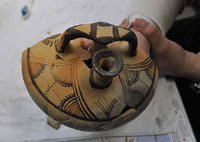
Φορτωμένο εμπορεύματα ήταν το μυκηναϊκό πλεούμενο (μήκους έως 10 μέτρων) που πριν από 3.200 χρόνια τσακίστηκε στις βραχώδεις ακτές της νησίδας Μόδι ή Λιοντάρι στον Αργοσαρωνικό. Αν και δεν είναι πολύ σαφές τι κουβαλούσε στο τελευταίο ταξίδι του το μικρό αυτό καράβι στους κατοίκους των γύρω περιοχών, πολλά μπορεί κανείς να υποθέσει, βλέποντας τους είκοσι πιθαμφορείς και τις υδρίες που
Traces from the big explosion of the Santorini volcano that occurred in the 17th century BC, have been discovered by Greek scientists in the Ionian Sea, in the depth of 4.000 metres.
It takes a brave soul to rewrite history by sailing against current thought. More than 500 years after Christopher Columbus “discovered” America, another seaman is doing just that, entering previously uncharted academic waters with claims that other “Europeans” — the Minoans — got there first, thousands of years earlier. Gavin Menzies, 72 years old, is drawing on his experience as
 |
Early humans, possibly even prehuman ancestors, appear to have been going to sea much longer than anyone had ever suspected. That is the startling implication of discoveries made the last two summers on the Greek island of Crete. Stone ools found there, archaeologists say, are at least 130,000 years old, which is considered strong evidence for the earliest known seafaring
One of the world’s oldest shipwrecks has been discovered off the coast of Devon after lying on the seabed for almost 3,000 years. The wreck has been found in just eight to ten metres of water in a bay near Salcombe, south Devon, by a team of amateur marine archaeologists from the South West Maritime Archaeological Group. In total, 295
The surgeon was dressed in a goat or sheep skin and used a sharpened stone to amputate the arm of his patient. The operating theatre was not exactly Harley Street — more probably a wooden shelter — but the intervention was a success, and it has shed light on the medical talents of our Stone Age ancestors. Scientists unearthed evidence
Abstract of a lecture that was given by Sandy MacGillivray at the Getty Villa on Saturday 6 February 2010.
Articles in the Greek press about the lecture of Professor Christos Doumas given at the Archaeological Society at Athens on the 4th of February.
Read more:
 |
On 28th September 2009, we started digging the foundations of our house in Kavrochori, Heraklion, Crete. During the final stages of the digging a hollow and faint sound was heard and we came across a hole. We stopped digging and went to see or rather to meet the history of the area coming from the deep past 3000 years ago!
One of the most perplexing mysteries that Egyptologists and Aegean experts are tackling is that of the frescoes of Tell el-Dab’a, also known as Avaris. This site was used as the capital of the Hyksos, at a time when they ruled much of Egypt, from 1640 – 1530 BC. It is on the Nile Delta and would have provided access
Article by Prof. Christos Doumas on the use of salt in ancient times (in Greek).
 |
In the final months of 2009, the continuation of the excavation by the 25th Ephorate of Prehistoric and Classical Antiquities at Katre street on the hill of Kastelli in the city of Chania, next to the classical fortification of Kidonia, resulted in the discovery of important evidence about the Minoan palatial centre of Chania during the final palatial period (14th-13th
Human ancestors that left Africa hundreds of thousands of years ago to see the rest of the world were no landlubbers. Stone hand axes unearthed on the Mediterranean island of Crete indicate that an ancient Homo species — perhaps Homo erectus — had used rafts or other seagoing vessels to cross from northern Africa to Europe via at least some
 |
Important information is being inferred about a particularly significant period in Aegean prehistory through the investigation of a 3,200 year old shipwreck by the Hellenic Institute of Marine Archaeology on the islet of Modi, south of Poros.