BOOKS | 2013
Edited by Athanasia Kanta & Massimiliano Marazzi
Napoli/Heraklion
2013
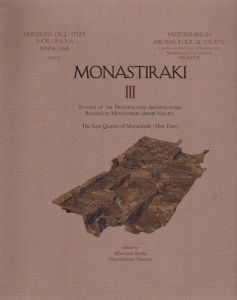 The architecture of the Protopalatial period is a difficult subject which in the case of Monastiraki has not been addressed so far systematically, although its study has been going on for years. The present volume deals with the East Quarter of the palatial centre.
Veit Stürmer
Thetis 20 (2013): 21-35
The paper presents shortly the most important results of 90 years of french excavations in the Minoan Palace of Malia.
Katja Alexandrakis
Thetis 20 (2013): 36-52
Since the “Renaissance“ of Minoan civilization within the initial 20th century the reception and consumption of the so-called Minoan culture has become pervasive in every corner of Crete.
Edited by Georgia Karamitrou-Mentesidi
Aiani, Kozani
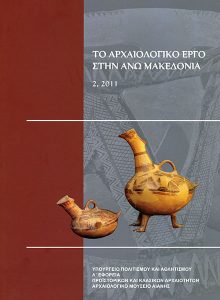 The book publishes the results of the symposium “The Archaeological Work in Upper Macedonia” held in Heidelberg in 2011. The symposium was organised by the 30th Ephorate of Prehistoric and Classical Antiquities in collaboration with the Institute of Classical Archaeology and the Society for the Study and Dissemination of Greek History based in Weilheim, Bavaria.
Edited by Yiannis Sakellarakis
Athens
 The third volume presents findings of the historical times from the excavations carried out by Yiannis Sakellarakis at the Minoan peak sanctuary at Agios Georgios sto Vouno on the island of Kythera.
Haggis, D.C.
Journal of Hellenic Studies 133, 261-262
Haggis, D.C., 2013. Review of S. Wallace, Ancient Crete: from Successful Collapse to Democracy’s Alternatives, Twelfth to Fifth Centuries B.C. (Cambridge 2010), Journal of Hellenic Studies 133, 261-262.
Legarra Herrero, B.
Journal of Hellenic Studies 133, 258-261
Legarra Herrero, B., 2013. Review of C. Knappett, An Archaeology of Interaction: Network Perspectives on Material Culture and Society (Oxford 2011) & P. van Dommelen and A.B. Knapp (eds), Material Connections in the Ancient Mediterranean: Mobility, Materiality, and Mediterranean Identities (London 2010), Journal of Hellenic Studies 133, 258-261.
Haysom, M.
Journal of Hellenic Studies 133, 256-257
Haysom, M., 2013. Review of E.H. Cline (ed.), The Oxford Handbook of the Bronze Age Aegean (Oxford 2010), Journal of Hellenic Studies 133, 256-257.
Schallin, A.-L.
Journal of Hellenic Studies 133, 255-256.
Schallin, A.-L., 2013. Review of W. Gauss & E. Kiriatzi, Pottery Production and Supply at Bronze Age Kolonna, Aegina. An Integrated Archaeological and Scientific Study of a Ceramic Landscape (Vienna 2011), Journal of Hellenic Studies 133, 255-256.
Louise Steel
Journal of Mediterranean Archaeology 26.1 (2013), 27-50
The Vounous Bowl occupies a privileged position in discussions of prehistoric representations on Cyprus. It has most commonly been viewed as a sacred scene, or a religious ceremony conducted within a rural sanctuary, and several commentators have emphasized the funerary connotations of the scene, perhaps depicting idealized funerary ritual or an ancestor cult.
Michael Given
Journal of Mediterranean Archaeology 26.1 (2013), 3-26
Over the last three decades, Mediterranean survey projects have established a broadly agreed methodology, a wide awareness of the invaluable contribution made by intensive survey, and a wealth of data from across the region. Where they have made less progress is in the interpretation of artefact density figures and other findings to go beyond the dots on the map and gain insights into past human lives, the complexity of past landscapes, and the relationship between people and the environment.
Πάνος Γ. Ροντογιάννης
Επετηρίς Εταιρείας Λευκαδίτικων Μελετών τόμος ΙΒ΄ (2009-2011) [2013], 13-38
Στα πρώτα δύο κεφάλαια της Ιστορίας της Νήσου Λευκάδος (τ. Α', Αθήνα, Εταιρεία Λευκαδικών Μελετών, 1980) παρακολουθήσαμε σύντομα τη γεωλογική ιστορία της Λευκάδος και μιλήσαμε και για τα εργαλειακά κατάλοιπα του μεσολιθικού ανθρώπου στο νησί γύρω στα 40.000 χρόνια πριν από την εποχή μας. Κατά την περίοδο αυτή -τέλος της Πλειστοκαίνου, αρχές της Ολοκαίνου (Βούρμιος περίοδος) έως γύρω στα 10.000 χρόνια πίσω-
Fred C. Woudhuizen
Dacia LVII (2013), 5-21
The Indo-Europeanization of Greece was a long-term process, which, in my opinion, entailed at least three distinct phases, covering the period from c. 3100 BC to c. 1600 BC. The third and last phase consists of the arrival c. 1600 BC of the founding fathers of the royal houses and ethnic identities considered as truly Greek.
Jon Henderson, Oscar Pizarro, Matthew Johnson-Roberson & Ian Mahon
International Journal of Nautical Archaeology 42:2 (September 2013), 243-256
Creating photo-mosaics and plans of submerged archaeological sites quickly, cost-effectively and, most importantly, to a high level of geometric accuracy remains a huge challenge in underwater archaeology.
Samuel Mark
International Journal of Nautical Archaeology 42:2 (September 2013), 270-285
Recently published reliefs from the causeway of Sahure and a review of contemporary iconography and archaeological data shed new light on a variety of features of Old Kingdom royal sailing boats and equipment, such as quarter rudders, rigging, signalling devices, decorations and crew.
