BOOKS | 2017
Gavin McGuire
Oxford
2017
 Archaeologist and award-winning photographer Gavin McGuire’s involvement with the Sissi Archaeological Project, where he conducted a seven-year photographic study of the Bronze Age Minoan excavations under the auspices of the Belgian School in Athens, Université Catholique de Louvain, offered an extraordinary opportunity to capture moments of human interaction during excavations as they interconnected with an ancient Minoan culture, stretching back millennia (2600-1200 BC).
Edited by Nikos Papadimitriou & Maria Toli
Athens
2017
 Ο παρών τόμος αποτελεί προϊόν ευρύτατης συνεργασίας και αποσκοπεί στο να προσφέρει μια επικαιροποιημένη επισκόπηση της αρχαίας κυπριακής ιστορίας από την εποχή των πρωιμότερης ανθρώπινης παρουσίας στο νησί, την 11η χιλιετία π.Χ., έως την κατάλυση των ανεξάρτητων πόλεων-βασιλείων και την ένταξη της Κύπρου στο πτολεμαϊκό βασίλειο της Αιγύπτου, στα τέλη του 4ου αι. π.Χ.
Marcus Bajema
Journal of Greek Archaeology 2 (2017): 81-114
The use of analogy to make inferences for a case based on another case is not comparative, and is not used here. The significant use of comparative categories lies in the coherence they bring to model building, as well as the stimulus provided by interpretive debates on particular aspects of early civilisations.
Jennifer M. Webb
Journal of Greek Archaeology 2 (2017): 53-80
Images of cattle, either as whole animals or as bucrania, appear repeatedly on artefacts that played an active role in social strategies and, through repetition and refinement, served over time as a framework for the formation and reproduction of social and ritual institutions.
Ilaria Caloi
Journal of Greek Archaeology 2 (2017): 33-52
This paper focuses on some unusual and not well-known structured deposits from this building, that largely consist of complete or fragmentary vases as well as occasionally other objects that are placed in a ‘structured’ way, with which I mean that they have either been positioned vertically and/ or horizontally, and sometimes comprise stacked cups, before being sealed. They are here called ‘filled-in bench and platform deposits’. They differ from other cases identified at Minoan sites, such as Knossos, Malia, Thronos/Kephala and Nopeigia-Drapanias, but also from practices attested in Bronze and Iron Age sites in Northern and Eastern Europe (e.g. Britain and Bulgaria).
S. Ligkovanlis
Journal of Greek Archaeology 2 (2017): 1-32
Following a brief review of the basic points and conclusions concerning archaeological research on the Upper Pleistocene in Northwestern Greece, our methods and research questions are presented. The overview of the empirical data is followed by a discussion of how these are integrated into the Palaeolithic narrative of the region and the wider context of Southeastern Europe.
Reinhard Jung, Stefan Alexandrov, Elena Bozhinova, Hans Mommsen, Anno Hein & Vassilis Kilikoglou
Archaeologia Austriaca 101 (2017): 269-302
Read the article
The production regions of that pottery could be established by means of Neutron Activation Analysis (NAA), and we compare the earlier results of Dragoyna with the new ones from Koprivlen. These results give us the opportunity to re-evaluate the development of contacts between the eastern Balkans, the northern Aegean and Mycenaean Greece.
Eleftheria Kardamaki
Archaeologia Austriaca 101 (2017): 73-142
Read the article
One of the main tasks has been the detailed analysis of well stratified material, which will clarify the development of the local pottery styles including evidence for continuity or discontinuity in the commonest pottery types and fabrics from the site. Based on the preliminary results from this study the developments and changes in the pottery tradition have been compared to those known from other centres in Laconia and beyond.
Edited by Metaxia Tsipopoulou
Aarhus
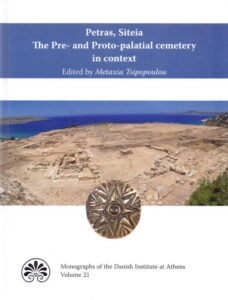 The second conference report on the archaeological site of Petras, Siteia concerns the progress of research conducted about the very important and extensive cemetery of the Pre- and Proto-palatial periods in eastern Crete - one of very few excavations started in Crete in the 21st century.
Blakolmer, F.
Archaeologia Austriaca 101 (2017): 326-332
Blakolmer, F., Review of: N. Marinatos, Sir Arthur Evans and Minoan Crete: Creating the Vision of Knossos (London/New York 2014), Archaeologia Austriaca 101 (2017): 326-332.
Petrakis, V.
Bryn Mawr Classical Review 2017.04.11
Read the book review
Petrakis, V., Review of: P. Pavúk, Troia VI Früh und Mitte: Keramik, Stratigraphie, Chronologie, Studia Troica Monographien, 3 (Bonn 2014), Bryn Mawr Classical Review 2017.04.11
Knodell, A. R.
Bryn Mawr Classical Review 2017.04.13
Read the book review
Knodell, A. R., Review of: M. Kramer-Hajos, Mycenaean Greece and the Aegean World: Palace and Province in the Late Bronze Age (Cambridge 2016), Bryn Mawr Classical Review 2017.04.13.
Doyle, J.
Bryn Mawr Classical Review 2017.06.28
Read the book review
Doyle, J., Review of: R. B. Koehl (ed.), Studies in Aegean Art and Culture: A New York Aegean Bronze Age Colloquium in Memory of Ellen N. Davis (Philadelphia 2016), Bryn Mawr Classical Review 2017.06.28.
M. E. Chovalopoulou, A. Bertsatos & S. K. Manolis
Mediterranean Archaeology & Archaeometry 17.1 (2017): 265-269
Read the article
We identified 15 adults along with 2 subadults, an infant and a fetus. Skeletal remains of domesticated animals were also recovered from the same undisturbed context, for which the recovered archaeological artifacts suggest that the tomb was Mycenaean/Late Helladic in date.
Vasileios Petrakos (ed.)
Tο Έργον της εν Aθήναις Aρχαιολογικής Eταιρείας 64 (2017): 58-59
Without abstract
