BOOKS | 2017
Edited by Michael Fotiadis, Robert Laffineur, Yannos Lolos & Andreas Vlachopoulos
Aegaeum 41
Leuven-Liège
 The 16th International Aegean Conference/Rencontre égéenne international encompasses all the geographical regions west of the Aegean (Western Mainland Greece, the Ionian islands and the Adriatic, Italy, Sicily, Malta, Sardinia, Corsica and the Balearic islands), giving prominence to those focal points and traits of the local civilizations which interact with their Aegean counterparts of the 3rd and 2nd millennium BC, not excluding their Neolithic background.
P. A. Mountjoy
Bonn
 The Mycenaean pottery from the excavations of M. Korfmann is presented in detail. It is discussed by excavated area starting with the areas on the mound; this is followed by that from the buildings round the base of the mound, then by that from buildings in the central Lower Town; it concludes with the material from the Fortification Ditch. Within each area the pottery is presented stratigraphically.
Edited by Simon Jusseret & Manuel Sintubin
Leuven
 Does the “Minoan myth” still stand up to scientific scrutiny? Since the work of Sir Arthur Evans at Knossos (Crete, Greece), the romanticized vision of the Cretan Bronze Age as an era of peaceful prosperity only interrupted by the catastrophic effects of natural disasters has captured the popular and scientific imagination. Its impact on the development of archaeology, archaeoseismology, and earthquake geology in the eastern Mediterranean is considerable.
Gori, M.
Bryn Mawr Classical Review 2017.10.04
Read the book review
Gori, M., Review of: E. Pernicka, S. Ünlüsoy & S. W. E. Blum (eds), Early Bronze Age Troy: Chronology, Cultural Development and Interregional Contacts. Proceedings of an International Conference Held at the University of Tübingen, May 8–10, 2009 [Studia Troica Monographien 8] (Bonn 2016), Bryn Mawr Classical Review 2017.10.04.
Caloi, I.
Bryn Mawr Classical Review 2017.10.45
Read the book review
Caloi, I., Review of: M. Tsipopoulou, Petras, Siteia: The Pre- and Proto-Palatial Cemetery in Context. Acts of a Two-Day Conference Held at the Danish Institute at Athens, 14-15 February 2015 [Monographs of the Danish Institute at Athens 21] (Aarhus 2017), Bryn Mawr Classical Review 2017.10.45.
Davis, J. L.
Bryn Mawr Classical Review 2017.10.23
Read the book review
Davis, J. L., Review of: F. A. Cooper & D. Fortenberry (eds), The Minnesota Pylos Project, 1990-98 (Oxford 2017), Bryn Mawr Classical Review 2017.10.23.
Capra, R. L.
Bryn Mawr Classical Review 2017.12.19
Read the book review
Capra, R. L., Review of: S. Demesticha & A. Bernard Knapp, Maritime Transport Containers in the Bronze-Iron Age Aegean and Eastern Mediterranean (Uppsala 2016), Bryn Mawr Classical Review 2017.12.19.
Kramer-Hajos, M.
Bryn Mawr Classical Review 2017.12.10
Reead the book review
Kramer-Hajos, M., Review of: U. Damm-Meinhardt, Baubefunde und Stratigraphie der Unterburg (Kampagnen 1976 bis 1983): die mykenische Palastzeit (SH III B2) und beginnende Nachpalastzeit (Beginn SH III C), Tiryns 17.1 (Wiesbaden 2015), Bryn Mawr Classical Review 2017.12.10.
Kalliopi Efkleidou
Athens
 Ένα βασικό συμπέρασμα της μελέτης είναι η διαπίστωση ότι καθ’ όλη τη διάρκεια της Ύστερης Εποχής του Χαλκού στην Αργολίδα χρησιμοποιούνταν ποικίλες στρατηγικές για την οργάνωση και διαμόρφωση του τοπίου, όπως η χωρική συσχέτιση/αποσυσχέτιση, η αρχιτεκτονική επιδεικτική κατανάλωση, η χρήση δραματουργικών στοιχείων στον αρχιτεκτονικό σχεδιασμό, με στόχο το διαρκή χειρισμό των κοινωνικών ταυτοτήτων όσων το βίωναν με κάθε τρόπο.
Emilia Banou
In D. Konidaris (ed.), 2017. Ι΄ Διεθνές Πανιόνιο Συνέδριο, Κέρκυρα, 30 Απριλίου – 4 Μαΐου 2014. IV. Φιλοσοφία, Αρχαιολογία, Αρχαιογνωσία, Αρχιτεκτονική, Θέατρο, Κερκυραϊκά Χρονικά, Β, vol. ΙΑ΄, Corfu: 231-243.
This paper focuses on the 2013 season of the archaeological research on the above mentioned site, which continues that of the late Professor Yiannis Sakellarakis (1992-1994). It aims at completing and enriching the picture of the Minoan presence on the island of Kythera, the geographical position of which was of crucial importance for cultural contacts since prehistory.
Garoufallia Metallinou
In D. Konidaris (ed.), 2017. Ι΄ Διεθνές Πανιόνιο Συνέδριο, Κέρκυρα, 30 Απριλίου – 4 Μαΐου 2014. IV. Φιλοσοφία, Αρχαιολογία, Αρχαιογνωσία, Αρχιτεκτονική, Θέατρο, Κερκυραϊκά Χρονικά, Β, vol. ΙΑ΄, Corfu: 201-214.
The two tumuli were constructed sequentially in the same place at different times and encompassed cist graves and a jar-burial. Samples of the site’s pottery are characteristic of the Ionian-Adriatic area.
Edited by Marisa Marthari, Colin Renfrew & Michael Boyd
Oxford
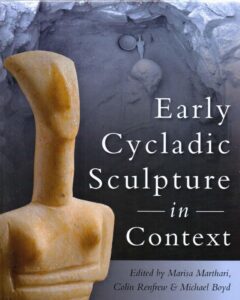 Using the material from recent excavation projects, and drawing on the papers presented at a symposium held in Athens in 2014, it is possible now to undertake a fresh overview of the entire body of sculpture from the Cycladic islands which has been found in secure archaeological contexts. Beginning with early examples from Neolithic settlement sites and extending into a consideration of material found in later contexts, the 35 chapters are divided into sections which examine sculpture from settlements, cemeteries and the sanctuary at Kavos, concluding with a discussion of material, techniques and aspects of manufacture.
Edited by Andromachi Economou & Vasiliki Florou
Athens
 H αρχαιολόγος και λαογράφος Άννα Αποστολάκι (1881-1958) ήταν πρωτοπόρα μορφή της ελληνικής επιστήμης: μια από τις πρώτες φοιτήτριες του Πανεπιστημίου Αθηνών, από τις πρώτες γυναίκες μέλος πολλών επιστημονικών φορέων και η πρώτη γυναίκα διευθύντρια μουσείου στην Ελλάδα. Η σταδιοδρομία της έχει έναν παραδειγματικό χαρακτήρα: αντικατοπτρίζει όλες τις δυσκολίες και αγκυλώσεις που κλήθηκαν να αντιμετωπίσουν οι γυναίκες της εποχής της στην προσπάθειά τους να σταδιοδρομήσουν και να αναλάβουν έναν πιο ενεργό ρόλο στην κοινωνία και στην επιστήμη.
Georgia Stratouli, Odysseas Metaxas, Anastasios Bekiaris & Anaya Sarpaki
In D. Konidaris (ed.), 2017. Ι΄ Διεθνές Πανιόνιο Συνέδριο, Κέρκυρα, 30 Απριλίου – 4 Μαΐου 2014. IV. Φιλοσοφία, Αρχαιολογία, Αρχαιογνωσία, Αρχιτεκτονική, Θέατρο, Κερκυραϊκά Χρονικά, Β, vol. ΙΑ΄, Corfu: 185-199.
Read the article
Drakaina Cave’s prehistoric deposits rendered findings that point to the performance of social gatherings and provide insights into elements of local social organization. Evidence stems from peculiarities in various categories of findings, e.g. the rare practice of lime-plaster floor construction, as well as the importance of the cave’s location.
Edited by Charlotte Langohr
Louvain-la-Neuve
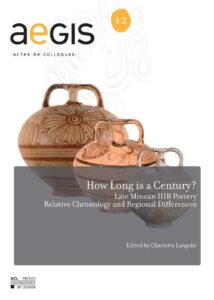 Covering approximately the century between 1300 and 1200 BC, the Late Minoan IIIB phase remains a blurred episode of Minoan civilisation. Archaeological data present a contradictory picture: on the one hand, they suggest a time of prosperity, with favourable conditions of subsistence and growth; on the other hand, there are signs of trouble illustrated by a series of abandonments of century-old occupied settlements.
