BOOKS | 2011
Edited by Thomas M. Brogan & Erik Hallager
Athens
2011
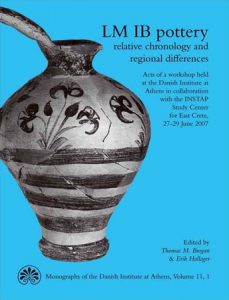
Once upon a time – in early 2005 – when the Minoan Seminar was still under the auspices of the Danish Institute at Athens, Tom Brogan mentioned that it might be a good idea to have a workshop on LM IB pottery focusing on the disagreement and unsolved problems connected with recent excavations in East Crete.
Edited by Philip P. Betancourt and Susan C. Ferrence
Philadelphia, Pennsylvania
2011
 Prof. James D. Muhly has enjoyed a distinguished career in the study of ancient history, archaeology, and metallurgy that includes an emeritus professorship at the University of Pennsylvania and a term as director of the American School of Classical Studies at Athens as well as receiving the Archaeological Institute of America's Pomerance Award for Scientific Contributions to Archaeology.
Edited by Fotis Ifantidis & Marianna Nikolaidou
Oxford
2011
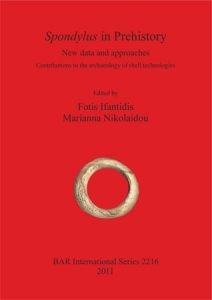 This volume offers a broad and up-to-date discussion of the Spondylus “phenomenon” in prehistory, in diverse archaeological contexts from Europe and two areas of the New World. It brings together new archaeological data, methodological advances, and current interpretations for the study of this important material.
Leslie Preston Day
London
2011
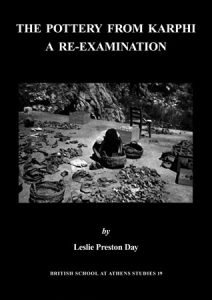 The site of Karphi, high above the Lasithi plateau, remains one of the most extensively investigated settlements of Early Iron Age Greece; it was excavated by the British School at Athens under the direction of John Pendlebury in 1937-39. In the report that swiftly followed the pottery was not presented in detail, though much was discussed in a later article by Mercy Seiradaki.
Edited by Ann Brysbaert
London/New York
2011
 This volume investigates smaller and larger networks of contacts within and across the Aegean and nearby regions, covering periods from the Neolithic until Classical times (6000–323 BC). It explores the world of technologies, crafts and archaeological 'left-overs' in order to place social and technological networks in their larger economic and political contexts.
Zeman-Wiśniewska, K.
Classical Review 61.2
Zeman-Wiśniewska, K., 2011. Review of A.-L. Schallin & P. Pakkanen (eds), Encounters with Mycenaean Figures and Figurines. Papers Presented at a Seminar at the Swedish Institute at Athens, 27–29 April 2001 (Stockholm 2009), Classical Review 61.2: 583-584.
Cline, E.H.
Classical Review 61.2
Cline, E.H., 2011. Review of B.E. Burns, Mycenaean Greece, Mediterranean Commerce, and the Formation of Identity (Cambridge 2010), Classical Review 61.2: 580-583.
Ridgway, D.
Classical Review 61.2
Ridgway, D., 2011. Review of F. Lo Schiavo, J.D. Muhly, R. Maddin, & A. Giumlia-Mair (eds), Oxhide Ingots in the Central Mediterranean (Biblioteca di Antichità Cipriote 8) (Cyprus and Rome 2009), Classical Review 61.2: 578-580.
Budin, S.L.
Classical Review 61.2
Budin, S.L., 2011. Review of N. Marinatos, Minoan Kingship and the Solar Goddess. A Near Eastern Koine (Chicago 2010), Classical Review 61.2: 576-578.
Letesson, Q.
Classical Review 61.2
Letesson, Q., 2011. Review of J.C. McEnroe, Architecture of Minoan Crete. Constructing Identity in the Aegean Bronze Age (Austin 2010), Classical Review 61.2: 574-575.
Haysom, M.
Classical Review 61.1
Haysom, M., 2011. Review of S. Privitera, Case e rituali a Creta nel periodo neopalaziale (Tripodes 9) (Athens 2008), Classical Review 61.1: 253-254.
Moignard, E.
Classical Review 61.2
Moignard, E., 2011. Review of K. Kathariou, Corpus Vasorum Antiquorum. Athens, Museum of Cycladic Art Fascicule 1 (Greece, Fascicule 11) (Athens 2009), Classical Review 61.2: 573-574.
C. Mountrakis, S. Georgaki & S.K. Manolis
The Mediterranean Archaeology & Archaeometry 11.1 (2011): 1-8.
Cranial trepanation is one of the most ancient surgical operations. This kind of ʺoperationʺ has been reported in prehistoric Greece with several specific case studies. In this paper, a significant case of trepanation, on a male skull, dated to the Late Bronze Age, is presented.
W.S. Downey
The Mediterranean Archaeology & Archaeometry 11.1 (2011): 9-20.
Archaeomagnetic research has enabled the determination of the secular variation record of the past geomagnetic field and has been used as a tool for absolute and relative dating. The archaeomagnetic secular variation of declination can be used in conjunction with architectural building plan orientation angles (strike directions) to establish, whether or not, a magnetic compass was possibly used to align buildings.
W.S. Downey
The Mediterranean Archaeology & Archaeometry 11.1 (2011): 21-23.
An archaeomagnetic directional study of Late Minoan archaeological materials, (burnt mud brick, a clay/ash horizon and hearth material), was carried out at locations within the archaeological complex at Malia, Crete. The study aimed to establish the suitability of materials for archaeomagnetic sampling and to obtain archaeomagnetic directions for comparison with other Late Minoan “fired” sites on Crete.
