BOOK REVIEWS | 2017
Salmon, J.
Journal of Hellenic Studies 137 (2017): 261-263
Salmon, J., Review of: E. R. Gebhard & T. E. Gregory (eds), Bridge of the Untiring Sea: The Corinthian Isthmus from Prehistory to Late Antiquity (Princeton 2015), Journal of Hellenic Studies 137 (2017): 261-263
Miles, M. M.
Journal of Hellenic Studies 137 (2017): 259-260
Miles, M. M., Review of: M. B. Cosmopoulos, Bronze Age Eleusis and the Origins of the Eleusinian Mysteries (Cambridge 2015), Journal of Hellenic Studies 137 (2017): 259-260
Haggis, D. C.
Journal of Hellenic Studies 137 (2017): 257-258
Haggis, D. C., Review of: L. C. Langford-Verstegen with contributions by P. P. Betancourt, C. Davaras, S.C. Ferrence & E. Nodarou, Hagios Charalambos: a Minoan Burial Cave in Crete 2. The Pottery (Philadelphia 2016), Journal of Hellenic Studies 137 (2017): 257-258
Galanakis, Y.
Journal of Hellenic Studies 137 (2017): 256-257
Galanakis, Y., Review of: A. Karetsou & L. Girella, Kalochoraphitis: Two Chamber Tombs from the LM IIIA2–B Cemetery. A Contribution to Postpalatial Funerary Practice in the Mesara (Padova 2015), Journal of Hellenic Studies 137 (2017): 256-257
P. A. Mountjoy
Bonn
 The Mycenaean pottery from the excavations of M. Korfmann is presented in detail. It is discussed by excavated area starting with the areas on the mound; this is followed by that from the buildings round the base of the mound, then by that from buildings in the central Lower Town; it concludes with the material from the Fortification Ditch. Within each area the pottery is presented stratigraphically.
Edited by Simon Jusseret & Manuel Sintubin
Leuven
 This volume, gathering the contributions of Minoan archaeologists, geologists, seismologists, palaeoseismologists, geophysicists, architects, and engineers, provides an up-to-date interdisciplinary appraisal of the role of earthquakes in Minoan society and in Minoan archaeology – what we know, what are the remaining issues, and where we need to go.
Jeremy B. Rutter
Philadelphia
 This volume presents the Late Bronze Age pottery from in and around House X, a large Minoan house at Kommos situated not far from the sea in South-Central Crete. This volume is richly illustrated with drawings, photos, and tables of data.
Jeremy B. Rutter
Philadelphia
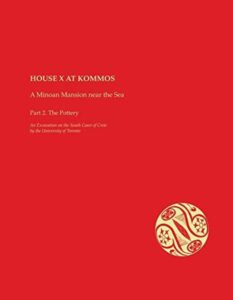 This volume presents the Late Bronze Age pottery from in and around House X, a large Minoan house at Kommos situated not far from the sea in South-Central Crete. This volume is richly illustrated with drawings, photos, and tables of data.
Laurens Thissen & Agathe Reingruber
In A. Reingruber, Z. Tsirtsoni, P. Nedelcheva 2017 (eds). Going West? The Dissemination of Neolithic Innovations between the Bosporus and the Carpathians. Proceedings of the EAA Conference, Instabul, 11 September 2014, Oxon-New York: 123-177.
Ivan Gatsov, Petranka Nedelcheva, Malgorzata Kaczanowska & Janusz K. Koztowski
In A. Reingruber, Z. Tsirtsoni, P. Nedelcheva 2017 (eds). Going West? The Dissemination of Neolithic Innovations between the Bosporus and the Carpathians. Proceedings of the EAA Conference, Instabul, 11 September 2014, Oxon-New York: 57-71.
Laurent Lespez, Zoï Tsirtsoni, Pascal Darcque, Dimitra Malamidou, Haïdo Koukouli-Chryssanthaki & Arthur Glais
In A. Reingruber, Z. Tsirtsoni, P. Nedelcheva 2017 (eds). Going West? The Dissemination of Neolithic Innovations between the Bosporus and the Carpathians. Proceedings of the EAA Conference, Instabul, 11 September 2014, Oxon-New York: 43-55.
READ THE ARTICLE
Burçin Erdoğu
In A. Reingruber, Z. Tsirtsoni, P. Nedelcheva 2017 (eds). Going West? The Dissemination of Neolithic Innovations between the Bosporus and the Carpathians. Proceedings of the EAA Conference, Instabul, 11 September 2014, Oxon-New York: 29-41.
READ THE ARTICLE
Edited by Susan Sherratt & John Bennet
Oxford & Philadelphia
 Contributors explore a variety of issues including the relationships between visual and verbal imagery, the social contexts of epic (or sub-epic) creation or re-creation, the roles of bards and their relationships to different types of patrons and audiences, the construction and uses of ‘history’ as traceable through both epic and archaeology and the relationship between ‘prehistoric’ (oral) and 'historical' (recorded in writing) periods. Throughout, the emphasis is on context and its relevance to the creation, transmission, re-creation and manipulation of epic in the present (or near-present) as well as in the ancient Greek past.
Edited by Susan Sherratt & John Bennet
Oxford & Philadelphia 2017
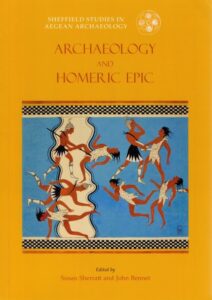 The relationship between the Homeric epics and archaeology has long suffered mixed fortunes, swinging between ‘fundamentalist’ attempts to use archaeology in order to demonstrate the essential historicity of the epics and their background, and outright rejection of the idea that archaeology is capable of contributing anything at all to our understanding and appreciation of the epics.
Edited by Michael Fotiadis, Robert Laffineur, Yannos Lolos & Andreas Vlachopoulos
Leuven-Liège
 The 16th International Aegean Conference/Rencontre égéenne international encompasses all the geographical regions west of the Aegean (Western Mainland Greece, the Ionian islands and the Adriatic, Italy, Sicily, Malta, Sardinia, Corsica and the Balearic islands), giving prominence to those focal points and traits of the local civilizations which interact with their Aegean counterparts of the 3rd and 2nd millennium BC, not excluding their Neolithic background.
