ADVANCED SEARCH +

Aegeus Society For Aegean Prehistory

BOOKS | 2015

Karlsruher Kykladika unter der Lupe. Zur Verbindung naturwissenschaftlicher Untersuchungen mit der Aufarbeitung des Erwerbs von Antiken ungewisser Provenienz

Athenische Mitteilungen 127/128 (2012/2013) [2015]: 1-46

The return of Early Cycladic objects from the collection of the Badisches Landesmuseum of Karlsruhe resulted from the acknowledgment that the museum’s problematic former acquisitions policy needed to be revisited.

Thravsma. Contextualising the Intentional Destruction of Objects in the Bronze Age Aegean and Cyprus

Louvain

Thravsma. Contextualising the Intentional Destruction of Objects in the Bronze Age Aegean and Cyprus How does intentionally inflicting damage to material objects mediate the human experience in the prehistoric eastern Mediterranean? For all of the diversity in cultural practice in the civilisations of the Greek mainland and Aegean islands, Crete, Cyprus and the eastern coast of Italy between 4000-750 BC, archaeologists consider the custom of ritually killing objects as a normative, if inconsistent practice.

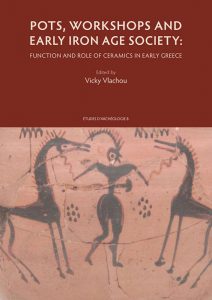
Pots, Workshop and Early Iron Age Society. Function and Role of Ceramics in Early Greece

Bruxelles

Pots, Workshop and Early Iron Age Society. Function and Role of Ceramics in Early Greece This volume brings together a number of papers that were presented at the international symposium on Pots, Workshops and Early Iron Age Society. Function and Role of Ceramics in Early Greece organised by the University of Athens (UoA) and the Université libre de Bruxelles (ULB), and held at the Université libre de Bruxelles in November 2013.

Adornment, ritual and identity: Inscribed Minoan jewellery

The Annual of the British School at Athens 110 (2015): 51-70

In this paper, we re-examine inscribed items of Minoan jewellery in the light of the increasing number of studies on ancient eastern Mediterranean jewellery and its meanings.

New perspectives on stone bead technology at Bronze Age Troy

Anatolian Studies 65 (2015): 1-18

Stone beads from the site of Troy, Turkey, have been studied in order to understand better the nature of lapidary technology and trade during the third to second millennium BC in this part of Anatolia.

On the architecture of the Toumba building at Lefkandi

The Annual of the British School at Athens 110 (2015): 203-212

The building at Toumba, Lefkandi, stands unique in its time and place. The remains of this monument are significant in terms of size and elaboration, and also on account of the way it has been reconstructed and interpreted as the ancestor of the Greek peripteral temple.