ADVANCED SEARCH +

Aegeus Society For Aegean Prehistory

ARTICLES | 2017

The Combat Agate from the Grave of the Griffin Warrior at Pylos

Hesperia 86.4 (2017): 583-605

The Pylos Combat Agate, in our view a Cretan work of Late Minoan I, may be the finest example of glyptic art yet discovered in a Minoan or Mycenaean context. It was found in 2015 in the grave of the so-called Griffin Warrior at Pylos.

Λύκαιο Όρος. Αρχαιολογικές έρευνες στο Ιερό του Διός

Themes in Archaeology 1.1 (2017): 102-105

Read the article

Σημαντικά ευρήματα ήρθαν στο φως κατά τις ανασκαφικές έρευνες του 2016 στο ιερό του Διός στο Λύκαιο Όρος, στο νοτιοδυτικό άκρο της Αρκαδίας, εκεί όπου κατά την τοπική παράδοση που διασώζει ο Παυσανίας γεννήθηκε και ανατράφηκε ο βασιλιάς των θεών.

Η κρητική αρχαιολογία σε επαναστατική περίοδο, 1878-1913. Αρχαιολογία και πολιτική στην Οθωμανοκρατία και την Κρητική Πολιτεία (Μέρος Β΄)

Themes in Archaeology 1.2 (2017): 166-175

Read the article

This paper deals with the period 1878 -1913, in which the Archaeology of Crete began. It was a revolutionary period, as Crete was part of the Ottoman Empire until 1898, and a semi-dependent state from 1898 to 1913, when it was united with Greece.

«Στιγμές στον χρόνο». Συζητώντας για τους μινωικούς αποθέτες θεμελίωσης

Themes in Archaeology 1.2 (2017): 224-235

Read the article

ρθρο αφορά στους μινωικούς αποθέτες θεμελίωσης, σχολιάζοντας ακροθιγώς ζητήματα που σχετίζονται με την ορολογία και τα βασικά χαρακτηριστικά τους, με έμφαση στη χωροθέτηση και στο περιεχόμενο.

Η Ίκλαινα και η γένεση του μυκηναϊκού κράτους της Πύλου

Themes in Archaeology 1.2 (2017): 166-175

Read the article

Current theory suggests that the formation of Mycenaean states was the result of the process of incorporation of regional centers of power by the powerful palatial centers. The mechanisms that led to these processes are, however, largely unknown, as the bulk of the evidence comes from the palaces and there is a dearth of systematic excavations of second-order centers. This gap is filled by the excavation conducted by the Athens Archaeological Society at Iklaina, one of the district capitals of the Mycenaean state of Pylos.

The Power of Images: Re-Examining the Wall Paintings from the Throne Room at Knossos

Annual of the British School at Athens 112 (2017): 47-98

In our view, the iconography of this programme places its execution at the onset of Late Minoan (LM) II. We see the inclusion of both ‘traditional’ (Neopalatial) and ‘innovative’ (Final Palatial) elements in the composition as suggestive of an attempt on behalf of the artist(s) and the commissioner(s) to blend artistic traditions in the creation of a new, yet still recognisable, image of power.

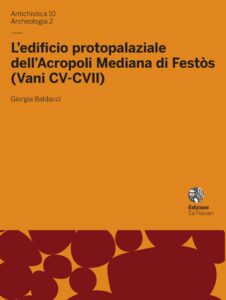
L’edificio protopalaziale dell’Acropoli Mediana di Festòs (Vani CV-CVII)

Venezia

L’edificio protopalaziale dell’Acropoli Mediana di Festòs (Vani CV-CVII) The present book consists in the full publication of both the structures and related finds excavated in the Protopalatial building located at the southern slope of the so-called Acropoli Mediana at Phaistos, ca. 100 m West of the Palace (Rooms CV, CVI and CVII). This building was the object of a rescue excavation, carried out by Doro Levi in 1969 and 1971.

Access to Upper Floors and an Early Light Well at EM II Vasiliki

Annual of the British School at Athens 112 (2017): 33-45

This paper singles out three separate houses from among the group of rooms originally called the ‘Red House’ by its discoverer, Richard Seager; it presents their sequencing, the order in which they were probably built, and how their first floors and roofs were reached.

Mainland Cosmopolitanism and the Rise of Personal Prestige: New Evidence from the Coastal Early Helladic Town of Helike, North-West Peloponnese, Greece

Annual of the British School at Athens 112 (2017): 1-32

Excavations carried out by The Helike Project in the Helike plain on the south-western coast of the Gulf of Corinth, north-west Peloponnese, since 2000, have brought to light the well-preserved remains of a coastal Early Helladic (EH) II–III settlement. The site developed as a densely organised settlement during the EH II period and underwent a major architectural transformation at the beginning of the following EH III.

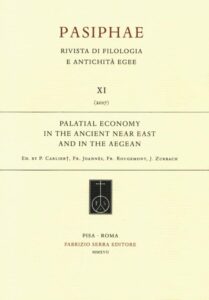
Palatial Economy in the Ancient Near East and in the Aegean. First Steps towards a Comprehensive Study and Analysis, Acts of the ESF Exploratory Workshop held in Sèvres, 16–19 Sept.

Pisa, Roma

Palatial Economy in the Ancient Near East and in the Aegean. First Steps towards a Comprehensive Study and Analysis, Acts of the ESF Exploratory Workshop held in Sèvres, 16–19 Sept. Les échanges scientifiques et, plus précisément, le travail de comparaison à différentes échelles entre les palais égéens et proche-orientaux est très vite apparu comme une nécessité après le déchiffrement du linéaire B, et même avant. Le travail en commun et la comparaison restent des défis, et les méthodes de comparaison (échelles, objets, finalités) restent des objets de discussion.

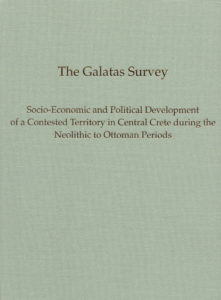
The Galatas Survey. Socio-Economic and Political Development of a Contested Territory in Central Crete during the Neolithic to Ottoman Periods

Philadelphia

The Galatas Survey. Socio-Economic and Political Development of a Contested Territory in Central Crete during the Neolithic to Ottoman Periods This volume explores the results of the American archaeological survey (2005-2007) carried out around the area of Galatas in Central Crete, as requested by Georgos Rethemiotakis, the Director of Excavations at Galatas.