ADVANCED SEARCH +

Aegeus Society For Aegean Prehistory

BOOKS

The Formation of Cyprus in the 2nd Millennium B.C. Proceedings of a Workshop held at the 4th Cyprological Congress May 2nd, 2008, Lefkosia, Cyprus

Wien 2009

The Formation of Cyprus in the 2nd Millennium B.C. Proceedings of a Workshop held at the 4th Cyprological Congress May 2nd, 2008, Lefkosia, Cyprus Many questions about the Middle and Late Cypriot Bronze Age remain unanswered, especially those concerned with chronology, social transformation and the development of local entities or industries. The title of this collection of papers “The Formation of Cyprus” was chosen to emphasize the fact that local community activities and trade on a local scale had a considerable influence on island-wide development and, in this instance, on the formation of society in the Bronze Age.

Sparta, Menelaion I: The Bronze Age

London 2009

Sparta, Menelaion I: The Bronze Age This is the account of an excavation by the British School at Athens at the major Mycenaean settlement in the central Eurotas valley of Laconia, close to the site of ancient and modern Sparta, in the south-central Peloponnese. The site was first identified and partly explored by the British School (under its sixth Director, R. M. Dawkins) in 1909-10. This volume presents the results of fieldwork undertaken by the School in 1973-77, 1980 and 1985, led by the then Director, H. W. Catling.

From Mesogeia to Argosaronikos. B΄ Ephorate of Prehistoric and Classical Antiquities. Research of a decade, 1994-2003. Proceedings of Conference, Athens, December 18-20, 2003

Markopoulo of Mesogeia 2009

From Mesogeia to Argosaronikos. B΄ Ephorate of Prehistoric and Classical Antiquities. Research of a decade, 1994-2003. Proceedings of Conference, Athens, December 18-20, 2003 A collection of 40 papers (and one inaugural address) from the conference From Mesogeia to Argosaronikos, held in Athens on 18-20 December 2003. The book presents recent excavations and finds conducted by the Second Ephorate of Prehistoric and Classical Antiquities in Attica, Piraeus, Troezen and the islands of Kythera and Antikythera during the decade 1994-2003 (since then the Second Ephorate has been divided into two Ephorates). The papers are presented following a geographical sequence. All papers are in Greek, followed by abstracts in English.

Forces of Transformation: The End of the Bronze Age in the Mediterranean. Proceedings of an International Symposium held at St. John’s College, University of Oxford, 25-6th March 2006

Oxford 2009

Forces of Transformation: The End of the Bronze Age in the Mediterranean. Proceedings of an International Symposium held at St. John’s College, University of Oxford, 25-6th March 2006 The volume is the first in nearly a decade to focus a wide range of scholarship on one of the most compelling periods in the antiquity of the Mediterranean and Near East. It presents new interpretive approaches to the problems of the Bronze Age to Iron Age transformation, as well as re-assessments of a wide range of high profile sites and evidence ranging from the Ugaritic archives, Hazor, the Medinet Habu reliefs, Tiryns and Troy. Implications for a changing climate are also explored in the volume.

Proceedings of the Symposium ‘Bronze Age Architectural Traditions in the Eastern Mediterranean: Diffusion and Diversity’, 07.-08. 05. 2008 in Munich

Weilheim 2009

Proceedings of the Symposium ‘Bronze Age Architectural Traditions in the Eastern Mediterranean: Diffusion and Diversity’, 07.-08. 05. 2008 in Munich On May 7 & 8, 2008 a symposium was held at the Gasteig in Munich - Germany, on the topic Bronze Age Architectural Traditions in the Eastern Mediterranean: Diffusion and Diversity. The Symposium was an initiative of the Society for the Study and Propagation of Hellenic History, based in Weilheim - Germany, which has organized several scientific gatherings in the past on philology and archaeology. Co-organizers were Verein Ägais (The Aegean Club), Munich.

FYLO. Engendering Prehistoric ‘Stratigraphies’ in the Aegean and the Mediterranean. Proceedings of an International Conference, University of Crete, Rethymno, 2-5 June 2005

Liège / Austin 2009

FYLO. Engendering Prehistoric ‘Stratigraphies’ in the Aegean and the Mediterranean. Proceedings of an International Conference, University of Crete, Rethymno, 2-5 June 2005 Twenty-nine papers are presented from the eponymous June 2005 conference run by the University of Crete as part of an interdisciplinary program on Gender in Social Sciences. Written by archaeologists of the prehistoric Aegean and wider Mediterranean, the papers focus on the issue of gender in the archaeology of the Bronze Age, as well as of the Neolithic and Upper Palaeolithic periods.

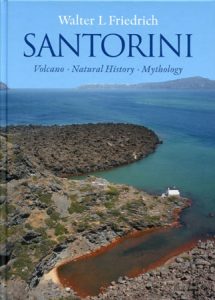
Santorini: Volcano, Natural History, Mythology

Aarhus 2009

Santorini: Volcano, Natural History, Mythology This is a completely new and revised edition of Fire in the Sea: The Santorini Volcano, Natural History and the Legend of Atlantis (originally published by Cambridge University Press, 2000). When the Greek island of Santorini, classically known as Thera, dramatically erupted in 1613 BC 13 years, it produced one of the largest explosions ever witnessed, thereby possibly giving rise to the legend of Atlantis. This so-called ‘Minoan’ eruption triggered tsunamis that devastated coastal settlements in the region. On Santorini it left behind a Bronze Age Pompeii, which is now being excavated.

Ein Trojanischer Federkrieg: Die Auseinandersetzungen zwischen Ernst Boetticher und Heinrich Schliemann

Wien 2009

Ein Trojanischer Federkrieg: Die Auseinandersetzungen zwischen Ernst Boetticher und Heinrich Schliemann In December 1883, a dispute began between Ernst Boetticher and Heinrich Schliemann over the latter’s interpretation of his research in Troy. After studying Schliemann’s book on his excavations in Troy, published in November 1880, Boetticher was convinced that Schliemann had misinterpreted the excavation results and had not found a settlement, but a fire-necropolis.

Time’s Up! Dating the Minoan Eruption of Santorini. Acts of the Minoan Eruption Chronology Workshop, Sandbjerg November 2007 initiated by Jan Heinemeier and Walter L. Friedrich

Athens 2009

Time’s Up! Dating the Minoan Eruption of Santorini. Acts of the Minoan Eruption Chronology Workshop, Sandbjerg November 2007 initiated by Jan Heinemeier and Walter L. Friedrich A collection of 21 papers from the workshop Minoan Eruption Chronology, held at Sandbjerg (Denmark) in November 2007. The book presents new evidence about the absolute date of the “Minoan” eruption of the Santorini volcano. Worth of mention is the question of the editor: “Should archaeologists stop quibbling about details of chronological arguments which belonged to the past, and simply discuss the chronological and historical implications of the new date?”

New Directions in the Skeletal Biology of Greece

Princeton, N.J. 2009

New Directions in the Skeletal Biology of Greece The papers in this book reflect current studies being conducted in the field of bioarchaeology in Greece. The authors present material ranging in date from the Palaeolithic to modern times. Biological anthropologists working in the Mediterranean region can draw on a wealth of archaeological and documentary evidence to inform their hypotheses. This book shows how scientific approaches to the past are shedding new light on previously insoluble questions. In addition to presenting a number of case studies, the editors provide a synthetic survey of the subject.

Archaeological Work on Thessaly and Central Greece, 2. Volos 16.3 – 19.3.2006. Vol. I: Thessaly. Vol. ΙΙ: Central Greece

Volos 2009

Archaeological Work on Thessaly and Central Greece, 2. Volos 16.3 – 19.3.2006. Vol. I: Thessaly. Vol. ΙΙ: Central Greece

The two volumes publish the proceedings of the Archaeological Work on Thessaly and Central Greece, held in Volos in March 2006. There are 85 papers concerning the period from the prehistoric to Ottoman times. The first volume is dedicated to Thessaly (53 papers), while the second one to Central Greece (32 papers). Most of the papers are in Greek; a few are in English, French and Italian.