BOOKS
Edited by Daniel J. Pullen
Oxford & Oakville
2010
 This volume brings together an international group of researchers to address how Mycenaean and Minoan states controlled the economy. The contributions, originally delivered at the 2007 Langford Conference at the Florida State University, examine the political economies of state (and pre-state) entities within the Aegean Bronze Age, including the issues of: centralization and multiple scales of production, distribution, and consumption within a polity importance of extraregional trade, craft specialization, role of non-elite institutions, temporal/diachronic variation within regions, ‘Aegean’ political economy as a monolithic process, political economy before the emergence of the palaces.
Metaxia Tsipopoulou & Erik Hallager with contributions by Cesare D’Annibale & Dimitra Mylona
Athens
2010
 The excavation at Petras started in 1985, initially as a small - scale test dig. In the late 1980’s it was granted the status of a ‘systematic research project’ by the Hellenic Ministry of Culture. It is a happy coincidence that the 25th anniversary of the excavation and the studies of its finds is marked by the presentation to the scholarly community of this monograph which constitutes the final publication of the hieroglyphic archive that came to light in a MM IIB destruction deposit of the palace of Petras.
John C. McEnroe
Austin
2010
 Ever since Sir Arthur Evans first excavated at the site of the Palace at Knossos in the early twentieth century, scholars and visitors have been drawn to the architecture of Bronze Age Crete. Much of the attraction comes from the geographical and historical uniqueness of the island. Equidistant from Europe, the Middle East, and Africa, Minoan Crete is on the shifting conceptual border between East and West and chronologically suspended between history and prehistory. In this culturally dynamic context, architecture provided more than physical shelter; it embodied meaning. Architecture was a medium through which Minoans constructed their notions of social, ethnic, and historical identity: the buildings tell us about how the Minoans saw themselves, and how they wanted to be seen by others.
Susan M. Lupack
Oxford
2008
 There is a great deal of evidence within the Linear B tablets that the administrations of the Mycenaean palaces took an interest in the religious aspect of their communities. Many tablets record the offerings that the palace sent to various deities and their shrines, and it is clear that there were numerous religious festivals in which the communities of the Mycenaean palaces, presumably with the wanax at their head, took part. However, the exact nature of the relationship between the palace and the religious sector is more difficult to discern, and has recently become a matter for debate among some Mycenologists.
Kalliope Sarri
Munich
2010
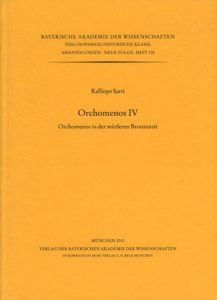 The book presents that part of the prehistoric settlement of Orchomenos in Boeotia which has remained unpublished until now, despite the recognition of its importance. In the introductory section of the volume the research conducted thus far on the settlement and its natural surroundings is presented; the Copais region where the gradual exploitation of natural resources created the necessary means for the design of the major drainage works in the Mycenaean period.
Thessaloniki
2010
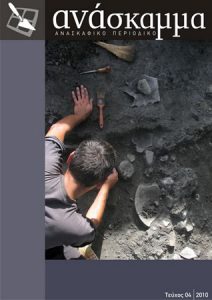
The books is the fourth issue of the Greek journal Anaskamma.
Edited by Onur Özbek
Istanbul
2008
 This book constitutes a thoroughly refereed International Workshop held in Çanakkale in 2006 and organised by two universities conjointly on funeral rites, rituals and ceremonies from Prehistory to Antiquity. The book covers a time span from mostly Bronze Age to Classical periods and examines some of the archaeological evidence while presenting and discussing individual sites on funeral practices. Scholars of history and archaeology from different countries, contribute to this volume by providing examples not only from the Troas region itself but also from neighbouring and more distant lands. Recent excavations and field surveys in the Troas and its neighbours provide additional information about the details of our ancestors’ response to the universal inevitable reality: the death.
Edited by J. Lesley Fitton
London
2009
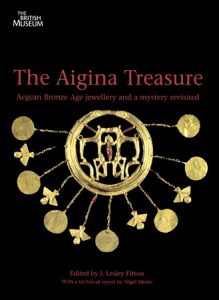
The Aigina Treasure, a group of Greek Bronze Age gold jewellery and other objects believed to come from the island of Aigina, was memorably described by Reynold Higgins as ‘a rich, beautiful and very perplexing collection’. It has both fascinated and puzzled scholars and the wider world since it first came to notice in 1891, when it was offered to the British Museum for sale. The fascination arises from the recognition that such rich assemblages are rare: the Treasure potentially provides very significant evidence both for the history of early jewellery and for the history of the culture that made and used it. However, the lack of precise provenance and known associations makes it difficult to determine exactly where in our picture of the ancient world the Aigina Treasure fits.
Alix Hänsel
Berlin
2009
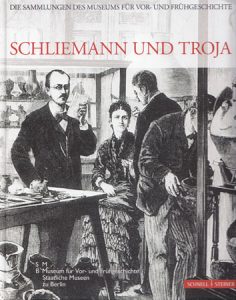
Bis heute ist Heinrich Schliemanns Bedeutung — Schatzgräber oder Pionier archäologischer Forschung — ebenso umstritten wie die Frage, ob die von ihm ausgegrabene Stadt tatsächlich das homerische Troja war. Das Berliner Museum für Vor- und Frühgeschichte besitzt weltweit die größte Sammlung von archäologischen Funden aus Schliemanns Grabungen in Troja, der sagenhaften Stadt des Dichters Homer.
Edited by Despoina Daniilidou
Athens
2009
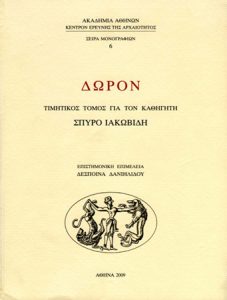
In 2008, Professor Spyros Iakovides celebrated his 85th birthday as well as 50 years of contribution to the excavation of Mycenae. He originally collaborated with George Mylonas and has been excavation director for the last 20 years. In order to honour his contribution, students, colleagues and friends dedicated a volume of studies on Mycenaean archaeology, the main field of research for Spyros Iakovides. The volume is a small token of appreciation, respect and caring for the academic professor and friend, with the fitting title of - ΔΩΡΟΝ -, a word first recorded on a Linear B tablet (ΤΥ Τη 316) with the meaning of contribution (do-ra).
Edited by Helène Whittaker
Oxford
2008

With the exception of Gullög Nordquist’s and Michael Wedde’s contributions, the articles in this volume derive from a session held at the eleventh annual meeting of the European Association of Archaeologists in Cork, September, 2005. The title of the session was Aegean Archaeology in the Wider European Context. The papers centred around questions concerning direct contacts and specific influences, cultural interaction between the Mycenaean world and the rest of Europe, and the role of Aegean material in discussions and interpretations of material found elsewhere.
Edited by Georgia Kourtessi-Philippakis
Paris
2009
 Le passé préhistorique du Sud-Est de l’Europe est à l’heure actuelle au centre de débats passionnants. Les enjeux sont, en effet, importants tant pour la péninsule balkanique elle-même, qui, entre la Méditerranée orientale et centrale, s’étire sur des latitudes importantes, que pour le vieux continent européen aux portes duquel elle se situe.
Edited by Sturt W. Manning & Mary Jaye Bruce
Oxford
2009
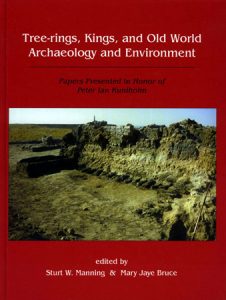 Dendrochronology, or tree-ring dating, provides a key resource for understanding archaeological sites and art historical objects and serves as a stepping stone for investigating past climate. In the Aegean and Eastern Mediterranean, Peter Ian Kuniholm is synonymous with dendrochronology and dendro-archaeology. Since 1973, he has collected wood and developed chronologies from forests, historic buildings, and archaeological sites throughout Greece, Turkey, and surrounding lands; the wood archive at Cornell houses thousands of samples, some of which extend back to 7000 BC.
Edited by Philip P. Betancourt and Costis Davaras
Philadelphia
2009
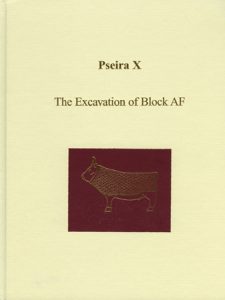 This book is the tenth volume in the series of excavation reports about the harbor town of Pseira, which is located on the island of the same name, just off the northeast coast of Crete. The book focuses on the excavation and interpretation of the architecture and material culture in Block AF. This southern group of buildings is one of the most important areas in the settlement because of its long succession of building phases. Block AF provides the fullest sequence of building phases from any one area at Pseira, with habitation extending from before MM II to LM III. It has examples of complex architectural details including a “pillar crypt”, elaborate upstairs floors, a well-preserved U-shaped staircase, and a well-designed kitchen, all of which contribute significantly to our knowledge of East Cretan building practices.
Edited by Dimitris Damaskos & Dimitris Plantzos
Athens
2008
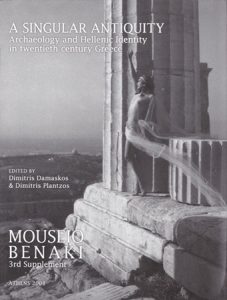 Modern Greeks envisage their collective past as a cultural commodity; authentic, usable and eternally present. Archaeology has been instrumental in constructing the nation’s identity, built on the tangible evidence it produces. This is by no means just a Greek phenomenon, a peculiarity of the state that inherited ‘the glory that was Greece’. The rapport, however, between archaeological research and national(ist) strategy presents some interesting facets in a country which has been struggling, for most of the twentieth century, to counter the predicaments of modernity with the promise of modernization. And it is these peculiarities, concerning the Greek archaeologist as much as the historian and the social anthropologist, which prompted this publication.
