BOOKS
Bryan E. Burns
New York
2010
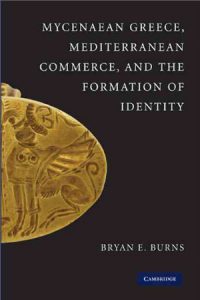 The impact of long-distance exchange on the developing cultures of Bronze Age Greece has been a subject of debate since Schliemann's discovery of the Shaft Graves at Mycenae. In Mycenaean Greece, Mediterranean Commerce, and the Formation of Identity, Bryan E. Burns offers a new understanding of the effects of Mediterranean trade on Mycenaean Greece by considering the possibilities represented by the traded objects themselves in their Mycenaean contexts.
Edited by Katharina Rebay-Salisbury, Marie Louise Stig Sørensen & Jessica Hughes
Oxford
2010

This volume grew out of an interdisciplinary discussion held in the context of the Leverhulme-funded project ‘Changing Beliefs in the Human Body’, through which the image of the body in pieces soon emerged as a potent site of attitudes about the body and associated practices in many periods.
Edited by C. Michel & M.-L. Nosch
Oxford
2010
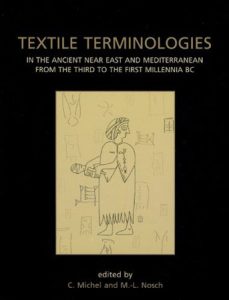 Written sources from the ancient Near East and eastern Mediterranean, from the third to the first millennia BC, provide a wealth of terms for textiles. The twenty-two chapters in the present volume offer the first comprehensive survey of this important material, with special attention to evidence for significant interconnections in textile terminology among languages and cultures, across space and time. For example, the Greek word for a long shirt, khiton, ki-to in Linear B, derives from a Semitic root, ktn. But the same root in Akkadian means linen, in Old Assyrian a garment made of wool, and perhaps cotton, in many modern languages.
Edited by Iain Morley & Colin Renfrew
Cambridge
2010
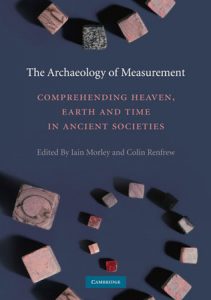 The construction of formal measurement systems underlies the development of science, technology, economy and new ways of understanding and explaining the world. Human societies have developed such systems in different ways, in different places and at different times, and recent archaeological investigations highlight the importance of these activities for fundamental aspects of human life.
Guy D. Middleton
Oxford
2010
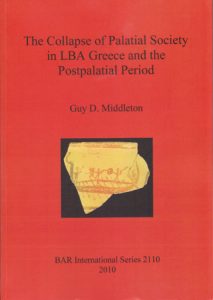 This monograph deals with the destruction and disappearance of the palaces and palace societies of Late Bronze Age or Mycenaean Greece c.1200 and aspects of continuity and change in the subsequent Postpalatial period of the twelfth and eleventh centuries (LHIIIC). It is primarily concerned with mainland Greece and the islands, excluding Crete. An emphasis in this work, where analysis of the Greek material itself or theories based upon it is attempted, is the potential for differences between palatial and non-palatial areas.
Luca Girella
Padova
2010
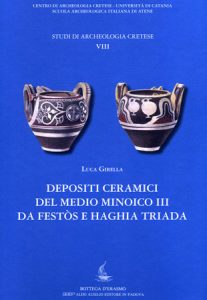
This volume deals with the Middle Minoan (MM) III pottery deposits from Phaistos and Ayia Triada, and has several purposes: firstly, to provide the evidence for a reassessment of the chronological sequence of the MM III in southern Crete; secondly, to add ceramic data to the scanty architectural evidence from both sites during this crucial period; thirdly, to clarify the key passage from MM III to LM IA by presenting specific deposits that support the MM IIIA and IIIB terminologies used in this volume; fourthly, to enlarge the ceramic corpus already embodied by substantial data published from Kommos.
Edited by Isabelle Boehm & Sylvie Müller-Celka
Lyon
2010
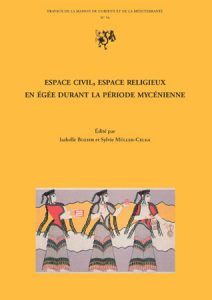
Y a-t-il une distinction entre civil et religieux en Grèce à l’âge du Bronze ? Les auteurs des contributions réunies dans ce volume abordent cette délicate question en suivant une démarche originale, croiser les points de vue de l’archéologue, de l’épigraphiste et du linguiste.
Evangelia Stefani
Thessaloniki
2010
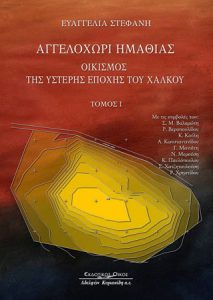 The prehistoric settlement of Angelochori, Emathia, in Macedonia, is located in a rural area, near to its modern namesake village. The excavations lasted from 1994 until 2003 and were conducted by the 17th Ephorate of Prehistoric and Classical Antiquities. The remains of a Late Bronze Age settlement have come to light.
Gemma Marakas
Oxford
2010
 The study of Greek ritual practice throughout the LH III B to Protogeometric periods is the central theme of this research. Chapter Two acknowledges the work of previous Aegean archaeologists and their methods for classification of the features which should be present in order for a site to be categorised as cultic in nature. The chapter goes one step further with the creation of new criteria specifically adapted to be relevant to all types of sanctuaries, be they palatial cult centres, settlement shrines, or isolated open-air shrines throughout the period.
Arianna Rizio
Patras
2010
 Η διαπραγμάτευση της αχαϊκής τοπογραφίας κατά τη μυκηναϊκή περίοδο αποτελεί τμήμα της διδακτορικής διατριβής της συγγραφέως που αφορά τους οικισμούς της Πελοποννήσου κατά την Ύστερη περίοδο του Χαλκού. Η διατριβή επιπλέον επικεντρώνεται στη συλλογή μαρτυριών που έχουν σχέση με τα οικιστικά κατάλοιπα αυτής της περιόδου, καθώς επίσης και στην ανάπτυξη μιας προβληματικής, αντικείμενο της οποίας αποτελεί η θεώρηση της δημιουργίας και ανάπτυξης του μυκηναϊκού οικισμού. Κατά τη διάρκεια της συγγραφής της και στο πλαίσιο της κατάταξης και ανάλυσης των οικιστικών εγκαταστάσεων ανά νομό, η συγγραφέας προσπάθησε να δώσει έμφαση στα τοπικά χαρακτηριστικά ώστε να γίνει αντιληπτό ότι αυτά έπαιξαν το δικό τους δυναμικό ρόλο στη δημιουργία και οργάνωση των οικιστικών πυρήνων της Ελλάδας κατά την υπό έρευνα περίοδο.
Edited by Nikolaos Kaltsas, Sylvian Fachard, Athanasia Psalti, Mimika Giannopoulou
Athens
2010
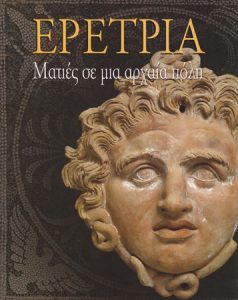 Greek catalogue of the temporary exhibition “Eretria: Insights into an Ancient City” that was hosted at the National Archaeological Museum from April 26th to August 25th, 2010. The exhibition, which was co-organized by the National Archaeological Museum and the IA’ Ephorate of Prehistoric and Classical Antiquities and was an initiative of the Swiss School of Archaeology, narrated the past of the city of Eretria and central Euboea from the prehistoric times until Late Antiquity.
Maria Anastasiadou
Darmstadt/Mainz
2011
 The study examines the Middle Minoan three-sided soft stone prism – hereafter referred to simply as prism. 625 examples of these seals known to date serve as the basis for the research. The goals of the study are twofold: firstly to assess the place of the prism in soft stone MM glyptic; and secondly, to examine and analyse prism iconography.
Anna Stroulia
Bloomington & Indianapolis
2010
Despite their ubiquitous presence among prehistoric remains in Greece, ground stone tools have yet to attract the same kind of attention as have other categories of archaeological material, such as pottery or lithics. As a consequence of this oversight the potential for this material to illuminate aspects of prehistoric life remains unexplored.
Andonis Vasilakis & Keith Branigan
Philadelphia, Pennsylvania
2010
 This volume presents the final report on the excavation of two Prepalatial tholos tombs and their associated remains at Chatzinas Liophyto near the Moni Odigitria (monastery) in south-central Crete. The grave goods and burial remains include pottery, metal objects, chipped stones, stone vases, gold and stone jewelry, sealstones, and human skeletal material. The results of the associated survey of the upper catchment of the Hagiopharango region are also reported.
Constantinos Papadopoulos
Oxford
2010
In the striking event of death, each community produces rituals, not explicitly or exclusively of a funerary nature. This is done in order to maintain both its stability and integrity, while incorporating the living into a fixed system of culturally defined roles and statuses.
