ADVANCED SEARCH +

Aegeus Society For Aegean Prehistory

BOOKS

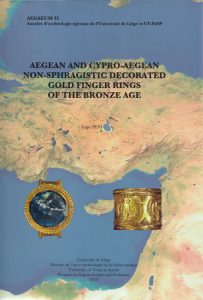
Aegean and Cypro-Aegean Non-Sphragistic Decorated Gold Finger Rings of the Bronze Age

Liège & Austin 2010

Aegean and Cypro-Aegean Non-Sphragistic Decorated Gold Finger Rings of the Bronze Age For the Aegean Bronze Age gold finger rings immediately call to mind the many gold signet rings and impressions thereof on clay sealings from both Crete and the Greek mainland; such items continue to be found in new excavations. The numerous seal impressions demonstrate that the rings were primarily used for administrative purposes. These are excluded from the present study, which focuses instead on the non-sphragistic decorated finger rings that occur less frequently. The author has attempted to assemble as many examples as possible.

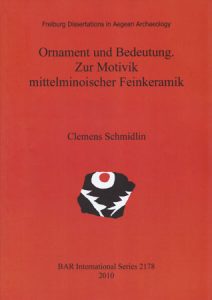
Ornament und Bedeutung. Zur Motivik mittelminoischer Feinkeramik

Oxford 2010

Ornament und Bedeutung. Zur Motivik mittelminoischer Feinkeramik

The subject of this study is middle-Minoan fine ware, also known as ‘Kamares’-ware. Earlier scholars were adapting typological and stylistic results for psychological explanations and therefore the meanings of motifs on vases from the point of view of the perceptions of the original artists and the users of their vessels have been misunderstood.
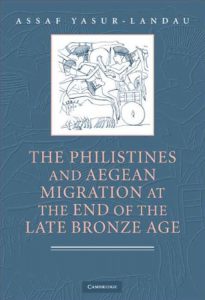
The Philistines and Aegean Migration at the End of the Late Bronze Age

Cambridge 2010

The Philistines and Aegean Migration at the End of the Late Bronze Age The author examines the early history of the biblical Philistines who were among the 'Sea Peoples' who migrated from the Aegean area to the Levant during the early twelfth century BC. Creating an archaeological narrative of the migration of the Philistines, he combines an innovative theoretical framework on the archaeology of migration with new data from excavations in Greece, Turkey, Cyprus, Syria, Lebanon, and Israel and thereby reconstructs the social history of the Aegean migration to the southern Levant.

The Funerary Landscape at Knossos. A Diachronic Study of Minoan Burial Customs with Special Reference to the Warrior Graves

Oxford 2011

The Funerary Landscape at Knossos. A Diachronic Study of Minoan Burial Customs with Special Reference to the Warrior Graves During the last century’s archaeological investigations of the advanced Bronze Age culture maintained by the so-called Minoans on the island of Crete, a number of tombs dated to the Late Minoan period and containing weapons have been discovered in the surroundings of the site of Knossos. The tombs are not confined to a certain area or cemetery, but are rather dispersed around the Palace and town. Although they are characterised by their weapons, other artefacts – such as bronze vessels and certain pottery types – also distinguish these tombs. The tombs are of three types: chamber tombs with long dromoi, shaft graves and pit-caves.

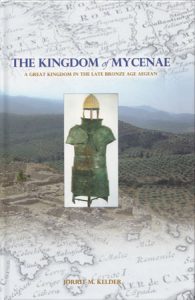
The Kingdom of Mycenae; A Great Kingdom in the Late Bronze Age Aegean

Bethesda, Maryland 2010

The Kingdom of Mycenae; A Great Kingdom in the Late Bronze Age Aegean The study at hand presents a new evaluation of the data and our understanding of the political landscape in Greece during the Late Bronze Age, especially during the fourteenth and thirteenth centuries BC. Over the last several years there has been a flood of new publications on this topic, in popular magazines, monographs, and scholarly publications.

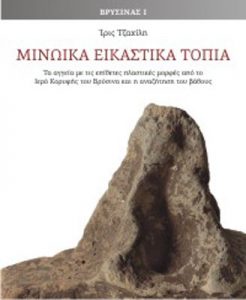
Βρύσινας Ι – Μινωικά Εικαστικά Τοπία. Τα αγγεία με τις επίθετες πλαστικές μορφές από το Ιερό Κορυφής του Βρύσινα και η αναζήτηση του βάθους (Vrysinas I – Minoan Artistic Landscapes)

Athens 2011

Βρύσινας Ι – Μινωικά Εικαστικά Τοπία. Τα αγγεία με τις επίθετες πλαστικές μορφές από το Ιερό Κορυφής του Βρύσινα και η αναζήτηση του βάθους (Vrysinas I – Minoan Artistic Landscapes) The starting-point of this study is a series of vases from the Vrysinas Peak Sanctuary with applied plastic decoration representing landscapes, currently presented as unique to this site. There is also reference to the clay figurines with depictions of rocks, trees and animals from the same site. The finds, the methods of artistic representation and other similar Minoan finds are analysed, before moving on to other categories of Minoan artwork with representations of landscapes. There is extensive discussion of the concept of perspective, the quest for depth and the form this quest assumes in Minoan contexts.

Mycenaean Greece, Mediterranean Commerce, and the Formation of Identity

New York 2010

Mycenaean Greece, Mediterranean Commerce, and the Formation of Identity The impact of long-distance exchange on the developing cultures of Bronze Age Greece has been a subject of debate since Schliemann's discovery of the Shaft Graves at Mycenae. In Mycenaean Greece, Mediterranean Commerce, and the Formation of Identity, Bryan E. Burns offers a new understanding of the effects of Mediterranean trade on Mycenaean Greece by considering the possibilities represented by the traded objects themselves in their Mycenaean contexts.

Body Parts and Bodies Whole. Changing Relations and Meanings

Oxford 2010

Body Parts and Bodies Whole. Changing Relations and Meanings

This volume grew out of an interdisciplinary discussion held in the context of the Leverhulme-funded project ‘Changing Beliefs in the Human Body’, through which the image of the body in pieces soon emerged as a potent site of attitudes about the body and associated practices in many periods.

Textile Terminologies in the Ancient Near East and Mediterranean from the Third to the First Millennnia BC

Oxford 2010

Textile Terminologies in the Ancient Near East and Mediterranean from the Third to the First Millennnia BC Written sources from the ancient Near East and eastern Mediterranean, from the third to the first millennia BC, provide a wealth of terms for textiles. The twenty-two chapters in the present volume offer the first comprehensive survey of this important material, with special attention to evidence for significant interconnections in textile terminology among languages and cultures, across space and time. For example, the Greek word for a long shirt, khiton, ki-to in Linear B, derives from a Semitic root, ktn. But the same root in Akkadian means linen, in Old Assyrian a garment made of wool, and perhaps cotton, in many modern languages.

The Archaeology of Measurement. Comprehending Heaven, Earth and Time in Ancient Societies

Cambridge 2010

The Archaeology of Measurement. Comprehending Heaven, Earth and Time in Ancient Societies The construction of formal measurement systems underlies the development of science, technology, economy and new ways of understanding and explaining the world. Human societies have developed such systems in different ways, in different places and at different times, and recent archaeological investigations highlight the importance of these activities for fundamental aspects of human life.

The Collapse of Palatial Society in LBA Greece and the Postpalatial Period

Oxford 2010

The Collapse of Palatial Society in LBA Greece and the Postpalatial Period This monograph deals with the destruction and disappearance of the palaces and palace societies of Late Bronze Age or Mycenaean Greece c.1200 and aspects of continuity and change in the subsequent Postpalatial period of the twelfth and eleventh centuries (LHIIIC). It is primarily concerned with mainland Greece and the islands, excluding Crete. An emphasis in this work, where analysis of the Greek material itself or theories based upon it is attempted, is the potential for differences between palatial and non-palatial areas.

Depositi ceramici del Medio Minoico III da Festòs e Haghia Triada

Padova 2010

Depositi ceramici del Medio Minoico III da Festòs e Haghia Triada

This volume deals with the Middle Minoan (MM) III pottery deposits from Phaistos and Ayia Triada, and has several purposes: firstly, to provide the evidence for a reassessment of the chronological sequence of the MM III in southern Crete; secondly, to add ceramic data to the scanty architectural evidence from both sites during this crucial period; thirdly, to clarify the key passage from MM III to LM IA by presenting specific deposits that support the MM IIIA and IIIB terminologies used in this volume; fourthly, to enlarge the ceramic corpus already embodied by substantial data published from Kommos.

Αγγελοχώρι Ημαθίας. Οικισμός της Ύστερης Εποχής του Χαλκού. Τόμος Ι (Angelochori. A Late Bronze Age Settlement in Emathia, Macedonia, Greece. Vol. I.)

Thessaloniki 2010

Αγγελοχώρι Ημαθίας. Οικισμός της Ύστερης Εποχής του Χαλκού. Τόμος Ι (Angelochori. A Late Bronze Age Settlement in Emathia, Macedonia, Greece. Vol. I.) The prehistoric settlement of Angelochori, Emathia, in Macedonia, is located in a rural area, near to its modern namesake village. The excavations lasted from 1994 until 2003 and were conducted by the 17th Ephorate of Prehistoric and Classical Antiquities. The remains of a Late Bronze Age settlement have come to light.

Ritual Practice between the Late Bronze Age and Protogeometric Periods of Greece

Oxford 2010

Ritual Practice between the Late Bronze Age and Protogeometric Periods of Greece The study of Greek ritual practice throughout the LH III B to Protogeometric periods is the central theme of this research. Chapter Two acknowledges the work of previous Aegean archaeologists and their methods for classification of the features which should be present in order for a site to be categorised as cultic in nature. The chapter goes one step further with the creation of new criteria specifically adapted to be relevant to all types of sanctuaries, be they palatial cult centres, settlement shrines, or isolated open-air shrines throughout the period.