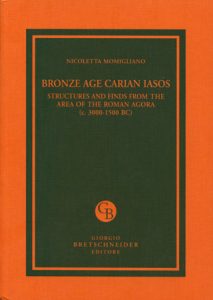
Iasos is an important archaeological site on the southwest coast of Turkey, and one of the very few in this region to have yielded substantial Bronze Age levels and structures, especially for the second millennium BC.
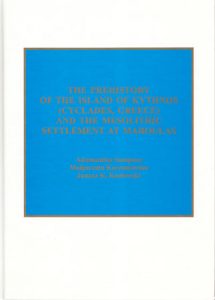
Adamantios Sampson, Malgorzata Kaczanowska & Janus K. KozlowskiKrakow2010
Kythnos with the neighbouring island of Keos is one of the islands of the Cyclades located closely to continental Greece. It is situated at a distance of 60 miles from Piraeus, but it is very close to Cape Sounion. The island which is 15 miles long from north to south and 5 miles wide is now almost bare, yet in the prehistoric period it boasted of quite abundant vegetation and important wild fauna.
The geographical position of Troy at the cross-roads between Anatolia, the Aegean, Black and Marmara Seas, as well as the eastern Balkans, has made it a focal point of cultural, economic and political relations for these regions. One aspect of this huge, multidimensional subject, being investigated for many years, is the collections of artefacts from H. Schliemann's excavations in Troy kept at many museums.
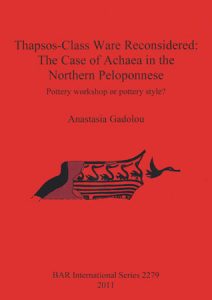
Recent excavations in the region of Achaea in the northern Peloponnese (Greece) have brought to light new evidence on the Thapsos-class of vases. Their identification amongst the grave goods as well as the dedications in the two important sanctuary sites of the area provide a starting point for reassessing the question of this particular ware’s identity and its main production centre.
'Ancient Greece' with its associations of city states, democratic governance, and iconic material culture, can no longer be envisaged as a uniform geographical or historical entity. The Classical city-states of Crete differed considerably in culture, history and governance from those of central Greece.
This book is a study of the woman-and-child motif – known as thekourotrophos – as it appeared in the Bronze Age eastern Mediterranean.Stephanie Lynn Budin argues that, contrary to many current beliefs,the image was not a universal symbol of maternity or a depiction of amother goddess.
Edited by Barbara Horejs, Reinhard Jung & Peter Pavúk Bratislava2010
The volume bears witness to the variety of pottery survival: mostly large amounts from hundreds of contexts, often in a secondary or tertiary position, pottery from short-lived settlements or tell-settlements in use for millennia, plain or decorated pottery, handmade pottery or wheel-thrown mass products.
Textile production was of greater value and importance to people in the past than any other social craft activity: everyone depended on cloth. As with other craft goods, such as pottery, metal objects, or ivory carving, the large-scale production and exchange of textiles required specialization and some degree of centralization.
Although the Greek Peninsula lies within a core area of early hominin movements between Africa and Europe but also within Eurasia itself, the Lower Palaeolithic record of Greece remains as yet extremely poor. Choosing the scanty Greek record as a case-study, Tourloukis elaborates on a hitherto largely overlooked subject in the Eurasian Early-Middle Pleistocene archaeology: the role of geomorphic processes in biasing archaeological distribution patterns of early human presence.
Block M is a substantial architectural complex comprising three large buildings at the heart of the Minoan town of Palaikastro. With traces of activity stretching back to the Prepalatial period, and occupation in the Protopalatial period, Block M sees its most intensive use in the Neopalatial period, in the 17th century bc.
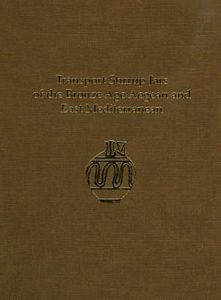
Halford W. Haskell, Richard E. Jones, Peter M. Day & John T. KillenPhiladelphia, Pennsylvania 2011
The transport stirrup jar was a vessel type used extensively in the Late Bronze Age III Aegean world. Found in a variety of contexts, the type was used both to transport and to store liquid commodities in bulk. The peak of the production and exchange of this jar corresponded with the time of economic expansion on the Greek mainland.
Vassos Karageorghis (with a chapter by Nicolle Hirschfeld)Nicosia2011
The Late Bronze Age civilization of Cyprus owes much to Porphyrios Dikaios, who excavated at Enkomi between 1948 and 1958 on behalf of the Department of Antiquities. Two volumes of text, one of plates and another of plans and sections were published by him (Philipp von Zabern Verlag, Mainz-am Rhein) in 1969 and 1971.
The book is the catalogue of the exhibition “Kykladen - Lebenswelten einer frühgriechischen Kultur” that took place at the Badisches Landesmuseum Karlsruhe from 16 December 2011 until 22 April 2012. Five thousand years ago a new chapter of European history was opened on a group of islands in the middle of the Aegean. Cycladic culture marked the beginning of a new era which ultimately defined the whole of Europe: the Bronze Age.
Edited by Nicholas Chr. Stampolidis, Yorgos Tassoulas & Melina Filimonos-TsopotouAthens2011
Islands off the beaten track is the name of a series of archaeological exhibitions being organised by and held at the Museum of Cycladic Art, in collaboration with the Ministry of Culture and Tourism. The exhibitions focus on the most remote, inaccessible, small and medium-sized islands of the Aegean archipelago.
Το βιβλίο εξετάζει την ενσωμάτωση της ψηφιακής τεχνολογίας στην ανασκαφική πράξη με επίκεντρο την ανάπτυξη ενός πληροφοριακού συστήματος για τη διαχείριση και τη διερεύνηση των αρχαιολογικών δεδομένων. Η προσέγγιση χρησιμοποιεί τα Συστήματα Γεωγραφικών Πληροφοριών (ΣΓΠ), διεθνώς γνωστά με τον όρο GIS, και εκμεταλλεύεται τις δυνατότητες που παρέχουν ως προς την τρισδιάστατη χωρική αναπαράσταση και την οπτική αντιπαραβολή της ανασκαφικής πληροφορίας.