Edited by Erik Hallager & Birgitta P. HallagerStockholm2011
This volume is the fourth in a series of seven presenting the results of the Greek-Swedish Excavations during the years 1970-1987 and 2001 in the Agia Aikaterini Square, Kastelli Khania. The excavations which are situated close to the harbour of the modern town of Khania, western Crete were under the direction of Dr Yannis Tzedakis and Professor Carl-Gustaf Styrenius.
Edited by Berit Wells† & Michael LindblomStockholm2011
This study presents the results of a small but intensive surface survey conducted on the Mastos Hill in the Berbati Valley in 1999. While remains from the Early and Late Helladic period were known from previous excavations on its southern and eastern slopes, this is the first analysis of the entire hill. It includes a digital documentation of the local topography as well as an account of the archaeological remains retrieved in the field.
Edited by Maria C. Shaw & Joseph W. Shaw Philadelphia, Pennsylvania2012
House X is by far the largest and best appointed of the Minoan houses excavated at Kommos in south-central Crete, a Minoan harbor and settlement that later became the site of a Greek sanctuary.
Edited by Nena Galanidou & Liv Helga DommasnesAthens2013
Στο πρώτο βιβλίο της σειράς "Δημόσια Αρχαιολογία" ανθρωπολόγοι, αρχαιολόγοι, μουσειολόγοι και ψυχολόγοι από διάφορες χώρες και διαφορετικές ακαδημαϊκές παραδόσεις ξεκινούν έναν διεπιστημονικό διάλογο σχετικά με την παρουσίαση του αρχαίου κόσμου στο παιδικό κοινό.
The Ashmolean Museum of the University of Oxford is home to one of the finest collections of art and archaeology in the world. With some 10,000 objects, it is also the home of the best and most comprehensive collection of Aegean antiquities (Cycladic, Minoan and Mycenaean) outside of Greece.
Edited by Nicholas Chr. Stampolidis, Athanasia Kanta & Angeliki Giannikouri Herakleion2012
An arduous effort which we made in 1997 had two aspects: first a series of international conferences and symposia and second extensive archaeological exhibitions, both focusing on the relations developed between the peoples of the Mediterranean during the Late Bronze Age and Early Iron Age.
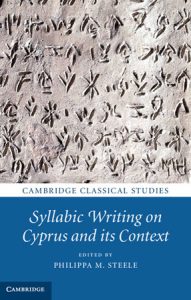
Edited by Philippa M. SteeleCambridge/New York2013
This volume offers a new and interdisciplinary treatment of syllabic writing in ancient Cyprus. A team of distinguished scholars tackles epigraphic, palaeographic, linguistic, archaeological, historical and terminological problems relating to the island's writing systems in the Late Bronze Age and Iron Age, from the appearance of writing around the fifteenth century down to the end of the first millennium BC.
Edited by Michalis Andrianakis, Petroula Varthalitou & Iris TzachiliRethymnon2012
Η δεύτερη συνάντηση για το Αρχαιολογικό Έργο Κρήτης, στις 26-28 Νοεμβρίου 2010, έγινε δύο ακριβώς χρόνια μετά την πρώτη, στις 28-30 Nοεμβρίου 2008, και με τους ίδιους σε γενικές γραμμές στόχους: μια ενημέρωση για το τρέχον αρχαιολογικό έργο, για τις δυσκολίες και τις νέες καταστάσεις που διαμορφώνονται και μία επικέντρωση γεωγραφική και πολιτισμική στην Κρήτη, με σκοπό να αναδειχθούν οι παρελθούσες και παρούσες ιδιαιτερότητές της.
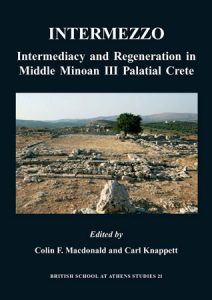
Edited by Colin F. Macdonald & Carl KnappettLondon2013
The Middle Minoan III period on Crete was initially identified and studied in detail at Knossos by Sir Arthur Evans. Subsequent scholarly attention focused on the preceding Old Palace period and the apparent floruit of the New Palaces at the beginning of the Late Bronze Age.
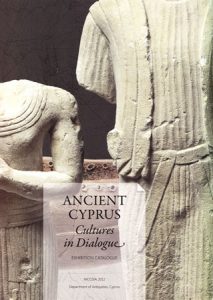
Edited by Despina Pilides & Nikolas PapadimitriouNicosia2012
The exhibition ‘Ancient Cyprus: Culture in Dialogue’ is presented in the Royal Museums of Art and History in Brussels on the occasion of Cyprus’ Presidency of the Council of the European Union, it presents an overview of the culture of Cyprus from the earliest human settlement on the island to the end of Antiquity.
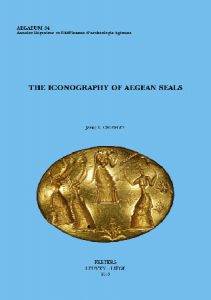
The Iconography of Aegean Seals is a detailed analysis of the iconography of the images on the Aegean seals, signets and sealings, providing for the first time a comprehensive structured overview of these images and a presentation of the artistic rules governing the composition of their designs.
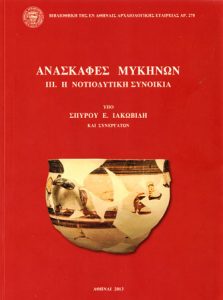
Ο παρών τόμος της σειράς των δημοσιεύσεων των ανασκαφών των Μυκηνών μετά το 1960 άφορα τις εργασίες στην περιοχή της λεγομένης Νοτιοδυτικής Συνοικίας της ακροπόλεως. Οι έρευνες στη συνοικία αυτή έγιναν υπό τη διεύθυνση του αείμνηστου καθηγητή Γ. Ε. Μυλωνά κατά τα έτη 1966, 1972, 1973, 1974, και του Σπύρου Ιακωβίδη κατά τα έτη 1988 και 1989.
Edited by Fillipo Carinci, Nicola Cucuzza, Pietro Militello & Orazio PalioPadova2011
Vincenzo La Rosa rientra nel novero di quelle rare figure di studioso in grado di associare una pluralità di interessi con una eccezionale capacità di attrarre energie e intelligenze per «fare Scuola», per trasmettere a chi sta vicino la passione per la ricerca, il rigore del metodo e l’acribia della domanda.
This volume is based on material from an intensive and systematic field survey of Halasarna (modern Kardamaina), located on a coastal plain in the southern part of the Dodecanesian island of Kos, and a study of settlement patterns across the Aegean.
The core of this study encompasses the presentation of the pottery analysis from Levels IV-V at Ulucak Mound in Izmir, Turkey, in order to reveal the site’s cultural-historical and chronological position within the greater Neolithic context of Turkey and the Aegean.