Edited by Anna Simandiraki-Grimshaw & Eleni StefanouOxford2012
The idea for this volume emerged from critical self-reflection about diverse archaeological practices in a session presented at the 13th European Association of Archaeologists Annual Meeting (Zadar, Croatia, 2007), in particular the conflicting relationship between the ‘mainstream’ and the ‘alternative’.
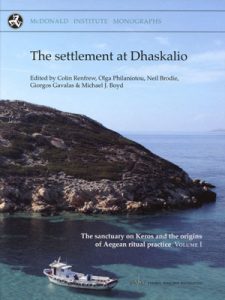
Edited by Colin Renfrew, Olga Philaniotou, Neil Brodie, Giorgos Gavalas & Michael J. BoydOxford/Oakville2013
This is the first volume in the series "The Sanctuary on Keros: Excavations at Dhaskalio and Dhaskalio Kavos, 2006–2008". Here the findings are presented from the well-stratified settlement of Dhaskalio, today an islet near the Cycladic island of Keros, Greece.
Edited by Pierre Carlier, Charles De Lamberterie, Markus Egetmeyer, Nicole Guilleux, Françoise Rougemont & Julien ZurbachPisa/Roma2012
Lors de sa réunion de Rome le 23 février 2006, le CIPEM a chargé la Franced’organiser en septembre 2010 le XIIIe colloque d’études sur les textes égéens. Cinquante-quatre ans après le colloque de Gif réuni à l’initiative de Michel Lejeune au lendemain du déchiffrement, qui avait rassemblé notamment Michael Ventris, John Chadwick et Emmett Bennett...
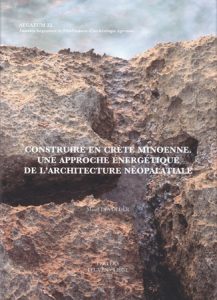
L’architecture crétoise néopalatiale (XVIIe-XVe s. av. J.-C.) est étudiée selon une approche énergétique qui permet de déterminer le temps nécessaire à la construction d’un édifice. Le nombre total d’heures de travail dévolues à l’accomplissement des différentes tâches sur le chantier, depuis l’acquisition des matériaux jusqu’à leur mise en place, est estimé.
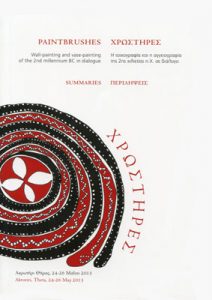
XΡΩΣΤΗΡΕΣ (CHROSTERES)-PAINTBRUSHES was a scientific symposium addressed to archaeologists, conservators of antiquities and artists specialized in the study of Aegean iconography, who wereinvited to participate in open discussions on the dialectical relationship that developed between the arts of vase-painting and wall-painting in the Aegean during the second millennium BC.
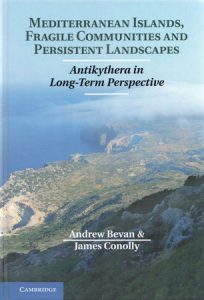
Andrew Bevan & James ConollyCambridge/New York2013
Mediterranean landscape ecology, island cultures and long-term human history have all emerged as major research agendas over the past half-century, engaging large swathes of the social and natural sciences. This book brings these traditions together in considering Antikythera, a tiny island perched on the edge of the Aegean and Ionian seas, over the full course of its human history from the Neolithic through the present day.
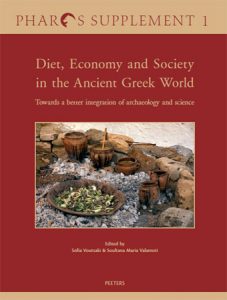
Edited by Sofia Voutsaki & Soultana Maria ValamotiLeuven2013
The last decades have witnessed the adoption and refinement of various scientific techniques that allow us to reconstruct past diets, but also to understand the role of food in social interaction. These are exciting developments, but the proliferation of analytical techniques may also lead to over-specialization and fragmentation of the field.
Individuals (or atoms), those that cannot be divided any further, are the building blocks of the world as we conceive it. Both words refer to what cannot be divided and usually denote the bricks and mortar of the social or material worlds respectively. Their study has fascinated many since the dawn of philosophy.
Leslie Preston Day & Kevin T. Glowacki (contributions by Heidi Dierckx, M.E Evans, Kimberly Flint-Hamilton, Geraldine C. Gesell, David S. Reese & Lynn M. Snyder)Philadelphia2012
Kavousi IIB: The Late Minoan IIIC Settlement at Vronda. Houses on the Periphery is the second volume in the final report on the cleaning and excavations at Vronda, Kavousi, which were conducted between 1983 and 1992 by Geraldine C. Gesell, Leslie Preston Day, and the late William D.E. Coulson.
This book revises our understanding of Mycenaean society through a detailed analysis of individuals attested in the administrative texts from the Palace of Nestor at Pylos in southwestern Greece, ca. 1200 BC. It argues that conventional models of Mycenaean society, which focus on administrative titles and terms, can be improved through the study of named individuals.
Edited by Stratis Papadopoulos & Dimitra MalamidouThessaloniki2012
Οι μελέτες αυτού του τόμου παρουσιάστηκαν στην επιστημονική ημερίδα που πραγματοποιήθηκε στη Θάσο το καλοκαίρι του 2003. Η συνάντηση των ειδικών επιστημόνων υπαγορεύτηκε από την ανάγκη μιας από κοινού προσέγγισης των δεδομένων του προϊστορικού οικισμού των Λιμεναρίων, και της ανταλλαγής πληροφοριών χρήσιμων για την εξέλιξη της έρευνας στους επιμέρους τομείς.
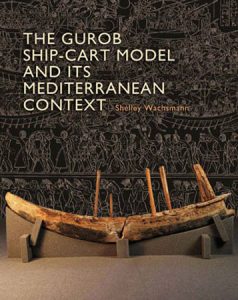
When Shelley Wachsmann began his analysis of the small ship model excavated by assistants of famed Egyptologist W. M. F. Petrie in Gurob, Egypt, in 1920, he expected to produce a brief monograph that would shed light on the model and the ship type that it represented. Instead, Wachsmann discovered that the model held clues to the identities and cultures of the enigmatic Sea Peoples, to the religious practices of ancient Egypt and Greece, and to the oared ships used by the Bronze Age Mycenaean Greeks.
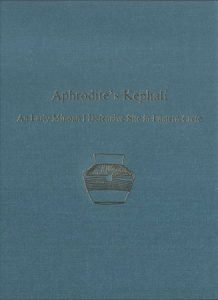
Philip P. Betancourt (with contributions by Kostas Chalikias, Heidi M.C. Dierckx, Andrew J. Koh, Evi Margaritis, Floyd W. McCoy, Eleni Nodarou & David S. Reese) Philadelphia2013
The small site of Aphrodite's Kephali, among several other Minoan and later sites, took advantage of the valley topography in the Isthmus of Ierapetra in eastern Crete by establishing themselves along the nearby hills, resulting in easy access to the natural trade route between the Aegean and the Libyan Seas. A discussion of the architecture, artifacts, and ecofacts are presented from the excavation of this Early Minoan I watchtower.
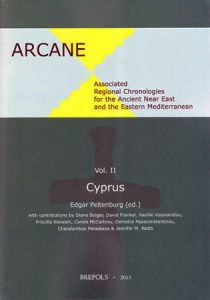
During the 3rd millennium BC, Cyprus became deeply involved with the Ancient Near East and with other parts of the East Mediterranean for the first time since the island was colonised. This included the likely migration of peoples from the East Aegean and Anatolia, and changes that ushered in the Bronze Age.
The publication of the Proceedings of the IVth Cyprological Congress was divided into two parts. In the first one were included all papers which were written in Greek, while all papers written in other languages were included in the second one. In both cases the papers were put in alphabetical order according to the family name of the writer, and not with reference to their period or content.


![Études mycéniennes 2010. Actes du XIII[e] colloque international sur les textes égéens (Sèvres, Paris, Nanterre, 20-23 septembre 2010)](https://www.aegeussociety.org/wp-content/uploads/2013/11/etudes-187x300.jpg)