Edited by Dimitris Nakassis, Joan Gulizio & Sarah A. James Philadelphia/Pennsylvania2014
The title of this volume, ke-ra-me-ja, is a woman's name that appears only once in the extant Mycenaean documentation, on Knossos Ap 639, a catalog of named women. We chose it because it means "potter" (Κεράμεια, from Greek κέραμος, "potter's clay") and combines two major strands of Cynthia Shelmerdine's many scholarly pursuits
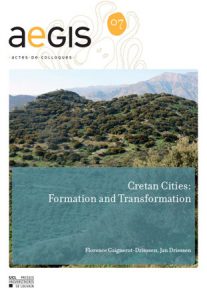
Edited by Florence Gaignerot-Driessen & Jan DriessenLouvain-la-Neuve2014
From 2010 to 2012, a seminar series entitled La naissance des cités crétoises was organised by UCL, with the support of the National Research Foundation (FNRS), the Hubert Curien Partnership Tournesol (PHC Tournesol), the Centre for the Study of Ancient Worlds (CEMA), and the Institute for Civilisations, Arts and Literature (INCAL).
Despite being explored as early as 1877, just one year after Schliemann’s discovery of Circle A at Mycenae, Mycenaean Attica has never been the subject of a general overview. Attention has only been devoted to single outstanding discoveries, such as the monumental tombs and cemeteries of Spata, Menidi, and Perati, or the citadels and settlements of the Acropolis at Athens, Eleusis, and Kiapha Thiti.
Mycenaean architecture is a topic widely investigated by archaeologists, from typological and/or technological and/or artistic perspectives and, more recently, from the socio-economic point of view.
The term pre-firing mark generally refers to an incised, impressed, stamped or painted mark on some part of a vessel, made during the course of manufacture and before the firing of the pot, which is why these marks are widely known as potters' marks
Ο θεσμός των Κρητολογικών Συνεδρίων έχει πια ενηλικιωθεί. Συμπληρώθηκε ήδη μισός αιώνας αδιάκοπης λειτουργίας του, που τον ανέδειξε σε πεδίο δημιουργικής συνάντησης των απανταχού γης ειδικών επιστημόνων ασχολούμενων με την έρευνα και μελέτη της ιστορίας και του πολιτισμού της Μεγαλονήσου.
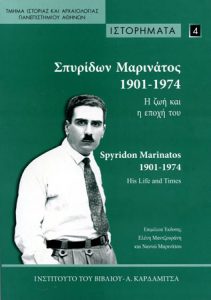
Edited by Eleni Mantzourani & Nanno MarinatosAthens2014
Το βιβλίο με τίτλο «Σπυρίδων Μαρινάτος 1901-1974: Η ζωή και η εποχή του», που εξεδόθη από το Ινστιτούτο του Βιβλίου – Α. Καρδαμίτσα, είναι ο τόμος των Πρακτικών του διήμερου επιστημονικού συνεδρίου που οργάνωσε το Τμήμα Ιστορίας και Αρχαιολογίας του Εθνικού και Καποδιστριακού Πανεπιστημίου Αθηνών στη μνήμη του αείμνηστου Καθηγητή και Ακαδημαϊκού Σπυρίδωνα Μαρινάτου στις 22 και 23 Ιουνίου 2012.
The eruption of the Thera (Santorini) volcano in the Aegean Sea in the mid-second millennium BC was a clearly defined, specific moment in Aegean and east Mediterranean prehistory that impacted on all the major cultures of the region.
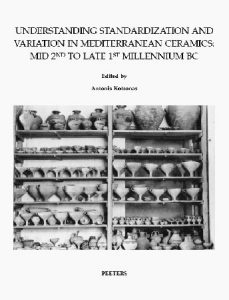
Edited by Antonis KotsonasLeuven - Paris - Walpole, MA2014
This volume is designed as a wide-ranging analysis of ceramic standardization and variation, and as a contribution to pottery studies in the Mediterranean and beyond.
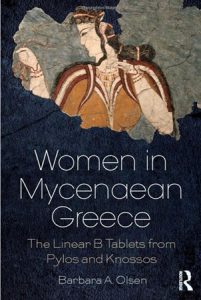
Women in Mycenaean Greece is the first book-length study of women in the Linear B tablets from Mycenaean Greece and the only to collect and compile all the references to women in the documents of the two best attested sites of Late Bronze Age Greece - Pylos on the Greek mainland and Knossos on the island of Crete.
Edited by Stella Souvatzi & Athena HadjiNew York2014
Space and Time in Mediterranean Prehistory addresses these two concepts as interrelated, rather than as separate categories, and as a means for understanding past social relations at different scales. The need for this volume was realised through four main observations: the ever growing interest in space and spatiality across the social sciences;
Dudley Moore, Edward Rowlands & Nektarios KaradimasCambridge2014
Although many books focus on the fascinating story of Heinrich Schliemann, little has been written on Mycenae before his excavations. This book, therefore, fills this gap. It looks at the English-speaking pioneers who visited the citadel at Mycenae before Schliemann, providing additional biographic references in the footnotes (and bibliography and associated sources).
Edited by Εva Simantoni-Bournia, Εugenia Gerousi & Olga KakavogianniAthens2014
Στους διακηρυγμένους στόχους της Ένωσης Αρχαιολόγων Ελλάδας ΗΩΣ συγκαταλέγονται η διευκόλυνση του διαλόγου πάνω σε θέματα που απασχολούν την ελληνική αρχαιολογική κοινότητα, η χωρίς προκαταλήψεις συζήτηση παλαιότερων και νέων προσεγγίσεων σχετικών με το ρόλο και την προστασία των μνημείων και η σχέση των τελευταίων με το κοινωνικό σύνολο.
Edited by Maria Emanuela Alberti & Serena SabatiniOxford & Oakville2013
Throughout the local Bronze and Iron Age, European and Mediterranean societies appear to have been involved in complex systems of exchange networks which invariably affected local customs and historical developments.