Die mykenische Palastverwaltung hat neben den schriftlichen Aufzeichnungen auf Tontäfelchen versiegelte Tonplomben zu einer effektiven Kontrolle administrativer Vorgänge systematisch eingesetzt. Auch wenn die Siegelpraxis in den mykenischen Palastzentren des griechischen Festlands und Kretas nicht das breite Funktionsspektrum anderer bürokratischer Systeme der Antike abdeckte, war sie für das Bestehen dieser Verwaltungssysteme grundlegend.
This book presents an archaeological study of Crete in transition from the Neolithic to the Early Bronze Age (c. 4000 to 3000 BC) within the broader South Aegean context. The study, based on the author’s own fieldwork, contains a gazetteer ofover 170sites.
Richard Jones, Sara T. Levi, Marco Bettelli & Lucia Vagnetti Rome 2014
This volume presents the fruits of research that began in the 1980s concerning a class of pottery that has assumed increasing importance in Italian late prehistory, namely pottery of Mycenaean type or style, usually decorated, dating from the 17th to 11th century BC, and found throughout peninsular Italy, Sicily and Sardinia.
Pascal Darcque, Martin Schmid & Aleydis van de MoortelAthens 2014
This volume is the first in a series publishing the results of the excavations carried out in the area immediately northeast of the palace of Malia. It presents the history of research and a period-by-period overview describing each building, room, and space with a complete inventory of the associated finds, including some C14-dated samples.
Edited by Sarah Cappel, Ute Günkel-Maschek & Diamantis PanagiotopoulosLouvain-la-Neuve2015
More than 100 years ago Sir Arthur Evans' spade made the first cut into the earth above the well-known Palace at Knossos. His research at the Kephala hill as well as contemporary fieldwork at further sites in Crete saw the birth of a new discipline: Minoan Archaeology.
Philip P. BetancourtPhiladelphia, Pennsylvania 2014
This is the first of five planned volumes to present the primary archaeological report about the excavation of the cave of Hagios Charalambos in eastern Crete. The Minoans used this small cavern as an ossuary for the secondary burial of human remains and grave goods, primarily during the Early and Middle Bronze Age.
Στις 22 Δεκεμβρίου 2014 έγινε στην Εταιρεία Δημόσια Συνεδρία εις μνήμην του Σπυρίδωνος Μαρινάτου (†1 Οκτωβρίου 1974) με οκτώ ομιλητές. Οι ομιλίες δημοσιεύονται στις επόμενες σελίδες. Σε αυτές προτάσσεται το κείμενο του Στυλιανού Αλεξίου, που είχε δοθεί ως πρόλογος σε τόμο κειμένων του Σπ. Μαρινάτου, εγχείρημα που οι περιστάσεις δεν επέτρεψαν να ευοδωθεί.
Ο παρών τόμος συγκεντρώνει τις εργασίες δέκα μεταπτυχιακών φοιτητών Α΄ κύκλου οι οποίες εκπονήθηκαν κατά τη διάρκεια του μεταπτυχιακού σεμιναρίου στο Τμήμα Ιστορίας και Αρχαιολογίας του Εθνικού και Καποδιστριακού Πανεπιστημίου Αθηνών με θέμα «Η ιστορία της προϊστορικής έρευνας στην Ελλάδα και την Ευρώπη κατά τον 19ο και 20ό αιώνα».
Before Sir Arthur Evans, the principal object of Greek prehistoric archaeology was the reconstruction of history in relation to myth. European travellers to Greece viewed its picturesque ruins as the gateway to mythical times, while Heinrich Schliemann, at the end of the nineteenth century, allegedly uncovered at Troy and Mycenae the legendary cities of the Homeric epics.
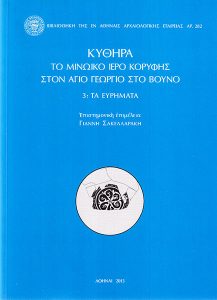
The third volume presents findings of the historical times from the excavations carried out by Yiannis Sakellarakis at the Minoan peak sanctuary at Agios Georgios sto Vouno on the island of Kythera.
The second volume presents findings from the excavations carried out by Yiannis Sakellarakis at the Minoan peak sanctuary at Agios Georgios sto Vouno on the island of Kythera.
Edited by Colin F. Macdonald, Eleni Hatzaki & Stelios AndreouAthens2015
Gerald Cadogan’s contributions to the archaeology of the East Mediterranean are directly related to the two Great Islands, Crete and Cyprus where he has directed excavations at Myrtos-Pyrgos and Maroni-Vournes respectively. This volume, comprising mostly Cretan and Cypriot studies, is offered by an array of scholars who have been taught or examined by Cadogan or who have collaborated with him in the field or excavation workrooms over the last fifty years.
Edited by Mary Harlow, Cecile Michel & Marie-Louise NoschOxford2014
Textile and dress production, from raw materials to finished items, has had a significant impact on society from its earliest history. The essays in this volume offer a fresh insight into the emerging interdisciplinary research field of textile and dress studies by discussing archaeological, iconographical and textual evidence within a broad geographical and chronological spectrum.
This book presents an archaeological study of Crete in transition from the Neolithic to the Early Bronze Age (c. 4000 to 3000 BC) within the broader South Aegean context. The study, based on the author’s own fieldwork, contains a gazetteer of over 170 sites.