This study has concentrated on the pottery of the early and middle subperiods of Troy VI that came to light during the excavations between 1988 and 2002.
Edited by Colin Renfrew, Olga Philaniotou, Neil Brodie, Giorgos Gavalas & Michael J. BoydCambridge 2015
This is the second volume in ‘The Sanctuary on Keros and Origins of Aegean Ritual Practice: the excavations of 2006-2008’ series. It describes the excavation and finds from the Special Deposits at Kavos at the sanctuary on Keros lying opposite the settlement on the islet of Dhaskalio.
The volume is the result of a workshop held at the Norwegian Institute at Athens 11th-13th of November 2011. It addressed the different layers of mobility in the Bronze and Early Iron Age of the Eastern Mediterranean.
Με το παρόν βιβλίο επιχειρείται η διερεύνηση των θρησκευτικών πεποιθήσεων και αντιλήψεων, αλλά και των λατρευτικών πρακτικών και τελετουργιών, κατά την προϊστορική περίοδο.
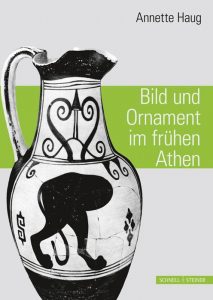
Bild und Ornament sind in ihrer visuellen Funktion eng aufeinander bezogen. Das vorliegende Buch hat sich zur Aufgabe gemacht, Bild-Ornament-Relationen für das 10. bis 7. Jh. v. Chr. in Athen nachzuzeichnen.
Traditionally, Neolithic cultural groups have been defined on the basis of a single type of archaeological evidence, namely, pottery. In practice, such clusters identified by specific pottery traits have often been treated as if they were communities with a common cultural identity
For more than one thousand years, people from every corner of the Greco-Roman world sought the hope for a blessed afterlife through initiation into the Mysteries of Demeter and Kore at Eleusis.
Il volume accoglie la catalogazione, articolata essenzialmente su basi stilistiche, della raccolta di ceramica geometrica proveniente dalla Grecia, conservata nel Museo fiorentino e di recente nuovamente esposta all’interno della Sezione Greca.
This volume presents the results of a multidisciplinary research program (“Balkans 4000”) financed by the French National Research Agency (ANR) and coordinated by the editor between 2007 and 2011, when she was a member of the Maison de l’Orient et de la Méditerranée (Laboratory of Archaeology and Archaeometry).
How does intentionally inflicting damage to material objects mediate the human experience in the prehistoric eastern Mediterranean? For all of the diversity in cultural practice in the civilisations of the Greek mainland and Aegean islands, Crete, Cyprus and the eastern coast of Italy between 4000-750 BC, archaeologists consider the custom of ritually killing objects as a normative, if inconsistent practice.
This volume presents the proceedings of the 9th annual conference in Postgraduate Cypriot Archaeology (POCA 2009), which was held at the Ioannou Centre for Classical and Byzantine Studies, University of Oxford from the 19th to the 21st of November 2009. POCA 2009 encompassed 24 presentations by postgraduate students and young researchers, coming from a number of institutions and universities in Europe and the United States.
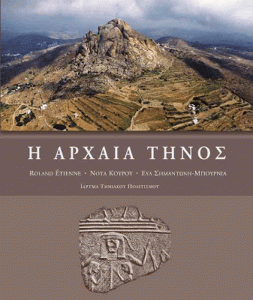
Roland Étienne, Nota Kourou, Eva Simantoni-BourniaAthens 2013
Μια συλλογική επιστημονική μελέτη, με σκοπό την προβολή της ιστορίας της Τήνου έως τους ύστερους ρωμαϊκούς χρόνους, με επιστημονικά κριτήρια που στοιχειοθετούνται από τις αρχαιολογικές ανασκαφές στην Τήνο και τις Κυκλάδες, από μαρτυρίες γραπτών πηγών της αρχαιότητας και τη διεθνή βιβλιογραφία.
This book is an attempt to reconstruct the image of Mycenaean Arcadia based on the archaeological and topographical data, more than four decades after the systematic investigation of R. Howell (BSA 1970) in the region.
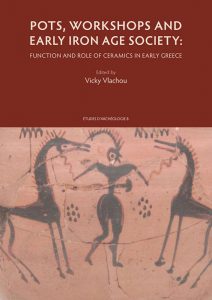
This volume brings together a number of papers that were presented at the international symposium on Pots, Workshops and Early Iron Age Society. Function and Role of Ceramics in Early Greece organised by the University of Athens (UoA) and the Université libre de Bruxelles (ULB), and held at the Université libre de Bruxelles in November 2013.





![Μυκηναϊκή Αρκαδία. Αρχαιολογική και τοπογραφική θεώρηση [Mycenaean Arcadia: An Archaeological and Topographical Approach]](https://www.aegeussociety.org/wp-content/uploads/2016/03/Salavoura-2015-web-215x300.jpg)