Edited by Paraskevi Elefanti, Niels Andreasen, P. Nick Kardulias & Gilbert MarshallUppsala 2016
While the analysis of stone tools has been a cornerstone of prehistoric archaeology since its inception, their role in the study of Greek sites gained greater traction only in the 1950s.
The book publishes the results of the Conference “The archaeology in Greece nowadays; monuments and people in crisis”, which took place in Athens in 19-20 March 2015.
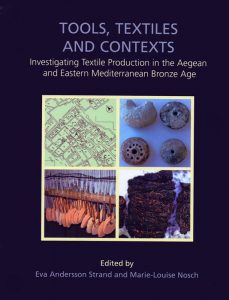
Edited by Eva Andersson Strand & Marie-Louise NoschOxford & Philadelphia 2015
Textile production is one of the most important crafts in Aegean and Eastern Mediterranean Bronze Age societies and recent interdisciplinary and collaborative work offers crucial new perspectives into this field. The new and updated catalogue of archaeological textile finds presented here clearly demonstrates, even from the few extant finds, that knowledge of the use of fibres and of elaborate textile techniques that were used to produce textiles of different qualities was well developed.
Το σπήλαιο Σαρακηνού βρίσκεται στον βραχώδη όγκο ανατολικά της πεδιάδας (αποξηραμένης πλέον λίμνης) της Κωπαΐδας και δυτικά του χωριού Ακραίφνιο, σε υψόμετρο ~100 μ.
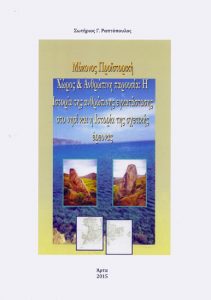
The book is a synthesis of older and new (unpublished) material for the prehistoric island of Mykonos. It is accompanied by an appendix on the history of research
In the 1960s a great new barrier dam was built across the Peneios Valley in Elis in the N.W. Peloponnese to create an artificial lake for irrigation purposes. In 1967 the Greek Archaeological Service organised a preliminary survey of the areas to be affected and also asked all the Foreign Archaeological Schools to assist and allocated specific sections to each.
Edited by Eva Alram- Stern & Angelika Dousougli-Zachos Bonn 2015
The monograph of E. Alram-Stern and A. Dousougli-Zachos “Die deutschen Ausgrabungen 1941 auf der Visviki-Magula/Velestino. Die neolithischen Befunde und Funde” appeared towards the end of 2015. It includes chapters not only on the history of the excavations at Visviki-Magoula, but also on the history of German archaeological research in Thessaly since the 19th century.
Edited by Evi Gorogianni, Peter Pavúk & Luca GirellaOxford 2016
Beyond Thalassocracies aims to evaluate and rethink the manner in which archaeologists approach, understand, and analyse the various processes associated with culture change connected to interregional contact, using as a test case the world of the Aegean during the Late Bronze Age (c. 1600–1100 BC).
Edited by Diamantis Panagiotopoulos, Ivonne Kaiser & Ourania KoukaBonn 2015
Die vorliegende Festschrift verdankt ihre Existenz nicht einer persönlichen oder wissenschaftlichen Pflicht, sondern vielmehr einem dringenden Bedürfnis zahlreicher Kollegen, Mitarbeiter, Schüler und Freunde sowohl dem Wissenschaftler als auch dem Menschen Wolf-Dietrich Niemeier einen großen Dank auszusprechen und sein verdienstvolles Wirken auf angemessene Weise zu würdigen.
The choice of the Archeological Museum of Mycenae for this year’s volume came about effortlessly. It is a place where historical facts are interwoven with mythology and protagonists like Atreus, Agamemnon, Clytemnestra, Menelaus, Iphigenia and Orestes come alive before the eyes of the visitor.
Landscape archaeology is being transformed by the recent development of novel geoinformatic techniques that facilitate entirely new ways to study the archaeological record. Despite this stimulating potential, these techniques are developing so quickly that many practitioners are not fully aware of their capabilities or the most suitable ways to apply them.
In this book the authors publish thirteen tombs and two pyres excavated by the Cyprus Department of Antiquities in the cemeteries of Palaepaphos, on the western part of Cyprus. More tombs from the same cemeteries were published by the same authors in 2014 and earlier (by V. Karageorghis) in 1983.
Extensive excavations in the Necropolis of Palaepaphos at site Skales undertaken by the Department of Antiquities in 1979 had demonstrated the importance of this kingdom of Cyprus from the early 11th century B.C. to the end of the Cypro-Geometric III period.
This book focuses on merging all disciplines, perspectives, theories, aspects and applications of disasters in their spatio-temporal framework (archaeodisasters), into one major scientific field (Disaster Archaeology).
The volume illustrates the architecture and the finds from two LM IIIA2-B chamber tombs excavated in 1973 and 2010 at Kalochorafitis in south-central Crete and 8 km N of the palatial site of Phaistos.