The book presents a contextual study of the Near Eastern imports which reached Crete during the Early Iron Age and were deposited in the Knossian tombs.
This regional study considers the transitional period between the collapse of the Palace of Knossos (end of 14th c. B.C.) and the birth of the Greek city-state (mid 7th c. B.C.) around the Mirabello Bay, in Eastern Crete.
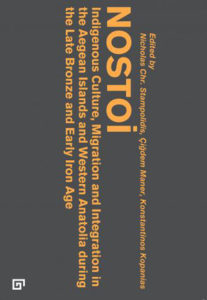
Edited by Nicholas Chr. Stampolidis, Çiğdem Maner & Konstantinos Kopanias Istanbul 2015
Nostoi. Indigenous Culture, Migration and Integration in the Aegean Islands and Western Anatolia during the Late Bronze and Early Iron Age is presenting one comprehensive volume with papers discussing various aspects of the intercultural contact between West Anatolia and the Aegean during the Late Bronze Age and Early Iron Age.
Edited by Walter Gauß, Gudrun Klebinder-Gauß & Constance von RüdenWien 2015
The current volume unites theoretical, anthropological, and archaeological approaches to knowledge transmission. The case studies cover various periods and regions from the ancient Mediterranean and beyond, from the Bronze Age to the Roman period, from the Levant in the east to the western Mediterranean and the Celtic north, but also from today’s central Niger.
The island of Euboea has always acted as a bridge connecting mainland Greece to the wider Aegean and the Mediterranean world; its archaeological importance was an acknowledged but often understated fact. Euboea, a region with an identity crisis, at the same time considered an island but also a part of the mainland, due to its geographical and cultural proximity, has for millennia played an important role in events that shaped aspects of Greek antiquity.
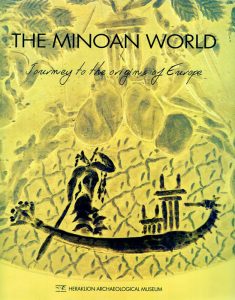
Edited by Stella Mandalaki & Giorgos Rethemiotakis Heraklion 2015
Τhe Minoan civilisation, one of the greatest achievements of human endeavour in the world, was the first civilisation to arise on European soil. Recognising its uniqueness, Arthur Evans, the excavator of Knossos, the metropolitan centre of the Minoan world, named the civilisation he brought to light "Minoan", inspired by the legendary King Minos of Knossos.
Το Αρχαιολογικό Έργο Κρήτης είναι πλέον θεσμός. Ένας θεσμός, ο οποίος στις σημερι-νές εξαιρετικά δύσκολες και αντίξοες συνθήκες έχει τη δύναμη να δημιουργεί ελπίδες και προσδοκίες. Η εντυπωσιακή αύξηση του αριθμού των συμμετεχόντων στην τρίτη συνάντηση το 2013 το αποδεικνύει πέρα από κάθε αμφιβολία.
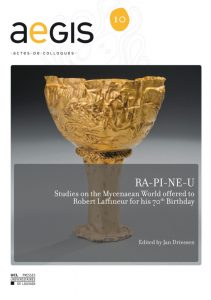
This volume, in honour of one of the Odysseuses in Aegean archaeology, Professor Robert Laffineur, comprises a combination of papers presented during a seminar series on recent developments in Mycenaean archaeology at the Université de Louvain during the academic year 2015-2016. These were organised within the frame of the ARC13/18 - 049 (concerted research action) “A World in Crisis?”.
Edited by Anastasia Dakouri-Hild & Michael J. BoydBerlin/Boston 2016
Places are social, lived, ideational landscapes constructed by people as they inhabit their natural and built environment. An ‘archaeology of place’ attempts to move beyond the understanding of the landscape as inert background or static fossil of human behaviour. From a specifically mortuary perspective, this approach entails a focus on the inherently mutable, transient and performative qualities of ‘deathscapes’: how they are remembered, obliterated, forgotten, reworked, or revisited over time.
Edited by Harald Meller, Hans Peter Hahn, Reinhard Jung & Roberto RischHalle (Saale)2016
The question of “Rich and Poor”, in other words of social inequality is, as shown by a glance at the newspapers, a highly topical issue. At the same time it is one of the fundamental questions of human communities.
Edited by Nicoletta Momigliano & Alexandre FarnouxLondon/New York2016
Since its rediscovery in the early 20th century, through spectacular finds such as those by Sir Arthur Evans at Knossos, Minoan Crete has captured the imagination not only of archaeologists but also of a wider public.
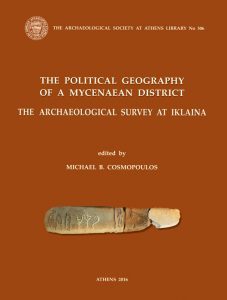
The historic village of Iklaina is located approximately 14 km to the northeast of the modern town of Pylos. As early as 1909 Konstantinos Kourouniotis had reported ancient tools from the area, but it was not until 1954 that Iklaina became the object of targeted archaeological exploration.
Edited by Anastasia Papathanasiou, Michael P. Richards & Sherry C. FoxPrinceton/New Jersey2015
The analysis of stable isotope ratios of carbon and nitrogen in bone collagen provides a powerful tool for reconstructing past diets, since it provides the only direct evidence of the foods that were actually consumed. The chapters that comprise this volume describe the application of this methodology to the archaeology of Greece, a country whose archaeobotanical remains have been isotopically studied more extensively than any other place in the world.
This volume treats in detail the pottery from the settlement on the islet of Dhaskalio, whose excavation is described in Volume I of the series. Much of the importance of this material lies in the undisturbed stratigraphy of the settlement, a fact that allowed for the recognition of three successive phases of occupation of the site with considerable ceramic continuity between them, as well as for safe inferences about its chronology, with wider implications for the later Εarly Βronze Αge of the Cyclades.