Giorgos Rethemiotakis & Maria EgglezouHeraklion2010
Eltyna or Eltynia is a Greek town located close to the village Kounavi in central Crete. The location of the ancient town became known ninety years ago after the discovery of an archaic inscription which records penalties for causing injuries to boys and adolescents. It records the ethnic name of the town's citizens together with authorities and political institutions accountable to the state, which was an autonomous polity (polis).
O λόγος περί γυναικών και ο λόγος των γυναικών ενυπάρχει στις αναπαραστάσεις του παρελθόντος, όσο και αν αποθαρρύνεται από την κατεστημένη έρευνα. Στο βιβλίο αυτό αποτιμάται η συμβολή των γυναικών στην αρχαιολογία με βάση το δίπτυχο της επιστημονικής και της έμφυλης ιδιότητάς τους.
The finding of a sword of possible Mycenaean or Aegean origin of the Late Bronze Age era, at Hattuša, dated ca. 1420-1400 BC, inspired the present research, which deals with the exchange of technologies and know-how between the regions around the Aegean Sea, as derived from the archaeological evidence and the ancient Greek literature.
The seismicity in Greece and in the adjacent regions is the highest in the Western Eurasia. One of the most active seismotectonic structures in that region is the Hellenic Arc and Trench (H-AT) system. The island of Crete occupies the central segment of H-AT just to the north of the front where the lithospheric plates of Africa and Eurasia converge and the former bends and subducts beneath the later.
The volume intends to be not only a straightforward presentation of the Middle and Late Bronze Age pottery from Mainland Greece, including the islands of Aegina and Paros, stored in the Schachermeyr Collection at the Austrian Academy of Sciences, but also to offer an in-depth discussing on a selection of ralated topics.
Edited by Elisabetta Borgna & Sylvie Müller Celka Lyon2011
This volume provides a comprehensive study of the burial mound phenomenon which emerged in large parts of Europe during the Copper and Bronze Ages, with a major focus on the Mediterranean and eastern European regions.
Athanasia Kanta (with contributions by Anastasia Tzigounaki, Louis Godart, Germana Pecoraro, Demetra Mylona & Alexia Speliotopoulou)Heraklion2012
In 1982 a short joint survey of the Amari valley took place as a co-operation between the University of Naples-Federico II and the Greek Archaeological Service. The team was led by Dr. Yiannis Tzedhakis, then Director of Classical and Prehistoric Antiquities at the Greek Ministry of Culture and Professor Luis Godart of the University of Naples.
Bernhard Steinmann widmet sich in seiner Untersuchung Waffengräbern der minoischen und mykenischen Hochkulturen aus dem 20. bis 12. Jahrhundert v.Chr. Zu den typischen Grabbeigaben gehören hier vor allem Waffen, die das Interesse der Elite spiegeln, ihre kriegerische Tüchtigkeit zu betonen.
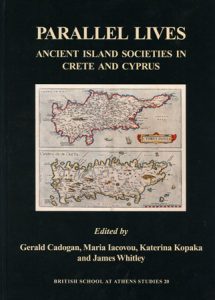
Edited by Gerald Cadogan, Maria Iacovou, Katerina Kopaka & James WhitleyLondon2012
How do the cultures of Crete and Cyprus, the two great islands of the eastern Mediterranean, compare in their history and development from the 3rd millennium to the 1st millennium BC? What was similar and what was different in their social and political, economic and technological, and religious and mortuary practices and behaviours, and in the natural settings and choices of places for settlements?
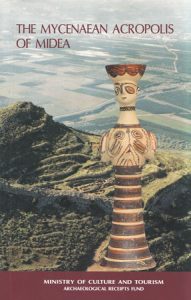
A brief guide of the archaeological site of Midea, with many colour figures of recent excavations and finds. The acropolis of Midea is the third most important Mycenaean acropolis of Argolis.
Costis Davaras & Philip P. BetancourtPhiladelphia, Pennsylvania2012
The publication of the Hagia Photia Cemetery is planned in three volumes. The first volume, which has already been published (Davaras and Betancourt 2004), presented the tomb groups and the architecture. The second volume about the excavation of the Hagia Photia cemetery focuses on the pottery. The third volume will present the obsidian, stone finds, metal objects, and other discoveries.
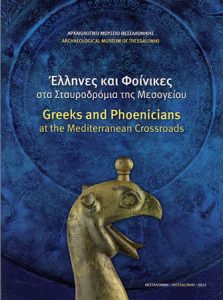
Edited by Polyxeni Adam-Veleni & Evangelia StefaniThessaloniki2012
Phoenicians and Greeks: two seafaring peoples who left clear marks on the Mediterranean routes. Their presence affected the fate of many other peoples and opened roads of trade and culture. Which were the meeting points of these rulers of the waves? And which their conflicting?
Edited by Vasiliki Kassianidou & George PapasavvasOxford2012
Ancient Cyprus was an important copper producing region, as well as a pioneer in the development and spread of metallurgy and metalwork in the wider region of the Eastern and Central Mediterranean. Eastern Mediterranean Metallurgy and Metalwork in the Second Millennium BC contains twenty-three papers that compare and contrast the material culture associated with metallurgical workshops, as well as discussing technological issues and their cultural and archaeological contexts.
Minoan seals have often been described as problematically ambiguous. By assembling and reframing current discourse, this volume challenges the value of characterising glyptic imagery in this way. Instead ambiguity may indicate the presence of deliberate practice, incorporating varied meanings through multivalent or condensed expression, well suited to the compact size of the glyptic medium.
The new volume of the journal ALS contains 4 articles (written in Greek) regarding the excavations of the prehistoric site of Akrotiri, as well as an article on a survey on the island of Therasia. There is also an obituary for Stella Spantidaki.