ADVANCED SEARCH +

Aegeus Society For Aegean Prehistory

BOOKS

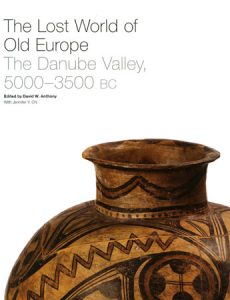
The Lost World of Old Europe: The Danube Valley, 5000-3500 BC

New York 2010

The Lost World of Old Europe: The Danube Valley, 5000-3500 BC

In the prehistoric Copper Age, long before cities, writing, or the invention of the wheel, Old Europe was among the most culturally rich regions in the world. Its inhabitants lived in prosperous agricultural towns. The ubiquitous goddess figurines found in their houses and shrines have triggered intense debates about women's roles. The Lost World of Old Europe is the accompanying catalog for an exhibition at New York University's Institute for the Study of the Ancient World. This superb volume features essays by leading archaeologists as well as breathtaking color photographs cataloguing the objects, some illustrated here for the first time.

Ancient Cyprus in the British Museum: Εssays in Ηonour of Veronica Tatton-Brown

London 2009

Ancient Cyprus in the British Museum: Εssays in Ηonour of Veronica Tatton-Brown The ancient Cypriot collections of the British Museum have inspired the essays in this volume in honour of Veronica Tatton-Brown, who for many years was their curator. Written by her academic colleagues and friends, the themes covered range from funeral rites at Late Bronze Age Enkomi to sculptured portraits of parents and children in the 5th and 4th centuries BC, along with the reconstruction of the Persian siege ramp at Palaipaphos and the history of Cypriot archaeology as revealed in the Museum's archives.

Inside the City in the Greek World: Studies of Urbanism from the Bronze Age to the Hellenistic Period

Cambridge 2009

Inside the City in the Greek World: Studies of Urbanism from the Bronze Age to the Hellenistic Period The focus of much recent archaeological study of urbanism has been on the relationship between urban centres and the rural sphere. However, this important line of inquiry has generally neglected the internal workings of cities. This volume presents an archaeological approach to urbanism in the ancient Aegean and related areas.

Μουσείο Μπενάκη, vol. 8 (Benaki Museum)

Athens 2008

Μουσείο Μπενάκη, vol. 8 (Benaki Museum) The book is the eight volume of the journal of the Benaki Museum. The two first articles, written in English, focus on a golden Mycenaean kylix of the Benaki Museum. The golden kylix decorated with repoussé runnig hounds was bought by Antoni Benaki himself in 1939; it consists one of the most known prehistoric artefacts of the Museum.

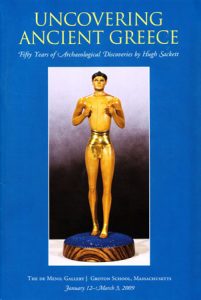
Uncovering Ancient Greece: Fifty Years of Archaeological Discoveries

Massachusetts 2009

Uncovering Ancient Greece: Fifty Years of Archaeological Discoveries Catalogue of an exhibition held at the de Menil Gallery (January 12, 2009 - March 3) to celebrate a long and fruitful career of Hugh Sackett with Groton School. Principally associated throughout his career with the British School in Athens, Mr. Sackett is best known for his work at five important archaeological digs that were the focus of the exhibition: the Dema and Vari Houses near Athens, the Unexplored Mansion at Knossos in Crete, the town of Lefkandi on the island of Euboea, and a previously unknown Minoan palace complex at Palaikastro in eastern Crete.

ΠΕΡΙΦEΡΕΙΑ. Étude régionale de la Crète aux Minoen Récent II-IIIB (1450-1200 av. J.-C.). 1. La Crète centrale et occidentale

Louvain-la-Neuve 2009

ΠΕΡΙΦEΡΕΙΑ. Étude régionale de la Crète aux Minoen Récent II-IIIB (1450-1200 av. J.-C.). 1. La Crète centrale et occidentale À la croisée de l’Âge d'or de la civilisation minoenne et de l'Âge du Fer, les 250 ans d'histoire de la société crétoise couverts par cet ouvrage représentent une période encore fortement débattue (1450-1200 av. J.-C.). Cette problématique historique spécifique, résumée sous l’appellation de « Crète mycénienne », s’est longtemps concentrée sur le site majeur de Knossos et les relations variées entre les sociétés complexes de la Crète et de la Grèce continentale.

Excavations at Sissi. Preliminary Report on the 2007-2008 Campaigns

Louvain-la-Neuve 2009

Excavations at Sissi. Preliminary Report on the 2007-2008 Campaigns During 2007 and 2008, the Belgian School at Athens undertook its first ever excavation on Crete, at the Minoan site of Sissi on the north coast of the island. Located at a few kilometres from the palatial site of Malia, the Sissi settlement presents a unique test case to examine the relationship between a palace site and its hinterland during the Bronze Age (2600-1250 BC).

Die Synchronisierung der nördlichen Levante und Kilikiens mit der ägäischen Spätbronzezeit

Wien 2009

Die Synchronisierung der nördlichen Levante und Kilikiens mit der ägäischen Spätbronzezeit For several decades we know quite a lot of sites in the northern Levant which yield Aegean finds, especially Mycenaean pottery and figurines. This study contains a catalogue of Mycenaean pottery, imported as well as locally made, found in Syria, the Lebanon and Cilicia in undisturbed contexts. These are of particular importance for the synchronization with sites in Southern Greece. There, the typology of the Mycenaean pottery is ensured by several settlement sequences.

Die geometrische Keramik von Kap Kolonna

Wien 2009

Die geometrische Keramik von Kap Kolonna The Protogeometric and Geometric pottery presented in this volume was mainly found on the Kolonna Hill, a cape protruding into the sea in front of the island of Aigina, bearing a settlement from Neolithic times onwards. The high quantities of Protogeometric pottery indicate that the acropolis of Cape Kolonna, which was abandoned during the Late Mycenaean times, was resettled in the 10th century B.C. It is apparent that the inhabitants of Aigina had close relations with Athens from the beginning, independent of their transmitted Doric descent, as the decorated ceramic fine wares have been almost exclusively imported from there.

Interconnections in the Eastern Mediterranean. Lebanon in the Bronze and Iron Ages. Proceedings of the International Symposium Beirut 2008

Beirut 2009

Interconnections in the Eastern Mediterranean. Lebanon in the Bronze and Iron Ages. Proceedings of the International Symposium Beirut 2008 The book publishes the Proceedings of the four day Symposium ‘Interconnections in the Eastern Mediterranean during the Bronze Age (Early, Middle, Late) and the Iron Age’ that was held in November 2008 in Beirut (Lebanon). The aims of the Symposium were: 1) To initiate in Lebanon an International forum for Mediterranean archaeology, 2) To focus on regionalism between ancient Lebanon and the Mediterranean world during Bronze Age and Iron Age.

The Master of Animals in Old World Iconography

Budapest 2010

The Master of Animals in Old World Iconography Old World iconography from the Upper Paleolithic to the Christian era consistently features symbolic representations of both female and male protagonists in conflict with, accompanied by or transmuted partly or completely into, animals. Adversarial relationships are made explicit through hunting and sacrifice scenes, including heraldic compositions featuring a central figure grasping beasts arrayed on either side, while more implicit expressions are manifested in zoomorphic attributes (horns, headdresses, skins, etc.) and composite or hybrid figures that blend animal and human elements into a single image.

Archaic State Interaction. The Eastern Mediterranean in the Bronze Age

Santa Fe, New Mexico 2010

Archaic State Interaction. The Eastern Mediterranean in the Bronze Age In current archaeological research the failure to find common ground between world-systems theory believers and their counterparts has resulted in a stagnation of theoretical development in regards to modeling how early state societies interacted with their neighbors. This book is an attempt to redress these issues. By shifting the theoretical focus away from questions of state evolution to state interaction, the authors develop anthropological models for understanding how ancient states interacted with one another and with societies of different scales of economic and political organization.

Contrôle économique et administration à l’époque des palais mycéniens (fin du IIe millénaire av. J.-C.)

Athens 2009

Contrôle économique et administration à l’époque des palais mycéniens (fin du IIe millénaire av. J.-C.) This book examines the economic control and the administration in Greece at the time of the Mycenaean palaces (texts dating to between ca. 1450 and 1200 BC). It relies primarily on the inscribed tablets discovered in the palaces and proposes a synthesis of the main aspects of the subject: the scribes (responsible for the book-keeping) and the organisation of the archives, the administrative geography, the taxation system, the administration of personnel, the control of land, the relationship between palatial administration and sanctuaries, the degree of palatial involvement in trade, as well as the use of palace functionaries or local dignitaries in procedures of economic control.

20 χρόνια. Το Αρχαιολογικό Έργο στη Μακεδονία και στη Θράκη. Επετειακός τόμος (20 years. The Archaeological Work at Macedonia and Thrace. Anniversary volume)

Thessaloniki 2009

20 χρόνια. Το Αρχαιολογικό Έργο στη Μακεδονία και στη Θράκη. Επετειακός τόμος (20 years. The Archaeological Work at Macedonia and Thrace. Anniversary volume) The volume publishes the Proceedings from the 20th anniversary Conference of the Archaeological Work at Macedonia and Thrace. Most of the articles are written in Greek and are followed by an extensive English summary. A large number of them refer to the prehistoric period and publish new evidence on Macedonia and Thrace.