BOOKS
Claus Reinholdt
Wien
2008
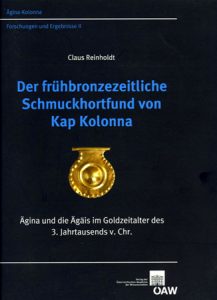
The jewellery hoard excavated under the floor of an Early Bronze Age house-unit in the prehistoric settlement of Cape Kolonna/Aigina represents in many ways an exceptional collection still unique in the central Aegean of the late third millenium B.C. The material consists of precious metals (gold, silver) and several nonmetallic valuable objects (carnalian, rock-crystal, frit) and belongs to a secondary hoard of pins, pendants and beads, partly bent for the deposit context (pins).
Thessaloniki
2009

The journal Anaskamma is published by the Emeritus Professor G.H. Hourmouziadis (Aristotle University of Thessaloniki, Greece). The articles are written in Greek and most of them refer to the excavations at the Neolithic Lake dwelling of Dispilio (Macedonia).
Cathy Gere
Chicago
2009
 In the spring of 1900, British archaeologist Arthur Evans began to excavate the palace of Knossos on Crete, bringing ancient Greek legends to life just as a new century dawned amid far-reaching questions about human history, art, and culture. Over the next three decades, Evans engaged in an unprecedented reconstruction project, creating a complex of concrete buildings on the site that owed at least as much to modernist architecture as it did to Bronze Age remains.
Edited by Colin F. Macdonald, Erik Hallager & Wolf-Dietrich Niemeier
Athens
2009
 The two-day seminar, which took place on 22-23 January 2005 at the German Archaeological Institute at Athens, gathered archaeologists of the Aegean (Greek, Turkish and other nationalities) who were involved in publishing material from sites that displayed evidence for a greater or lesser ‘Minoan presence’.
Edited by Iris Tzachili
Athens
2008
 The jigsaw puzzle of the metallurgy and metalworking of the Aegean is slowly being completed. It is being filled in by new finds, new methods, and analyses that point to new possibilities. The pieces of the puzzle are still difficult to assemble: our knowledge is frequently fragmented, both geographically and chronologically.
Athens
2007
![PHAROS. Journal of the Netherlands Institute in Athens Volume XV, 2007 [2009]](https://www.aegeussociety.org/wp-content/uploads/2010/01/PHAROS_XV-213x300.jpg) This is the fifteenth volume of the journal PHAROS published by the Netherlands Institute in Athens. The articles focus on work conducted in Greece by the Netherlands Institute in Athens and the Belgian School at Athens. Most of the articles of this volume are of prehistoric interest.
This is the fifteenth volume of the journal PHAROS published by the Netherlands Institute in Athens. The articles focus on work conducted in Greece by the Netherlands Institute in Athens and the Belgian School at Athens. Most of the articles of this volume are of prehistoric interest.
Peter Soar
Cambridge
2009
 Theodore Fyfe (1875-1945) is widely known as Arthur Evans’s architect during the first five excavating seasons at the Palace of Knossos (1900-1904). From 1904 onwards Fyfe was working mainly for John James Burnet at the British Museum. From 1922 until 1936, he was Director of the Cambridge School of Architecture; and from 1926 until his retirement in 1941 he was University Lecturer in Architecture.
Leslie Preston Day, Nancy L. Klein & Lee Ann Turner contributions by Heidi Dierckx, Kimberly Flint-Hamilton, Geraldine C. Gesell, David S. Reese, and Lynn Snyder
Philadelphia, Pa.
2009
 This volume is the second in the series of final reports on the work of the Kavousi Project and the first volume on the cleaning (1982–1984) and excavations (1987–1992) at the mountain sites located above the modern village of Kavousi in eastern Crete. These sites, Vronda and the Kastro, shed light on the Early Iron Age, the transitional period in Cretan history known popularly as the Dark Ages, thereby elucidating the way of life of the people who lived in the area of Kavousi during that period and how their culture changed over time.
Edited by Christos Loucos, Napoleon Xifaras & Kleanthi Pateraki
Rethymnon
2009
 The volume brings together a series of papers in honour of Professor Nikolaos Faraklas, on the occasion of his retirement from the University of Crete. The papers (in Greek) are written by colleagues and former students. Some of the papers cover prehistoric issues.
Edited by Garyfalia Arvanitou-Metallinou
Corfu
2007

Corfu is most notably known for the important role it has played in the sea routes to the West since the 8th century B.C.; over the past decades, excavation finds have helped analyse its presence, both materially as well as institutio¬nally. Until recently, prehistoric research in the island has been led exclusively by professor Augustus Sordinas.
Constantinos Paschalidis, with a contribution by P.J.P. McGeorge
Oxford
2009
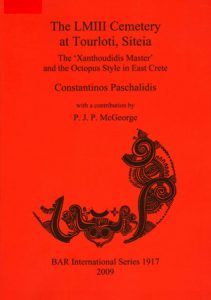 Halfway along the mountainous route between the Ierapetra isthmus and Siteia, on the northern limits of the western mountain range of the Siteia province (eastern Crete), is the small village of Tourloti. Approximately 2.5 kilometres north of the village, on the hillside that drops down to the beach at Mochlos, on the site of Plakalona, is a LMIII chamber tomb cemetery. Richard B. Seager was the first to identify and excavate the site in 1900.
Edited by Christos Doumas
Athens
2008
 The book publishes the Proceedings of the conference Akrotiri Thera. Thirty years of research (1967-1997), that took place in Athens on 19-20 December 1997. The papers written in Greek are divided into seven parts: Production and measurement systems, diet, storage, art, ideology, external relations, and modern technology.
Edited by Vassilis Aravantinos
Athens
2008
 The Proceedings of the 4th International Congress on Boeotian studies (held in Livadia on 9-12 September 2000) are presented in two volumes of almost 2000 pages. The first volume focuses on the archaeology and topography of Boeotia, while the second one on philological, historical and ethnographical issues. The articles are written in several languages (mostly in Greek). Ten articles of the first volume are of prehistoric interest, most of them regarding the Cadmea.
E. Protonotariou-Deilaki (edited by Helen Morou-Kapokaki)
Athens
2009
 The book is a posthumous publication of the Ph.D. dissertation of Evaggelia Protonotariou-Deilaki (†2002) (submitted in 1980 at the University of Athens). The publication, edited by Helen Morou-Kapokaki, was based on photographic material that was found in Deilaki’s archive donated by her daughter Maria to the Ephorate of Palaeoanthropology and Speleology of Southern Greece. The dissertation focuses on Middle and Late Helladic cemeteries that were excavated by Protonotariou-Deilaki in Argos during the 1970s. The cemeteries according to the author were tumuli. The book includes unknown and precious photographs.
Edited by Chara Papadatou-Giannopoulou
Patra
2008
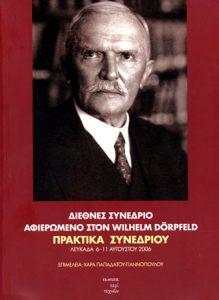
The book publishes the Proceedings of an International Congress devoted to the German archaeologist Wilhelm Dörpfeld (1853-1940) that took place on the island of Lefkada in August 2006. The 26 papers written in Greek, German and English are divided into two parts. The first part focuses on the life and work of Dörpfeld, while the second one on the Homeric Ithaca. The book also contains an article on a Mycenaean beehive tomb found recently on Lefkada (see appendix).
