ARTICLES | 2016
I. Christodoulakis, C. Athanassas, Y. Bassiakos & C. Varotsos
In E. Photos-Jones, Y. Bassiakos, E. Filippaki, A. Hein, I. Karatasios, V. Kilikoglou & E. Kouloumpi (eds), 2016. Proceedings of the 6th Symposium of the Hellenic Society for Archaeometry (Bar International Series 2780), Oxford: 175-178.
Here, we attempt a comparison of the results achieved by both methods. The new luminescence ages estimated for littoral sediments allowed us to re-assess the eustatic, isostatic and tectonic changes during the aforementioned period of geological time. In addition, for the first time, we consider the contribution of airborne dust transferred from distant areas to the local sedimentary record with the intention of reconstructing patterns of atmospheric circulation over the Late Quaternary.
E. D. Chiotis
In E. Photos-Jones, Y. Bassiakos, E. Filippaki, A. Hein, I. Karatasios, V. Kilikoglou & E. Kouloumpi (eds), 2016. Proceedings of the 6th Symposium of the Hellenic Society for Archaeometry (Bar International Series 2780), Oxford: 161-166.
Read the article
he effect of the mid-Holocene sea level highstand is confirmed as a contributing factor in the formation of the Piraeus early island, as narrated by Strabo, roughly in the period between 6000 and 5000 years before present. Meandering of the Kifissos River resulted in the formation of oxbow lakes which can be traced on modem topographic maps as closed depressions. A meander of the Kifissos River is delineated which flooded ancient sites in the 5th century BC near Plato’s Academy and he indicates that the statesman of Athens Cimon “converted the Academy from a waterless and arid spot into a well-watered grove” by digging channels for watering from this meander.
Christos Doumas
Athens
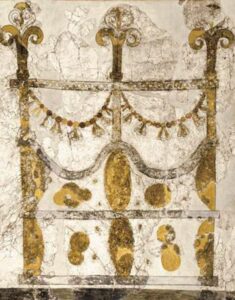 The mercantile transactions of the Theran seafarers with the Mediterranean and the world of the East brought great wealth, evidenced by the monumental public and private buildings that graced the city, and contributed to the burgeoning of figurative art focused on man and his environment. But what makes Akrotiri unique in the world is its wall-paintings. For this reason, readers of the book Prehistoric Thera will enjoy an exclusive privilege, as presented in its pages, for the first time, are restored mural paintings and pottery which are not exhibited in the Museum of Prehistoric Thera.
Margaretha Kramer-Hajos
New York
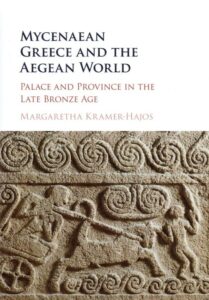 Drawing on network and agency theory, two current and highly effective methodologies in prehistoric Mediterranean archaeology, Kramer-Hajos argues that the Euboean Gulf region thrived when it was part of a decentralized coastal and maritime network, and declined when it was incorporated in a highly centralized mainland-looking network. Her research and analysis contributes new insights to our understanding of the mechanics and complexity of the Bronze Age Aegean collapse.
Kennell, S. A.
Archaeologia Austriaca 100 (2016): 315-320
Kennell, S. A., Review of: C. Thanos & W. Arentzen, Without Having Seen the Queen: The 1846 European Travel Journal of Heinrich Schliemann: A Transcription and Annotated Translation (Leiden 2012), Archaeologia Austriaca 100 (2016): 315-320.
Rutter, J. B.
Archaeologia Austriaca 100 (2016): 288-291
Rutter, J. B., Review of: P. Pavúk, Troia VI Früh und Mitte: Keramik, Stratigraphie, Chronologie, Studia Troica. Monographien 3 (Bonn 2014), Archaeologia Austriaca 100 (2016): 288-291.
Jung, R.
Archaeologia Austriaca 100 (2016): 281-287
Jung, R., Review of: R. Jones, S. T. Levi, M. Bettelli & L. Vagnetti, Italo-Mycenaean Pottery: The Archaeological and Archaeometric Dimensions (Rome 2014), Archaeologia Austriaca 100 (2016): 281-287.
I. Liritzis, Z. Jin, A. Fan, A. Sideris & A. Drivaliari
Mediterranean Archaeology & Archaeometry 16.3 (2016): 245-250
Read the article
An initial archaeological reconnaissance of the partially looted site has produced some indication of use during late Helladic and later periods. Our four ages by luminescence and C-14 have shown that this site was used initially in Late Helladic period, and reused during the Middle Geometric, the Early Archaic and the Classical periods.
A. Sampson, J. K. Kozlowski & M. Kaczanowska
Mediterranean Archaeology & Archaeometry 16.3 (2016): 229-243
Read the article
Recent research at Areta in the northern side of Chalki Island (Dodecanese) has revealed an enormous quantity of lithics of the Mesolithic period. It is the first time that such an old settlement is located in the area of the Dodecanese, thus extending to the southeast of the Aegean the already known Mesolithic network of sites and creating a sea route from Cyclades to Dodecanese.
Edited by Metaxia Tsipopoulou
Philadelphia, Pennsylvania
 This volume is the first of two that represent the final publication of Sector I of the Prepalatial to Postpalatial Minoan urban settlement and palace of Petras, Siteia, located in eastern Crete, and it presents the results of the excavations conducted there from 1985 to 2000.
Individual chapters focus on the architecture (Tsipopoulou), cooking wares (Alberti), Early Minoan (EM) and Middle Minoan (MM) I pottery (Relaki), a unique example of an EM–MM amphora stamped with a seal prior to firing (Krzyszkowska), numerous miniature vessels and figurines (Simandiraki-Grimshaw), and a study of vessels (primarily Neopalatial) with potter’s marks (Tsipopoulou).
This volume is the first of two that represent the final publication of Sector I of the Prepalatial to Postpalatial Minoan urban settlement and palace of Petras, Siteia, located in eastern Crete, and it presents the results of the excavations conducted there from 1985 to 2000.
Individual chapters focus on the architecture (Tsipopoulou), cooking wares (Alberti), Early Minoan (EM) and Middle Minoan (MM) I pottery (Relaki), a unique example of an EM–MM amphora stamped with a seal prior to firing (Krzyszkowska), numerous miniature vessels and figurines (Simandiraki-Grimshaw), and a study of vessels (primarily Neopalatial) with potter’s marks (Tsipopoulou).
Edited by Eva Alram-Stern, Fritz Blakolmer, Sigrid Deger-Jalkotzy, Robert Laffineur & Jörg Weilhartner
Leuven-Liege
 At the METAPHYSIS conference a large range of issues of ritual, myth and symbolism in the Aegean Bronze Age were addressed, such as ritual places and ritual landscapes, sacral and sepulchral rituals, social and political ceremonies, ritual acts and performances, the supernatural realm, liminality, irrationality and magic, mythology, hybrid creatures, heroes/heroines, divinities, symbols, emblems and iconography, images of power, and cosmology. Thus, META-PHYSIS was dedicated to the complex relationship between humans and ‘the other’ - the broad scholarly interface between a popular ritual belief and the cult of deities, i.e. religion in its proper sense.
Giorgos Papantoniou
Journal of Greek Archaeology 1 (2016): 73-108
I will first try to identify evidence of ritual and cult at the ‘extra-urban’ sanctuary site of Agia Irini (Figure 1) before attempting to establish their connections with the Late Cypriot ritual system of the urban center of Enkomi. I will then focus on the transformations that the cult of the ‘Cypriot Goddess’ underwent from the Late Cypriot to the Early Iron Age in an effort to emphasize the importance that this cult acquired in the later Iron Age, that is, the Cypro-Archaic and the Cypro-Classical periods. I will finally turn to the Iron Age polity of Amathous, endeavoring to detect connections with (and embodiments of) an indigenous Late Cypriot past.
Kristin E. Leith
Journal of Greek Archaeology 1 (2016): 45-72
By analysing weaponry distribution and inclusion practices within the highly elite context of the Shaft Graves (active 1700-1450 BC), this paper highlights the inventive nature of elite early Mycenaean burial practice and also explores the possible ‘anomaly’ of a female warrior burial. It argues that the expression of elite Mycenaean warrior ideology was more fluid and inclusive than has been previously assumed, and that a model of gendered domaining is not only limiting, but obscures the creative, ‘work-in-progress’ approach to male and female distinction and differentiation in the Shaft Graves.
John Bintliff
Journal of Greek Archaeology 1 (2016): 33-44
This article focusses on one of the author's favourite landscapes, the Plain of Argos, and his involvement with its Bronze Age landscape over a period of more than forty years.
Nena Galanidou, Giorgos Iliopoulos & Christina Papoulia
Journal of Greek Archaeology 1 (2016): 1-32
In this paper we place the Island of Lefkas in the central Ionian Sea under the spotlight to examine the lithic assemblages recovered by A. Dousougli and K. Zachos from five open-air sites: Karyotes, Cape Doukato, Tsoukalades, Englouvi and Marantochori. We use observations on raw materials, production technology and typology to present a comprehensive account of the core reduction strategies and the tools recovered, and to place the finds in a Palaeolithic timeline.
