Edited by Jorrit M. Kelder & Willemijn J. I. WaalLeiden2019
In this book the much-debated problem of political organization in Mycenaean Greece (ca. 1400-1200 BC) is analysed and contextualised through the prism of archaeology and contemporary textual (Linear B, Egyptian and Hittite) evidence.
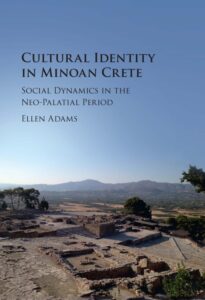
Neopalatial Crete - the 'Golden Age' of the Minoan Civilization - possessed palaces, exquisite artefacts, and iconography with pre-eminent females. While lacking in fortifications, ritual symbolism cloaked the island, an elaborate bureaucracy logged transactions, and massive storage areas enabled the redistribution of goods.
Edited by Philippa M. SteeleOxford & Philadelphia2017
Understanding Relations Between Scripts: The Aegean Writing Systems arises from a conference held in Cambridge in 2015. The question of how writing systems are related to each other, and how we can study those relationships, has not been studied in detail and this volume aims to fill a gap in scholarship by presenting a number of case studies focused on the writing systems of the Bronze Age Aegean.
Late Bronze Age Aegean cooking vessels illuminate prehistoric cultures, foodways, social interactions, and communication systems. While many scholars have focused on the utility of painted fineware vessels for chronological purposes, the contributors to this volume maintain that cooking wares have the potential to answer not only chronological but also economic, political, and social questions when analysed and contrasted with assemblages from different sites or chronological periods.
This book examines pottery assemblages from MBA levels at Akrotiri, Thera and related stratigraphy. The first volume includes an overview of relevant evidence in the Cyclades, sections on Akrotiri stratig-raphy and chronology, the typology and iconography of local and imported pottery, fabric analysis and manufacture technology, as well as a section on ceramic weaving equipment and an inscribed loom-weight.
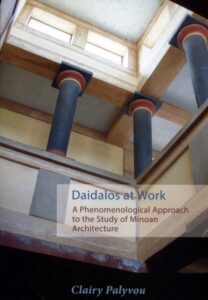
The Bronze Age was a time of affluence and innovation for Crete, a unique "moment" in the early history of architecture that, in a bizarre way, seems to echo the formative years of the Modern world of the 20th century AD. The mythical Daidalos, with his many attributes and tasks, stands for the prototpye of “an architect at work” following orders and desires set by his clients and by society.
Edited by Christina Souyoudzoglou-Haywood & Aidan O’SullivanOxford2019
Experimental Archaeology: Making, Understanding, Story-telling is based on the proceedings of a two-day workshop on experimental archaeology at the Irish Institute of Hellenic Studies at Athens in 2017, in collaboration with UCD Centre for Experimental Archaeology and Material Culture. Scholars, artists and craftspeople explore how people in the past made things, used and discarded them, from prehistory to the Middle Ages.
H μελέτη αυτή φωτίζει όψεις της θρησκείας σε μια από τις πιο σημαντικές περιόδους της αιγαιακής προϊστορίας. Εδώ τα συνεχώς εμπλουτισμένα αρχαιολογικά στοιχεία υποδεικνύουν σύνθετες διεργασίες σε έναν ευρύ γεωγραφικό χώρο. Αξιοποιώντας το σύνολο του διαθέσιμου αρχαιολογικού υλικού από ήδη γνωστές και από νέες θέσεις, η συγγραφέας διερευνά την εξέλιξη και τις αλλαγές που σημειώθηκαν στη θρησκευτική οργάνωση και τη συμπεριφορά των Μυκηναίων μεταξύ του 14ου και του 12ου αιώνα π.Χ.
Edited by Yannis Galanakis, Anastasia Christophilopoulou & James GrimeCambridge2017
Secret texts and secret writing have an age-old fascination. In this hook two stories are told: of the people who worked on breaking vital codes in the Second World War and those who deciphered the Linear B script – Europe’s earliest comprehensible writing system. Here experts in the fields of Mycenaean epigraphy and the study of the Aegean Bronze Age join with fellow specialists in mathematics, cryptography and the history of computer.
This book presents the publication of Building 1, the first building we excavated (in the years 1986-89) and surely once the finest in its day. It is not the first volume in the series, and indeed follows the publication of the partially excavated Building 2, and Block M/Building 6.
Although architecture provides a decisive framework for many forms of social interaction, thus preconfiguring them, and simultaneously represents an expression and hence a product of social conventions, few connections have thus far been made between the scholarly study of architecture and the social history of Mycenaean Greece.
Die mykenische Kultur gilt als erste Hochkultur auf dem europäischen Festland. Auf der griechischen Halbinsel Peloponnes und in Mittelgriechenland erlebte sie ihren Höhepunkt zwischen 1600 und 1200 v. Chr. Heinrich Schliemann entdeckte ab 1874 durch seine Ausgrabungen in Mykene, Tiryns und Orchomenos diese prähistorische Kultur.
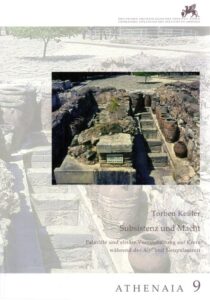
Die minoischen Paläste waren multifunktionale Zentren, denen auch in wirtschaftlicher Hinsicht eine grundlegende Bedeutung zukam. Der Begriff der Redistribution war bisher prägend zur Beschreibung der minoischen Wirtschaft: Man ging davon aus, dass Güter an zentraler Stelle gesammelt und sodann an die Bevölkerung zurückverteilt wurden – auch Grundnahrungsmittel.
Edited by Jack L. Davis & John BennetPrinceton2017
This volume represents the product of 25 years of study conducted by the Pylos Regional Archaeological Project, a multidisciplinary, diachronic archaeological expedition formally organized in 1990 to investigate the history of prehistoric and historic settlement in western Messenia in Greece.
Bodies of Maize, Eaters of Grain provides a comparative study of the earliest urban civilizations of the Maya lowlands and the Greek mainland. It builds upon earlier comparative studies by Gordon Childe, Robert Adams and Bruce Trigger, extending their work into new directions. Specifically, the focus lies on the art styles of the Late Preclassic lowland Maya and Mycenaean Greece.