ADVANCED SEARCH +

Aegeus Society For Aegean Prehistory

BOOK REVIEWS | 2010

Salomon Reinach and the religious interpretation of Palaeolithic art

Antiquity 84 (September 2010): 853–863.

When did upper Palaeolithic cave art come to be thought of as religious? The author shows an origin rooted in the intellectual movements of the later nineteenth century, and in particular in the personage and thought of Salomon Reinach.

A source in Bulgaria for Early Neolithic ‘Balkan flint’

Antiquity 84 (September 2010): webpage.

During a study trip in the Lower Danube Valley in the summer of 2009, we crossed the western part of the Moesian Platform, along a route partly following the Iskar River Valley, which brought us to the Danube throughout Pleven and Nikopol. Here, along the road that runs parallel to the Zass’idere torrent, close to its confluence with the Danube at the southern outskirts of Nikopol, we noticed that the cutting of the earth road along the slopes of Ali Kach Baba hill had exposed a white chalk formation (Upper Cretaceous) with several embedded seams of flint nodules.

Neolithic anthropocentrism: the principles of imagery and symbolic manifestation of corporeality in the Balkans

Documenta Praehistorica XXXVII (2010): 227-238.

The body in the Neolithic was used as adequate symbolic medium which on the one hand strengthened the crucial features of individuals, while on the other was capable to explicate the essential function of particular objects and constructions. As result to this also the concept of imagery hybridism was deployed which incorporate human body within more complex segments of visual culture and symbolic communication.

The Neolithic–Chalcolithic sequence in the SW Anatolian Lakes Region

Documenta Praehistorica XXXVII (2010): 269-284.

This paper reviews the radiocarbon, stratigraphic and pottery evidence from five early pottery sites in SW Turkey. A comparison of the results with data from Ulucak in West Turkey indicates no significant time lag between these areas. The onset of Neolithic sites early in the 7th millennium calBC makes it difficult to link their emergence to the collapse theories applied to SE Anatolian societies at the end of the PPNB period. The chronology proposed is not compatible with allegedly contemporary developments in SE Europe.

The manipulation of death: a burial area at the Neolithic Settlement of Avgi, NW Greece

Documenta Praehistorica XXXVII (2010): 95-104.

In the Neolithic of Northern Greece the disposal of the deceased is strongly related to the community of the living, and in most cases to the built environment. Burials often occur in close proximity to, or underneath ‘domestic’ structures. The constant association of dead ancestors with the living social environment may indicate a particular desire by Neolithic people to negotiate their past by incorporating it into their own present.

The representation of phalli in Neolithic Thessaly, Greece

Documenta Praehistorica XXXVII (2010): 215-226.

This paper is an attempt to elucidate a rather understudied aspect of Neolithic imagery from Thessaly, Greece, objects representing phalli, and at the same time to consider the possibility that gender was not a prominent structuring principle in the past, allowing for the fact that phalli did not elicit a pervasive binary categorization of bodies, but instead were invoked in specific circumstances with particular objectives.

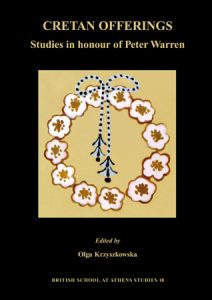
Cretan Offerings: Studies in Honour of Peter Warren

London

Cretan Offerings: Studies in Honour of Peter Warren In recognition of the outstanding contribution made by Peter Warren to Aegean archaeology — and in particular to Cretan studies — this volume offers a collection of 36 papers reflecting his wide-ranging research interests. Among the topics addressed are material culture and iconography, including frescoes, pottery, seals and stone vases; chronology, inter-site relationships, overseas connections and religion; Knossos and the legacy of Sir Arthur Evans;

The use of SEM-EDS, PIXE and EDXRF for obsidian provenance studies in the Near East: a case study from Neolithic Çatalhöyük (central Anatolia)

Journal of Archaeological Science 37.11 (November 2010): 2705-2720.

In this paper we evaluate the relative analytical capabilities of SEM-EDS, PIXE and EDXRF for characterizing archaeologically significant Anatolian obsidians on the basis of their elemental compositions. The study involves 54 geological samples from various sources, together with an archaeological case study involving 100 artifacts from Neolithic Çatalhöyük (central Anatolia).

Archaeobotanical inference of Bronze Age land use and land cover in the eastern Mediterranean

Journal of Archaeological Science 37.10 (October 2010): 2622-2629.

Charcoal and charred seeds at five Bronze Age archaeological sites discern ancient land use in the eastern Mediterranean. Seed frequencies of orchard crops, annual cereals and pulses, and wild or weedy plants are used to characterize plant utilization at different archaeological sites on the island of Cyprus, in the Rift Valley of Jordan, and in the Jabbul Plain and along the upper Euphrates River valley in Syria.

Lead pigments and related tools at Akrotiri, Thera, Greece. Provenance and application techniques

Journal of Archaeological Science 37.8 (August 2010): 1830-1840.

This paper refers to an investigation of finds that are associated with the raw materials and tools for the preparation or use of lead pigments at Akrotiri on Thera, Greece, during the Early, Middle and Late Cycladic Bronze Age (c. 3000–1600 BC). For the detection and the preliminary characterisation of remains of pigments that were found on stone tools, the in situ application of X-Ray Fluorescence spectroscopy proved to be invaluable.

Tell formation processes as indicated from geoarchaeological and geochemical investigations at Xeropolis, Euboea, Greece

Journal of Archaeological Science 37.7 (July 2010): 1564-1571.

Xeropolis is a tell site on the island of Euboea, Greece just to the east of the village of Lefkandi, and was occupied from the Early Bronze Age to the Early Iron Age. Excavations in recent years have provided an opportunity to investigate site formation processes using geoarchaeological and geochemical techniques.

Arsenic accumulation on the bones in the Early Bronze Age İkiztepe population, Turkey

Journal of Archaeological Science 37.5 (May 2010): 1033-1041.

In this study, arsenic, copper and lead content of a group of human and animal bones recovered from the Early Bronze Age İkiztepe site have been analyzed using ICP-MS method. Average arsenic value of 90 femur bones of a human was found to be 15.0 ± 5.79 ppm which was varied among age and sex groups, and among species. Origin of arsenic accumulation in bones was diagenetic because overall the groups were highly variable.

Strofilas (Andros Island, Greece): New evidence for the Cycladic Final Neolithic period through novel dating methods using luminescence and obsidian hydration

Journal of Archaeological Science 37.6 (June 2010): 1367-1377.

The recently excavated coastal prehistoric settlement of Strofilas on Andros Island (Cyclades, Greece) in the Aegean sheds new light on the transitional phase from the Final Neolithic to Early Cycladic period regarding masonry, fortification, and richly engraved rock art. The fortification possesses early evidence of preserved defensive architecture, as evidenced from the plethora of scattered finds from within and around the settlement. Important features are carvings on rock walls which mainly depict ships, animals, and fish.