
ARTICLES | 2010
Review of Becoming Human: Innovation in Prehistoric Material and Spiritual Culture
American Journal of Archaeology
Coward, F., 2010. Online review of C. Renfrew & I. Morley (eds), Becoming Human: Innovation in Prehistoric Material and Spiritual Culture (Cambridge 2009), American Journal of Archaeology 114.4 (October).
Review of The Cambridge Companion to the Aegean Bronze Age
American Journal of Archaeology
Moody, J., 2010. Online review of C.W. Shelmerdine (ed.), The Cambridge Companion to the Aegean Bronze Age (New York 2008), American Journal of Archaeology 114.4 (October).
Review of Aegyptiaca on the Island of Crete in Their Chronological Context: A Critical Review
American Journal of Archaeology
Cline, E.H., 2010. Online review of J. Phillips, Aegyptiaca on the Island of Crete in Their Chronological Context: A Critical Review (2 vols) (Vienna 2008), American Journal of Archaeology 114.4 (October).
Review of The LMIII Cemetery at Tourloti, Siteia: The “Xanthoudias Master” and the Octopus Style in East Crete
American Journal of Archaeology
Rutter, J.B., 2010. Online review of C. Paschalidis, The LMIII Cemetery at Tourloti, Siteia: The “Xanthoudias Master” and the Octopus Style in East Crete (Oxford 2009), American Journal of Archaeology 114.4 (October).
Review of Terracotta Statues and Figurines of Cypriote Type Found in the Aegean: Provenance Studies
American Journal of Archaeology
Fourrier, S., 2010. Online review of V. Karageorghis, N. Kourou, V. Kilikoglou & M.D. Glascock (eds), Terracotta Statues and Figurines of Cypriote Type Found in the Aegean: Provenance Studies (Nicosia 2009), American Journal of Archaeology 114.4 (October).
Shells from Sarepta (Lebanon) and East Mediterranean purple-dye production
Mediterranean Archaeology & Archaeometry 10.1 (2010): 113-141.
This paper concerns the shells from the 1969-74 excavations at Sarepta (Lebanon) under the direction of the late J.B. Pritchard (University of Pennsylvania). Most of the 500 marine shells, ranging in date from the LB I to Roman/Byzantine, are typical Mediterranean forms.Isotopic evidence for the primary production, provenance and trade of Late Bronze Age glass in the Mediterranean
Mediterranean Archaeology & Archaeometry 10.1 (2010): 1-24.
The earliest known man made glass comes from Mesopotamia and dates to the 23rd century BC. By the 16th century BC the first glass vessels appear in Mesopotamia, but the earliest evidence for the fusion of glass from raw materials has been found at the 13th century BC Egyptian site of Qantir.Flexible Stones. Ground Stone Tools from Franchthi Cave
Bloomington & Indianapolis
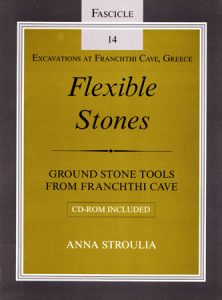
Despite their ubiquitous presence among prehistoric remains in Greece, ground stone tools have yet to attract the same kind of attention as have other categories of archaeological material, such as pottery or lithics. As a consequence of this oversight the potential for this material to illuminate aspects of prehistoric life remains unexplored.
Models of relatedness and Early Helladic architecture: Unpacking the Early Helladic II hearth room
Journal of Mediterranean Archaeology 23.2 (2010): 245-264.
This paper brings forward a particular architectural arrangement—the room with the central hearth—that becomes popular on the Greek mainland in Early Helladic II, in order to refocus analysis of the relationship between architecture and models of social organization proposed for this period.The Minoan ‘Palace-Temple’ reconsidered: A Critical assessment of the spatial concentration of political, religious and economic power in Bronze Age Crete
Journal of Mediterranean Archaeology 23.2 (2010): 219-243.
Although aspects of Arthur Evans’s vision of Minoan society have undergone modification during the course of the 20th century, his basic interpretation of the monumental building complex with courts at Knossos as a Palace-Temple, or the residence of both a political and religious authority, remains the dominant paradigm in Minoan archaeology.Moni Odigitria: A Prepalatial Cemetery and Its Environs in the Asterousia, Southern Crete
Philadelphia, Pennsylvania
Death management & Virtual Pursuits: A Virtual Reconstruction of the Minoan Cemetery at Phourni, Archanes
Oxford
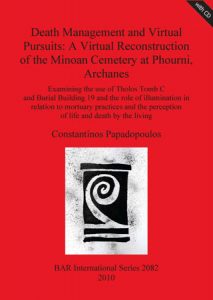
In the striking event of death, each community produces rituals, not explicitly or exclusively of a funerary nature. This is done in order to maintain both its stability and integrity, while incorporating the living into a fixed system of culturally defined roles and statuses.
Review of Egypt and Cyprus in Antiquity: Proceedings of the International Conference, Nicosia 2003
Journal of Ancient Egyptian Interconnections
Wilkinson, R.H. & Schon, R., 2010. Review of D. Michaelides, V. Kassianidou & R.S. Merrillees (eds), Egypt and Cyprus in Antiquity: Proceedings of the International Conference, Nicosia 2003 (Oxford 2009), Journal of Ancient Egyptian Interconnections 2.3: 50-51.
Review of Aegyptiaca on the Island of Crete in their Chronological Context: A Critical Review
Journal of Ancient Egyptian Interconnections
Wilkinson, R.H. & Schon, R., 2010. Review of J. Phillips, Aegyptiaca on the Island of Crete in Their Chronological Context: A Critical Review (Vienna 2008), Journal of Ancient Egyptian Interconnections 2.2: 27-28.