ARTICLES | 2010
Patrick Quinn, Peter Day, Vassilis Kilikoglou, Edward Faber, Stella Katsarou-Tzeveleki & Adamantios Sampson
Journal of Archaeological Science 37.5 (May 2010): 1042-1052.
Combined petrographic and chemical analysis of MN and LN ceramics from the Cave of the Cyclops on the island of Youra, Greece, has revealed a compositionally diverse assemblage with a range of different local and off-island sources. Ceramics deposited in Neolithic times on this barren, rocky outpost of the Sporades chain may have originated from a surprising number of possible origins, including from the Plain of Thessaly, Euboea and the volcanic northeast Aegean islands.
Eric Fouache, Stéphane Desruelles, Michel Magny, Amandine Bordon, Cécile Oberweiler, Céline Coussot, Gilles Touchais, Petrika Lera, Anne-Marie Lézine, Lionel Fadin & Rébecca Roger
Journal of Archaeological Science 37.3 (March 2010): 525-535.
Since the early 1990s, excavations of a protohistoric lakeside settlement in the Korça basin carried out by a French–Albanian archaeological team have induced geomorphological and palynological studies about the sedimentary records of Lake Maliq. These studies allow us to distinguish a series of centennial-scale high and low lake level events between 4200 and 4000 cal BP (2899–2637 BC/2843–2416 BC) and 2600 cal BP (822–671 BC), probably due to large-scale climate changes (in the Mediterranean basin). In addition, the sediment sequence also gives evidence of a millennial-scale trend of lake level rise. It appears to be an interplay between lake level rises and falls against tectonic subsidence of the basin allowing accommodation space for sediment deposition.
R.G.V. Hancock & Tristan Carter
Journal of Archaeological Science 37.2 (February 2010): 243-250.
To assess the analytical accuracies and precisions of archaeometric elemental analyses by different techniques, a relatively homogeneous material such as obsidian must be studied. An assessment of published elemental concentration data from two Anatolian obsidian sources shows that while in most cases analytical accuracy is as high as is commonly expected, in some cases it is not.
Edited by Anna Philippa-Touchais, Gilles Touchais, Sofia Voutsaki & James Wright
Athens
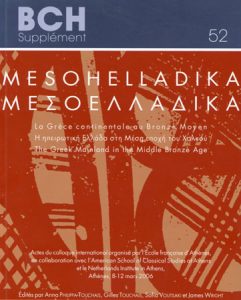 During the first half of the 2nd millennium BC, as the first palaces appear in Crete and the Minoan civilisation is flourishing, the Greek mainland goes through what is considered a period of stagnation, it not decline and social regression: the Middle Helladic period. The Middle Bronze Age in the Greek mainland has received very little attention, perhaps because of the relative austerity of the material culture and the absence of overt social differentiation.
Letesson, Q.
Bryn Mawr Classical Review
Letesson, Q., 2010. Online review of J.W. Shaw, Minoan Architecture: Materials and Techniques. Studi di archeologia cretese (Padova: Bottega d’Erasmo, 2009), Bryn Mawr Classical Review 2010.08.48.
Read the book review
Nakassis, D.
Bryn Mawr Classical Review
Nakassis, D., 2010. Online review of F. Rougemont, Contrôle économique et administration à l’époque des palais mycéniens (fin du IIe millénaire av. J.-C.) (Athènes: École française d’Athènes, 2009), Bryn Mawr Classical Review 2010.09.14.
Read the book review
Irwin, D.T.
Bryn Mawr Classical Review
Irwin, D.T., 2010. Online review of P.P. Betancourt & C. Davaras, Pseira X: The Excavation of Block AF (Philadelphia: 2009), Bryn Mawr Classical Review 2010.07.54.
Read the book review
Cummings, C.
Bryn Mawr Classical Review
Cummings, C., 2010. Online review of Y. Tzedakis, H. Martlew & M.K. Jones (eds), Archaeology Meets Science: Biomolecular Investigations in Bronze Age Greece: The Primary Scientific Evidence, 1997-2003 (Oxford: Oxbow Books, 2008), Bryn Mawr Classical Review 2010-10-70.
Read the book review
Magnani, M.
Bryn Mawr Classical Review
Magnani, M., 2010. Online review of S. Heilen, In pursuit of Wissenschaft: Festschrift für William M. Calder III zum 75. Geburtstag (Hildesheim/New York: 2008), Bryn Mawr Classical Review 2010.01.13.
Read the book review
Kennell, S.A.H.
Bryn Mawr Classical Review
Kennell, S.A.H., 2010. Online review of R.D. Morritt, The Quest: John Morritt, His Travels to Troy, 1794-1796 (Newcastle upon Tyne: 2010), Bryn Mawr Classical Review 2010.07.37.
Read the book review
Edited by Walter Müller
Mainz

The book presents the results of the 6th International Seal Conference, with the title ‘Die Bedeutung der minoischen und mykenischen Glyptik‘. The Conference took place in Marburg (Germany) in October 2008, on the occasion of the 50 years of the Corpus der Minoischen und Mykenischen Siegel. The 33 papers are written in English (23), German (8) and French (2).
Dudley Moore
Oxford
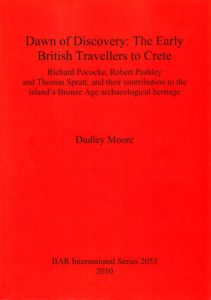 It is intended to focus on three important British travellers to Crete during the 18th and 19th centuries to establish whether or not they wade any significant contribution to the field of research with regard to the archaeological heritage of Bronze Age Crete. It is an attempt to bring these ‘lost pioneers’ of antiquity to the fore and to recognize their efforts as part of the foundation of the discovery of the island’s Bronze Age archaeology prior to the groundbreaking excavations of Sir Arthur Evans. They arc Richard Pococke (1704-65), Robert Pashley (1805-59) and Thomas Spratt (1811-88).
Edited by Michalis Andrianakis & Iris Tzachili
Rethymnon
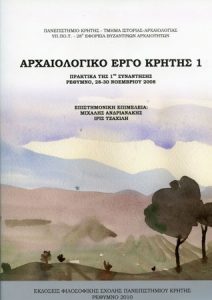
The book publishes the Proceedings of the First “Archaeological Work of Crete”. The Conference took place in November 2008, at the University of Crete (Rethymnon). The numerous papers are divided into 6 sections. The first section presents the work of the offices of the Ministry of Culture, the next four sections focus on the work of the four Prefectures of Crete (Lassithi, Heraklion, Rethymnon and Chania), while the final section includes some general issues.
Edited by Nikolas Papadimitriou, with the collaboration of Zoi Tsirtsoni
Athens
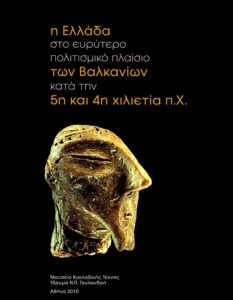 In parallel with the exhibition "The Lost World of Old Europe. The Danube Valley, 5000-3500 BC", the Museum of Cycladic Art, in collaboration with the Hellenic Ministry of Culture and Tourism - General Directorate of Antiquities and Cultural Heritage, is organizing a small presentation of characteristic artifacts from Greek Neolithic sites of the 5th and 4th millennium BC for comparative reasons. This presentation aims at revealing the similarities and the differences that existed between Greece and other regions of SE Europe 7.000 ago, and to exploring developments in Greece within a wider historical and cultural framework.
Edited by David W. Anthony
New York
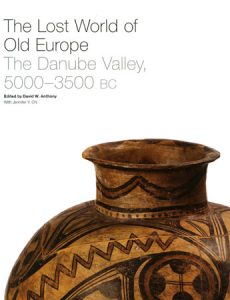
In the prehistoric Copper Age, long before cities, writing, or the invention of the wheel, Old Europe was among the most culturally rich regions in the world. Its inhabitants lived in prosperous agricultural towns. The ubiquitous goddess figurines found in their houses and shrines have triggered intense debates about women's roles. The Lost World of Old Europe is the accompanying catalog for an exhibition at New York University's Institute for the Study of the Ancient World. This superb volume features essays by leading archaeologists as well as breathtaking color photographs cataloguing the objects, some illustrated here for the first time.
