
ARTICLES | 2010
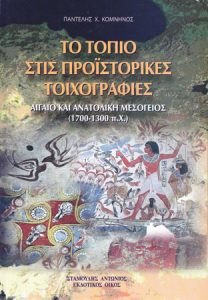
Το τοπίο στις προϊστορικές τοιχογραφίες. Αιγαίο και ανατολική Μεσόγειος (1700-1300 π.Χ.) (The Landscape in Prehistoric Frescoes. Aegean and Eastern Mediterranean, 1700-1300 BC)
Thessaloniki
New evidence on the religious use of Room 67 at Hala Sultan Tekke. A tribute to Paul Åström
Journal of Prehistoric Religion XXII (2010): 57-61.
In 1988, the archaeological team under the direction of Paul Åström unearthed in Area 8 at Hala Sultan Tekke a building complex consisting of five rooms. Room 67 is the main room of this complex. The complex was interpreted as a sanctuary as its plan is considerable to that of sanctuaries at Kition and Enkomi.Trade, politics and religion in the Early Iron Age Aegean: Explaining the sacred island of Delos
Journal of Prehistoric Religion XXII (2010): 39-56.
Delos was a major religious centre in antiquity, yet the origins of this small island’s earliest known cults – those of Apollo, Artemis and Hera – are poorly understood. The author argues that sanctuaries dedicated to these deities developed in the Early Iron Age, mainly in the eighth century BC.Maternity, children, and ‘Mother Goddesses’ in Minoan iconography
Journal of Prehistoric Religion XXII (2010): 7-38.
This article reconsiders both the presence and role of maternal, kourotrophic, and child-oriented iconography in the Minoan repertoire. Contrary to the received wisdom, the only kourotrophic iconography in Minoan Crete is not a Mycenaean-influenced figural group from Mavrospelio cemetery, but a strongly Egyptianizing plaque from Monastiraki.Ἔλαιον εὐῶδες, τεθυωμένον. Τα αρωματικά έλαια και οι πρακτικές χρήσης τους στη μυκηναϊκή Ελλάδα και την αρχαία Εγγύς Ανατολή (Well-scented, Perfume Oil: Perfumed Oils and Practices of Use in Mycenaean Greece and the ancient Near East, 14th-13th cent. BC.)
Chania
The use of oxygen isotopes in sheep molars to investigate past herding practices at the Neolithic settlement of Çatalhöyük, central Anatolia
Archaeometry 52.3 (June 2010): 429–449.
This paper presents a pilot study designed to test the use of oxygen isotopes for investigating aspects of early herding practices in the Neolithic of western Asia, using the site of Çatalhöyük in central Anatolia as a case study. Time-sequenced δ18O values in dental enamel of archaeological sheep are assessed for post-depositional diagenetic effects and compared with seasonal δ18O meteoric water values in the region today. The evidence is used to indicate the environmental conditions in which individual sheep spent their first year, enabling management of breeding and birthing seasons, and movement to seasonal pastures, to be investigated.The Oxford Handbook of the Bronze Age Aegean
Oxford
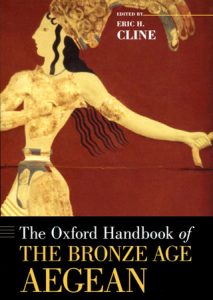
The Greek Bronze Age, roughly 3000 to 1000 BC, witnessed the flourishing of the Minoan and Mycenean civilizations, the earliest expansion of trade in the Aegean and wider Mediterranean Sea, the development of artistic techniques in a variety of media, and the evolution of early Greek religious practices and mythology. The period also witnessed a violent conflict in Asia Minor between warring peoples in the region, a conflict commonly believed to be the historical basis for Homer's Trojan War. The Oxford Handbook of the Bronze Age Aegean provides a detailed survey of these fascinating aspects of the period, and many others, in sixty-six newly commissioned articles.
Review of A Companion to Linear B. Mycenaean Greek Texts and their World
Kratylos
Weilhartner, J., 2010. Review of Y. Duhoux & A. Morpurgo Davies (eds), A Companion to Linear B. Mycenaean Greek Texts and their World, vol. 1 (Louvain-la-Neuve 2008), Kratylos 55: 112-118.
Review of Art and Identity in Dark Age Greece, 1100–700 BCE
Journal of Hellenic Studies
Whitley, J., 2010. Review of S. Langdon, Art and Identity in Dark Age Greece, 1100–700 BCE (Cambridge and New York 2008), Journal of Hellenic Studies 130: 250-251.
Review of The People of Knossos: Prosopographical Studies in the Knossos Linear B Archives
JHS
Nakassis, D., 2010. Review of H. Landenius Enegren, The People of Knossos: Prosopographical Studies in the Knossos Linear B Archives (Uppsala 2008), Journal of Hellenic Studies 130: 249-250.
Review of Early Enkomi: Regionalism, Trade and Society at the Beginning of the Late Bronze Age in Cyprus & Prehistoric and Protohistoric Cyprus
JHS
Reyes, A.T., 2010. Review of L. Crewe, Early Enkomi: Regionalism, Trade and Society at the Beginning of the Late Bronze Age in Cyprus (Oxford 2007) & A.B. Knapp, Prehistoric and Protohistoric Cyprus (Oxford 2008), Journal of Hellenic Studies 130: 247-249.
Review of Aegean Bronze Age Rhyta
JHS
Steel, L., 2010. Review of R.B. Koehl, Aegean Bronze Age Rhyta (Philadelphia 2006), Journal of Hellenic Studies 130: 246-247.
Review of Negotiating Island Identities: the Active Use of Pottery in the Middle and Late Bronze Age Cyclades
JHS
Haysom, M., 2010. Review of I. Berg, Negotiating Island Identities: the Active Use of Pottery in the Middle and Late Bronze Age Cyclades (Piscataway, NJ 2007), Journal of Hellenic Studies 130: 244-246.
Review of The Cambridge Companion to the Aegean Bronze Age
JHS
Adams, E., 2010. Review of C.W. Shelmerdine (ed.), The Cambridge Companion to the Aegean Bronze Age (Cambridge and New York 2008), Journal of Hellenic Studies 130: 243-244.