M. Civitillo, S. Ferrara & T. Meissner (επιμέλεια)Cambridge 2024
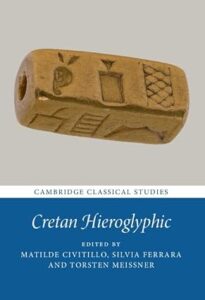
Nearly 4000 years ago a hieroglyphic script was used on Crete which predates Linear A and Linear B, indeed any other writing in Europe, but remains undeciphered since its discovery at the beginning of the twentieth century. This is the first comprehensive account of this script, which is analysed by the leading experts through an array of lenses, including archaeology, philology, palaeography, cognitive studies and decipherment theory, in order to showcase its importance in the history of writing.
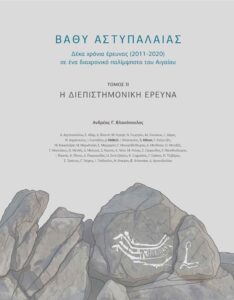
Ο δεύτερος τόμος του έργου Βαθύ Αστυπάλαιας. Δέκα χρόνια έρευνας (2011-2020) σε ένα διαχρονικό παλίμψηστο του Αιγαίου τιτλοφορείται Η Διεπιστημονική Αρχαιολογική Έρευνα. Αυτός αρθρώνεται από τις μεγάλες ενότητες των προ-ανασκαφικών και ανασκαφικών δεδομένων, οι οποίες, μαζί με τις συνθετικές εργασίες που οι συνεργάτες της έρευνας πεδίου καταθέτουν, διαμορφώνουν τα τέσσερα μέρη του βιβλίου που εξετάζουν τις ερευνημένες πτυχές του παλίμψηστου κόλπου και των μνημείων του.
The Lion Gate is an icon, a piece of art more than 3300 years old, representing the glory of Mycenaean Greece. Preserved in situ, it has passed through time and circumstance, witnessing its own civilisation fail and many others flourishing since. Often considered as an emblem for the royal house of Mycenae, it is the only surviving piece of large-scale sculpture of the Greek Bronze Age.
John Bennet, Artemis Karnava & Torsten Meißner (επιμέλεια)Ρέθυμνο2024
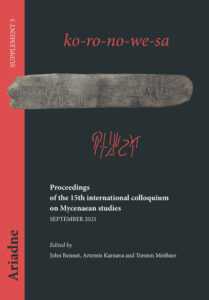
As editors and organisers, we were gratified to note a good number of early- and mid-career scholars among those contributing to this volume, and even more early-career scholars and students had expressed an interest in attending the meeting itself, leaving the editors in no doubt that interest in Mycenaean, and indeed Aegean studies more widely, is unbroken and continues to attract the intellectual attention of rising academics in a large number of disciplines.
Το έργο αυτό αποτελεί συστηματική μελέτη των απαρχών της οίκησης του Ελλαδικού Χώρου, από τις πρωιμότερες διαθέσιμες μαρτυρίες την Μεσολιθική έως και την Πρώιμη Εποχή του Χαλκού (9η - 3η χιλιετία π.Χ.), συνεκτιμώντας ανάλογα δεδομένα από την ευρύτερη Ανατολική Μεσόγειο (κυρίως 14η χιλιετία π.Χ. κ.ε.), Εγγύς Ανατολή, Μεσοποταμία, Ανατολία, Πόντος - Κασπία, Αίγυπτος - Αφρική.
The site of Phylakopi on Melos occupies a special place in the prehistory of the Aegean Bronze Age. The first work there by the British School at Athens in 1896–99 (there were two further campaigns, in 1911 and 1974–77) was memorably described by Carl Blegen as ‘the first really serious effort to understand stratification, the first really good excavation in Greece’. The Field Director, Duncan Mackenzie, kept detailed day-to-day records of the work, later applying methods developed on Melos to the excavation of Knossos.