The Klissoura cave site (Argolid, Greece) is a multi–layered site with layers dating back to the Middle Palaeolithic. In the Aurignacian layer were found concave clay forms which are estimated, by C14 dates, to be 35–37.5 calibrated kyrs BP. In this study the author takes an experimental approach to investigate these important primitive features.
Ann-Louise Schallin & Petra Pakkanen (επιμέλεια)Stockholm2009
This volume presents fourteen articles which discuss Mycenaean figurines from various points of view. They focus on different aspects of the figurines, elaborating on their function, contextual characteristics, production, use-life, classification, topography, and history of scholarship. The articles are based on papers given at a workshop at the Swedish Institute at Athens in April 2001 entitled ‘Cultic Space and Mycenaean Figurines’.
Το βιβλίο αποτελεί τον κατάλογο της έκθεσης ‘Πριγκίπισσες της Μεσογείου στην αυγή της Ιστορίας’, που παρουσιάστηκε στο Μουσείο Κυκλαδικής Τέχνης από τις 13 Δεκεμβρίου 2012 ως τις 8 Μαϊου 2013. Αρχόντισσες ή πριγκίπισσες, ιέρειες ή θεραπεύτριες και μάγισσες, γυναίκες με κύρος γένους ή γνώσης, ντόπιες που ξεχώρισαν ή άλλες που παρέλαβαν και υιοθέτησαν πολιτισμικά στοιχεία άλλων κοινωνιών ακόμα και από άνδρες που οι ίδιες παντρεύτηκαν στην πατρίδα τους -ντόπιους ή ξένους- ή ακόμη και αυτές που για λόγους επιγαμίας ή άλλους, ταξίδεψαν από τη μια περιοχή σε μια άλλη, είναι οι γυναίκες αυτές τις οποίες εξέταζε η έκθεση.
The archaeological sites on the Monastiriako Kephali hill analysed in this volume include the earliest known mortuary activity at the key Minoan centre of Knossos on the island of Crete. Two Bronze Age sites are presented, known as the ‘Tomb’ and the ‘Deposit’, originally excavated in the 1930s but until now never published in detail.
This volume presents current research related to Greek prehistory and Classical Archaeology and thus serves as a crosssection of the research strategies, which the Swedish Institute at Athens promotes. The topics relate to research, which span from the Neolithic to the Hellenistic times.
Elizabeth B. French & Jonathan E. Tomlinson (with contributions by S. M. A. Hoffman, †V. J. Robinson & R. E. Jones)Oxford2013
Since 1890 when Sir Flinders Petrie first realised the importance of the Aegean pottery he had found in Egypt further discoveries of these wares have been noted with more than superficial interest. Early studies, however, right up to the mid 20th century, had to be based on stylistic, and thus often subjective, criteria.
In 1995 Jeremy B. Rutter presented the pottery of the Fourth Settlement at Lerna in Lerna III: The Pottery of Lerna IV. The present volume is the companion to the Rutter volume, outlining the architectural sequence of the EH III period at the site withdescriptions of the major building types and other features, such as hearths, ovens, and bothroi.
Gary Beckman, Trevor Bryce & Eric H. ClineAtlanta2011
Twenty-six texts found in the Hittite capital of Hattusa dating from the fifteenth–thirteenth centuries B.C.E. contain references to a land known as “Ahhiyawa,” which most scholars now identify with the Late Bronze Age Mycenaean world. The subject of continuing study and controversy since they were first published in 1924...
Absolute dates for the Minoan Old- and New Palace Period are still under discussion. While the ‘traditional’ chronology favored a date for the Santorini eruption at the end of the chronological phase Late Minoan IA around 1500 BC based on archaeological evidence and the historical chronology of Egypt, adherents of the ‘high’ chronology placed the eruption in second half of the 17th century BC based on radiocarbon evidence.
La Méditerranée orientale du Bronze récent (seconde moitié du IIe millénaire avant notre ère) est caractérisée par d'intenses échanges de biens, d'hommes et d'idées, qui ont parcouru ses flots et ont contribué à la création d’une culture internationale le long de ses côtes.
Είναι ο υλικός κόσμος "επιφανειακός", "εφήμερος", και ως εκ τούτου καταδικασμένος να συγκαλύπτει και να συσκοτίζει ό,τι θεωρείται "ουσιαστικό", "αληθινό" και "αιώνιο"; Είναι άψυχος" και "παθητικός", στον αντίποδα της οντότητας του "ανθρώπου", που είναι "ζωντανός" και "ενεργητικός"; Τότε, πώς μπορεί ένα έργο τέχνης να "δρα": να καθηλώνει, να συγκινεί, να προκαλεί συναισθήματα στο θεατή του;
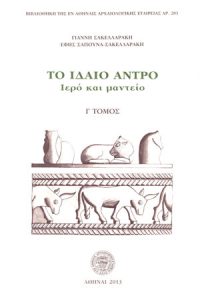
Δεν μπορεί να είναι συνηθισμένος ο πρόλογος για μια κρητική σπηλιά, αν αυτή είναι «the most important cave sanctuary in iron age Crete» κατά τον Sir John Boardman, μια σπηλιά που χρησιμοποιήθηκε συνεχώς για 5.000 περίπου χρόνια, από την Ύστερη Νεολιθική εποχή μέχρι σήμερα.
The regional development of Cyprus and the on-going changes on the island are highly interesting topics, which were investigated in several studies in recent years by the SCIEM 2000 Cyprus project. This book by Louise Maguire represents a new departure from the traditional analysis of material culture; she has analysed pottery decoration by looking at traces of painting practices.
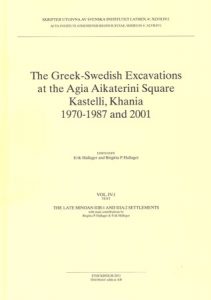
Erik Hallager & Birgitta P. Hallager (επιμέλεια)Stockholm2011
This volume is the fourth in a series of seven presenting the results of the Greek-Swedish Excavations during the years 1970-1987 and 2001 in the Agia Aikaterini Square, Kastelli Khania. The excavations which are situated close to the harbour of the modern town of Khania, western Crete were under the direction of Dr Yannis Tzedakis and Professor Carl-Gustaf Styrenius.