A. Traverso, B. Benvenuti & V. Tiné (επιμέλεια)2016
This book, available for free on the web as an almost complete draft, makes available to the Aegean archaeologists the fundamental results achieved in over thirty years of excavations, restorations and interdisciplinary studies on the key-site for the northern Aegean Early Bronze age.
The origins, as well as the interconnections of the Mycenaeans with other civilizations, were always of great interest to Prof. Papadopoulos. This honorary volume expands to diverse eras, from Neolithic to Byzantine times, following Mycenaean paths that lead even to the distant East: to Egypt, whose culture Prof. Papadopoulos taught for many years at Ioannina University, and to Jordan, where he excavated for more than 10 years.
The wall paintings discussed in this volume were originally discovered in 1958 by Niko-laos Verdelis during the excavation of the West House, one of the four buildings, also known as the “Ivory Houses,” south of Grave Circle B, at Mycenae.
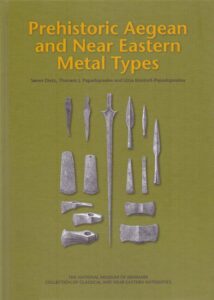
Søren Dietz, Thanasis J. Papadopoulos & Litsa Kontorli-PapadopoulouCopenhagen2015
The catalogue contains all Aegean metals kept in the Department of Ancient Cultures of Denmark and the Mediterranean. In the section on the Near Eastern metals, bronzes from Hama, however, are not included. Except for that, all metal objects from the Near East dated before 1000 BC are found in the catalogue.
The 17 contributions reflect on tensions at the core of how we consider interaction in archaeology, particularly the motivations and mechanisms leading to social and material encounters or displacements. Linked to this are the ways we conceptualise spatial and social entities in past societies (scales) and how we learn about who was actively engaged in interaction and how and why they were (modes).
O Αποθέτης 39 βρίσκεται μέσα στο μεγάλο προϊστορικό νεκροταφείο Τσέπι Μαραθώνος και ανασκάφηκε συστηματικά κατά τα έτη 1999 και 2000. Αυτό το ιδιαίτερο εύρημα εξαιρέθηκε της πρώτης δημοσίευσης με τίτλο Τσέπι Μαραθώνος.
The book presents a contextual study of the Near Eastern imports which reached Crete during the Early Iron Age and were deposited in the Knossian tombs.
This regional study considers the transitional period between the collapse of the Palace of Knossos (end of 14th c. B.C.) and the birth of the Greek city-state (mid 7th c. B.C.) around the Mirabello Bay, in Eastern Crete.
Nicholas Chr. Stampolidis, Çiğdem Maner & Konstantinos Kopanias (επιμέλεια)Κωνσταντινούπολη 2015
Nostoi. Indigenous Culture, Migration and Integration in the Aegean Islands and Western Anatolia during the Late Bronze and Early Iron Age is presenting one comprehensive volume with papers discussing various aspects of the intercultural contact between West Anatolia and the Aegean during the Late Bronze Age and Early Iron Age.
Walter Gauß, Gudrun Klebinder-Gauß & Constance von Rüden (επιμέλεια)Βιέννη2015
The current volume unites theoretical, anthropological, and archaeological approaches to knowledge transmission. The case studies cover various periods and regions from the ancient Mediterranean and beyond, from the Bronze Age to the Roman period, from the Levant in the east to the western Mediterranean and the Celtic north, but also from today’s central Niger.
The island of Euboea has always acted as a bridge connecting mainland Greece to the wider Aegean and the Mediterranean world; its archaeological importance was an acknowledged but often understated fact. Euboea, a region with an identity crisis, at the same time considered an island but also a part of the mainland, due to its geographical and cultural proximity, has for millennia played an important role in events that shaped aspects of Greek antiquity.
Από τα σημαντικότερα επιτεύγματα της παγκόσμιας ανθρώπινης δημιουργίας, ο μινωικός πολιτισμός είναι ο πρώτος που αναπτύχθηκε σε ευρωπαϊκό έδαφος. Αναγνωρίζοντας τη μοναδικότητα του, ο Arthur Evans, ανασκαφέας της Κνωσού, του μητροπολιτικού κέντρου του μινωικού κόσμου, ονόμασε τον πολιτισμό που έφερε στο φως, μινωικό, εμπνεόμενος από το μυθικό βασιλιά της Κνωσού Μίνωα.
Το Αρχαιολογικό Έργο Κρήτης είναι πλέον θεσμός. Ένας θεσμός, ο οποίος στις σημερι-νές εξαιρετικά δύσκολες και αντίξοες συνθήκες έχει τη δύναμη να δημιουργεί ελπίδες και προσδοκίες. Η εντυπωσιακή αύξηση του αριθμού των συμμετεχόντων στην τρίτη συνάντηση το 2013 το αποδεικνύει πέρα από κάθε αμφιβολία.
This volume, in honour of one of the Odysseuses in Aegean archaeology, Professor Robert Laffineur, comprises a combination of papers presented during a seminar series on recent developments in Mycenaean archaeology at the Université de Louvain during the academic year 2015-2016. These were organised within the frame of the ARC13/18 - 049 (concerted research action) “A World in Crisis?”.