Maurizio Del Freo & Massimo Perna (επιμέλεια)Padova 2016
Questo manuale intende offrire un quadro aggiornato delle conoscenze nel campo dell’epigrafia micenea. Nato dalla collaborazione di un gruppo di specialisti di varie università e centri di ricerca, contiene un'introduzione alla scrittura e alla lingua dei testi micenei e un'analisi dettagliata dei principali documenti in lineare B, suddivisi per argomento. Nel primo volume, la scrittura, le pratiche scribali e quelle amministrative sono presentate nel dettaglio e messe a confronto con quelle delle amministrazioni minoiche in “geroglifico” cretese e in lineare A, mentre i documenti sono contestualizzati sul piano archeologico e descritti dal punto di vista epigrafico, paleografico e archivistico.
Stella Demesticha & Bernard A. Knapp (επιμέλεια)Uppsala2016
The maritime transport of goods in bulk provides a clear indicator of many facets of trade, from networks and merchants to individual economic transactions. One of the key material factors involved is what we term the Maritime Transport Container (MTC), examples of which include the Canaanite jar, Transport Stirrup jar and Phoenician amphora, or more generally transport amphorae.
Susan Sherratt & John Bennet (επιμέλεια)Oxford & Philadelphia2017
Contributors explore a variety of issues including the relationships between visual and verbal imagery, the social contexts of epic (or sub-epic) creation or re-creation, the roles of bards and their relationships to different types of patrons and audiences, the construction and uses of ‘history’ as traceable through both epic and archaeology and the relationship between ‘prehistoric’ (oral) and 'historical' (recorded in writing) periods. Throughout, the emphasis is on context and its relevance to the creation, transmission, re-creation and manipulation of epic in the present (or near-present) as well as in the ancient Greek past.
Susan Sherratt & John Bennet (επιμέλεια)Oxford & Philadelphia 20172017
The relationship between the Homeric epics and archaeology has long suffered mixed fortunes, swinging between ‘fundamentalist’ attempts to use archaeology in order to demonstrate the essential historicity of the epics and their background, and outright rejection of the idea that archaeology is capable of contributing anything at all to our understanding and appreciation of the epics.
Michael Fotiadis, Robert Laffineur, Yannos Lolos & Andreas Vlachopoulos (επιμέλεια)Leuven-Liège2017
The 16th International Aegean Conference/Rencontre égéenne international encompasses all the geographical regions west of the Aegean (Western Mainland Greece, the Ionian islands and the Adriatic, Italy, Sicily, Malta, Sardinia, Corsica and the Balearic islands), giving prominence to those focal points and traits of the local civilizations which interact with their Aegean counterparts of the 3rd and 2nd millennium BC, not excluding their Neolithic background.
Michael Fotiadis, Robert Laffineur, Yannos Lolos & Andreas Vlachopoulos (επιμέλεια)Leuven-Liège 2017
The 16th International Aegean Conference/Rencontre égéenne international encompasses all the geographical regions west of the Aegean (Western Mainland Greece, the Ionian islands and the Adriatic, Italy, Sicily, Malta, Sardinia, Corsica and the Balearic islands), giving prominence to those focal points and traits of the local civilizations which interact with their Aegean counterparts of the 3rd and 2nd millennium BC, not excluding their Neolithic background.
Edited by Evangelia Kiriatzi & Carl KnappettCambridge2016
This volume represents a significant contribution to this new trend as it engages thematically with a wide range of connectivities in the later prehistory of the Mediterranean, from the later Neolithic of northern Greece to the Levantine Iron Age, and with diverse forms of materiality, from pottery and metal to stone and glass. With theoretical overviews from leading thinkers in prehistoric mobilities, and commentaries from top specialists in neighbouring domains, the volume integrates detailed case studies within a comparative framework.
In this book, Kramer-Hajos examines the Euboean Gulf region in Central Greece to explain its flourishing during the postpalatial period. Providing a social and political history of the region in the Late Bronze Age, she focuses on the interactions between this “provincial” coastal area and the core areas where the Mycenaean palaces were located.
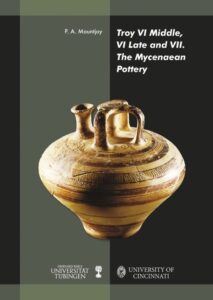
The Mycenaean pottery from the excavations of M. Korfmann is presented in detail. It is discussed by excavated area starting with the areas on the mound; this is followed by that from the buildings round the base of the mound, then by that from buildings in the central Lower Town; it concludes with the material from the Fortification Ditch. Within each area the pottery is presented stratigraphically.
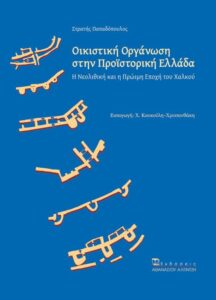
Η «Οικιστική οργάνωση στην προϊστορική Ελλάδα της Νεολιθικής περιόδου και της Πρώιμης Εποχής Χαλκού» του Στρατή Παπαδόπουλου προσφέρει μια συνοπτική και εξαιρετικά περιεκτική παρουσίαση αρχαιολογικών δεδομένων και θεωρητικού προβληματισμού γι’ αυτές τις δύο σημαντικές φάσεις του Προϊστορικού Αιγαίου.
Simon Jusseret & Manuel Sintubin (επιμέλεια)Leuven2017
Does the “Minoan myth” still stand up to scientific scrutiny? Since the work of Sir Arthur Evans at Knossos (Crete, Greece), the romanticized vision of the Cretan Bronze Age as an era of peaceful prosperity only interrupted by the catastrophic effects of natural disasters has captured the popular and scientific imagination. Its impact on the development of archaeology, archaeoseismology, and earthquake geology in the eastern Mediterranean is considerable.
Geraldine C. Gesell & Leslie Preston Day (επιμέλεια)Philadelphia-Pennsylvania2016
Detailed analyses of the architecture, pottery, other finds (including figurines and stone tools), and botanical and faunal remains are presented in this third volume, along with a complete history of the site and an attempt to reconstruct the social, political, and religious organization of the settlement.
Maria Mina, Sevi Triantaphyllou & Yiannis Papadatos (επιμέλεια)Oxford2016
In these 28 thematically arranged papers, specialists in the archaeology of the eastern Mediterranean confront the perceived invisibility of past bodies and ask new research questions. Contributors discuss new and old evidence; they examine how bodies intersect with the material world, and explore the role of body-situated experiences in creating distinct social and other identities.
Ένα βασικό συμπέρασμα της μελέτης είναι η διαπίστωση ότι καθ’ όλη τη διάρκεια της Ύστερης Εποχής του Χαλκού στην Αργολίδα χρησιμοποιούνταν ποικίλες στρατηγικές για την οργάνωση και διαμόρφωση του τοπίου, όπως η χωρική συσχέτιση/αποσυσχέτιση, η αρχιτεκτονική επιδεικτική κατανάλωση, η χρήση δραματουργικών στοιχείων στον αρχιτεκτονικό σχεδιασμό, με στόχο το διαρκή χειρισμό των κοινωνικών ταυτοτήτων όσων το βίωναν με κάθε τρόπο.
Marisa Marthari, Colin Renfrew & Michael Boyd (επιμέλεια)Oxford2017
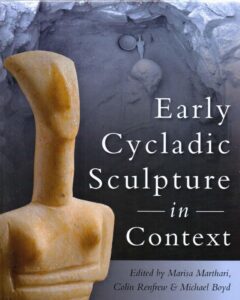
Using the material from recent excavation projects, and drawing on the papers presented at a symposium held in Athens in 2014, it is possible now to undertake a fresh overview of the entire body of sculpture from the Cycladic islands which has been found in secure archaeological contexts. Beginning with early examples from Neolithic settlement sites and extending into a consideration of material found in later contexts, the 35 chapters are divided into sections which examine sculpture from settlements, cemeteries and the sanctuary at Kavos, concluding with a discussion of material, techniques and aspects of manufacture.