ΣΥΝΘΕΤΗ ΑΝΑΖΗΤΗΣΗ +

Αιγεύς Εταιρεία Αιγαιακής Προϊστορίας

ΒΙΒΛΙΑ

Staging Death. Funerary Performance, Architecture and Landscape in the Aegean

Berlin/Boston 2016

Staging Death. Funerary Performance, Architecture and Landscape in the Aegean Places are social, lived, ideational landscapes constructed by people as they inhabit their natural and built environment. An ‘archaeology of place’ attempts to move beyond the understanding of the landscape as inert background or static fossil of human behaviour. From a specifically mortuary perspective, this approach entails a focus on the inherently mutable, transient and performative qualities of ‘deathscapes’: how they are remembered, obliterated, forgotten, reworked, or revisited over time.

Cretomania. Modern Desires for the Minoan Past

London/New York 2016

Cretomania. Modern Desires for the Minoan Past Since its rediscovery in the early 20th century, through spectacular finds such as those by Sir Arthur Evans at Knossos, Minoan Crete has captured the imagination not only of archaeologists but also of a wider public.

Archaeodiet in the Greek World: Dietary Reconstruction from Stable Isotope Analysis

Princeton/New Jersey 2015

Archaeodiet in the Greek World: Dietary Reconstruction from Stable Isotope Analysis The analysis of stable isotope ratios of carbon and nitrogen in bone collagen provides a powerful tool for reconstructing past diets, since it provides the only direct evidence of the foods that were actually consumed. The chapters that comprise this volume describe the application of this methodology to the archaeology of Greece, a country whose archaeobotanical remains have been isotopically studied more extensively than any other place in the world.

The Pottery from Dhaskalio

Cambridge 2016

The Pottery from Dhaskalio This volume treats in detail the pottery from the settlement on the islet of Dhaskalio, whose excavation is described in Volume I of the series. Much of the importance of this material lies in the undisturbed stratigraphy of the settlement, a fact that allowed for the recognition of three successive phases of occupation of the site with considerable ceramic continuity between them, as well as for safe inferences about its chronology, with wider implications for the later Εarly Βronze Αge of the Cyclades.

Η αρχαιολογία στην Ελλάδα του σήμερα. Μνημεία και άνθρωποι σε κρίση

Αθήνα 2016

Διαβάστε όλο το βιβλίο σε ψηφιακή μορφή
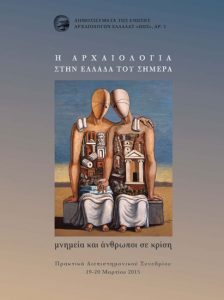
Η αρχαιολογία στην Ελλάδα του σήμερα. Μνημεία και άνθρωποι σε κρίση Πρόκειται για τα πρακτικά του Διεπιστημονικού Συνεδρίου «Η αρχαιολογία στην Ελλάδα του σήμερα. Μνημεία και άνθρωποι σε κρίση» που πραγματοποιήθηκε στην Αθήνα στις 19-20 Μαρτίου 2015.

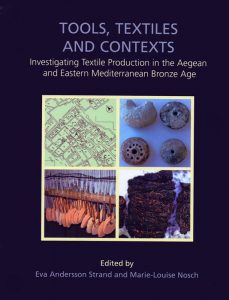
Tools, Textiles and Contexts. Investigating Textile Production in the Aegean and Eastern Mediterranean Bronze Age

Oxford & Philadelphia 2015

Tools, Textiles and Contexts. Investigating Textile Production in the Aegean and Eastern Mediterranean Bronze Age Textile production is one of the most important crafts in Aegean and Eastern Mediterranean Bronze Age societies and recent interdisciplinary and collaborative work offers crucial new perspectives into this field. The new and updated catalogue of archaeological textile finds presented here clearly demonstrates, even from the few extant finds, that knowledge of the use of fibres and of elaborate textile techniques that were used to produce textiles of different qualities was well developed.

Το σπήλαιο Σαρακηνού στο Ακραίφνιο Βοιωτίας. Συμβολή στην προϊστορία της Kεντρικής Ελλάδος

Αθήνα 2014

Το σπήλαιο Σαρακηνού στο Ακραίφνιο Βοιωτίας. Συμβολή στην προϊστορία της Kεντρικής Ελλάδος Το σπήλαιο Σαρακηνού βρίσκεται στον βραχώδη όγκο ανατολικά της πεδιάδας (αποξηραμένης πλέον λίμνης) της Κωπαΐδας και δυτικά του χωριού Ακραίφνιο, σε υψόμετρο ~100 μ.

Μύκονος Προϊστορική. Χώρος και ανθρώπινη παρουσία: Η Ιστορία της ανθρώπινης εγκατάστασης στο νησί και η Ιστορία της σχετικής έρευνας

Άρτα 2015

Μύκονος Προϊστορική. Χώρος και ανθρώπινη παρουσία: Η Ιστορία της ανθρώπινης εγκατάστασης στο νησί και η Ιστορία της σχετικής έρευνας Το βιβλίο αποτελεί μία συνθετική παρουσίαση παλαιότερου και νέου (αδημοσίευτου) υλικού για την προϊστορική Μύκονο. Συνοδεύεται από παράρτημα για την ιστορία της σχετικής έρευνας.

Elis 1969: The Peneios Valley Rescue Excavation Project

Oxford 2015

Elis 1969: The Peneios Valley Rescue Excavation Project In the 1960s a great new barrier dam was built across the Peneios Valley in Elis in the N.W. Peloponnese to create an artificial lake for irrigation purposes. In 1967 the Greek Archaeological Service organised a preliminary survey of the areas to be affected and also asked all the Foreign Archaeological Schools to assist and allocated specific sections to each.

Die Deutschen Ausgrabungen 1941 auf der Visviki-Magula / Velestino. Die neolithischen Befunde und Funde

Bonn 2015

Die Deutschen Ausgrabungen 1941 auf der Visviki-Magula / Velestino. Die neolithischen Befunde und Funde To βιβλίο δημοσιεύει τις γερμανικές ανασκαφές του 1941 στη Μαγούλα Βισβίκη στο Βελεστίνο Θεσσαλίας. Η Μαγούλα Βισβίκη εντοπίσθηκε στις αρχές του 20ού αιώνα από τον πρωτοπόρο αρχαιολόγο Χρήστο Τσούντα. Στη θέση αυτή πραγματοποίησε ανασκαφική έρευνα ο Γερμανός αρχαιολόγος Hans Reinerth με εντολή του γερμανικού φασιστικού κράτους το 1941 (Οκτώβριος-Δεκέμβριος) και με συνεργάτες τον Rudolf Stampfuss και τον Wilhelm Stossel.

Beyond Thalassocracies. Understanding Processes of Minoanisation and Mycenaeanisation in the Aegean

Oxford 2016

Beyond Thalassocracies. Understanding Processes of Minoanisation and Mycenaeanisation in the Aegean Beyond Thalassocracies aims to evaluate and rethink the manner in which archaeologists approach, understand, and analyse the various processes associated with culture change connected to interregional contact, using as a test case the world of the Aegean during the Late Bronze Age (c. 1600–1100 BC).

Ein Minoer im Exil. Festschrift für Wolf-Dietrich Niemeier

Bonn 2015

Ein Minoer im Exil. Festschrift für Wolf-Dietrich Niemeier Die vorliegende Festschrift verdankt ihre Existenz nicht einer persönlichen oder wissenschaftlichen Pflicht, sondern vielmehr einem dringenden Bedürfnis zahlreicher Kollegen, Mitarbeiter, Schüler und Freunde sowohl dem Wissenschaftler als auch dem Menschen Wolf-Dietrich Niemeier einen großen Dank auszusprechen und sein verdienstvolles Wirken auf angemessene Weise zu würdigen.