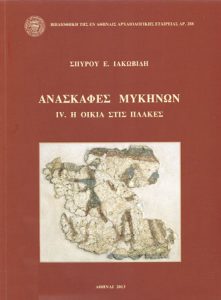
H οικία ευρίσκεται στην θέση «Πλάκες», στους ΝΔ. πρόποδες του λόφου του Προφήτη Ηλία, επάνω από τη δεξιά όχθη του ρέματος της Κοκορέτσας και σε απόσταση περίπου 200 μ. από την βόρεια πύλη της ακρόπολης των Μυκηνών, σε ένα σημείο όπου ο Steffen σημειώνει λείψανα αρχαίων θεμελίων και αναλημμάτων (Antike Grund- und Stützmauern), χωρίς αυτά πού επισημαίνει να συμπίπτουν με βεβαιότητα με την θέση της ανασκαφής (Karten von Mykene, Blatt I, Berlin 1884).
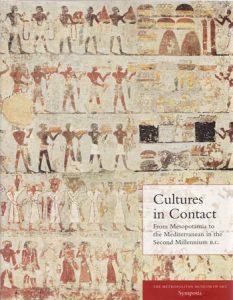
Joan Aruz, Sarah B. Graff & Yelena Rakic (επιμέλεια)New York2013
In conjunction with the 2008–9 exhibition Beyond Babylon: Art, Trade, and Diplomacy in the Second Millennium B.C. at The Metropolitan Museum of Art, a series of lectures brought together major international scholars in a variety of fields concerned with the worlds of the Near East and the eastern Mediterranean in the middle and late Bronze Ages.
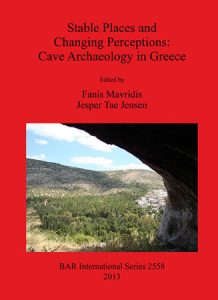
Caves are considered as important elements of world cultural heritage, having been actively used by man, with significant scientific, historical, archaeological, and anthropological value. However, it is not only their unique value, regarding these aspects, that makes caves particularly important.
H διδακτορική διατριβή με θέμα: «Σύγκλιση – Απόκλιση. Έρευνα & Συνεισφορά στην τοπική κεραμική της Περιφέρειας Αρμένων-Ρεθύμνου και στην Κεραμική Παραγωγή της Κρήτης κατά τον 14ο και 13ο π. Χ. αιώνα», εκπονήθηκε στο Πανεπιστήμιο της Χαϊδελβέργης.
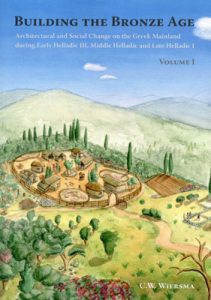
The Early Helladic III (EH III) and Middle Helladic (MH) periods in Greece are assumed in the literature to be simple in terms of social organization and material remains. However, these periods have barely been the subject of detailed studies of social change. Domestic architecture and the level of the household in particular, have received little consideration.
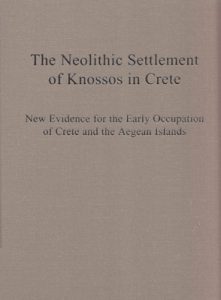
Nikos Efstratiou, Alexandra Karetsou & Maria Ntinou (επιμέλεια)Philadelphia2013
The site of Knossos on the Kephala hill in central Crete is of great archaeological and historical importance for both Greece and Europe. Dating to 7000 B.C., it is the home of one of the earliest farming societies in southeastern Europe, and, in the later Bronze Age periods, it developed into a remarkable center of economic and social organization within the island, enjoying extensive relations with the Aegean, the Greek mainland, the Near East, and Egypt.
Colin Renfrew, Olga Philaniotou, Neil Brodie, Giorgos Gavalas & Michael J. Boyd (επιμέλεια)Oxford/Oakville2013
This is the first volume in the series "The Sanctuary on Keros: Excavations at Dhaskalio and Dhaskalio Kavos, 2006–2008". Here the findings are presented from the well-stratified settlement of Dhaskalio, today an islet near the Cycladic island of Keros, Greece.
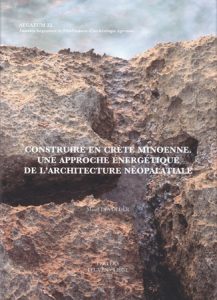
L’architecture crétoise néopalatiale (XVIIe-XVe s. av. J.-C.) est étudiée selon une approche énergétique qui permet de déterminer le temps nécessaire à la construction d’un édifice. Le nombre total d’heures de travail dévolues à l’accomplissement des différentes tâches sur le chantier, depuis l’acquisition des matériaux jusqu’à leur mise en place, est estimé.
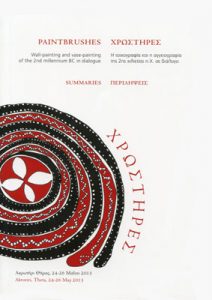
Η επιστημονική συνάντηση ΧΡΩΣΤΗΡΕΣ απευθύνθηκε σε αρχαιολόγους, συντηρητές αρχαιοτήτων και καλλιτέχνες που ειδικεύονται στη μελέτη της αιγαιακής εικονογραφίας, και οι οποίοι κλήθηκαν σε μία τράπεζα ανοικτών συζητήσεων με θέμα τη διαλεκτική σχέση που οι τέχνες της αγγειογραφίας και της τοιχογραφίας ανέπτυξαν στο Αιγαίο της 2ης χιλιετίας π.Χ.
Andrew Bevan & James ConollyCambridge/New York2013
Mediterranean landscape ecology, island cultures and long-term human history have all emerged as major research agendas over the past half-century, engaging large swathes of the social and natural sciences. This book brings these traditions together in considering Antikythera, a tiny island perched on the edge of the Aegean and Ionian seas, over the full course of its human history from the Neolithic through the present day.
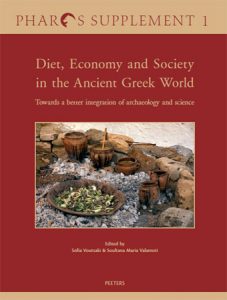
Sofia Voutsaki & Soultana Maria Valamoti (επιμέλεια)Leuven2013
The last decades have witnessed the adoption and refinement of various scientific techniques that allow us to reconstruct past diets, but also to understand the role of food in social interaction. These are exciting developments, but the proliferation of analytical techniques may also lead to over-specialization and fragmentation of the field.
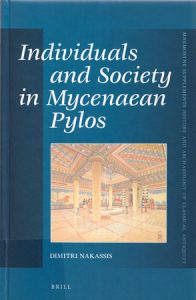
This book revises our understanding of Mycenaean society through a detailed analysis of individuals attested in the administrative texts from the Palace of Nestor at Pylos in southwestern Greece, ca. 1200 BC. It argues that conventional models of Mycenaean society, which focus on administrative titles and terms, can be improved through the study of named individuals.
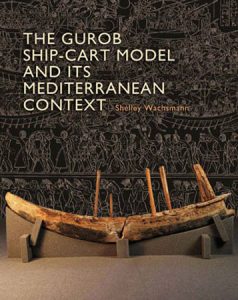
When Shelley Wachsmann began his analysis of the small ship model excavated by assistants of famed Egyptologist W. M. F. Petrie in Gurob, Egypt, in 1920, he expected to produce a brief monograph that would shed light on the model and the ship type that it represented. Instead, Wachsmann discovered that the model held clues to the identities and cultures of the enigmatic Sea Peoples, to the religious practices of ancient Egypt and Greece, and to the oared ships used by the Bronze Age Mycenaean Greeks.
Philip P. Betancourt (with contributions by Kostas Chalikias, Heidi M.C. Dierckx, Andrew J. Koh, Evi Margaritis, Floyd W. McCoy, Eleni Nodarou & David S. Reese)Philadelphia2013
The small site of Aphrodite's Kephali, among several other Minoan and later sites, took advantage of the valley topography in the Isthmus of Ierapetra in eastern Crete by establishing themselves along the nearby hills, resulting in easy access to the natural trade route between the Aegean and the Libyan Seas. A discussion of the architecture, artifacts, and ecofacts are presented from the excavation of this Early Minoan I watchtower.
During the 3rd millennium BC, Cyprus became deeply involved with the Ancient Near East and with other parts of the East Mediterranean for the first time since the island was colonised. This included the likely migration of peoples from the East Aegean and Anatolia, and changes that ushered in the Bronze Age.