The Lion Gate is an icon, a piece of art more than 3300 years old, representing the glory of Mycenaean Greece. Preserved in situ, it has passed through time and circumstance, witnessing its own civilisation fail and many others flourishing since. Often considered as an emblem for the royal house of Mycenae, it is the only surviving piece of large-scale sculpture of the Greek Bronze Age.
Alain BlancStudi Micenei ed Egeo-Anatolici, Nuova Serie 10 (2024): 9-20
The Mycenaean neuter plural pe-ne-we-ta qualifies articles of clothing (pa-we-a /pharweha/), or it is used near the logogram TELA. There have been several proposals: /pnewent-/ ‘vaporosi’ (Gallavotti), /pneuwent/- ‘ariosi’ (Doria), /pen-went-/ or /penewent-/ (Chadwick : pen- from πίνος ‘natural grease in wool’), or even /sphēn-went-/ ‘featuring a weave with wedges’ (σφήν), but none of these explanations is suitable (cf. DMic. II, 99). We try to show that pe-ne-we-ta can conceal /phernewwenta/ ‘provided with /phernes-/’.
Ján Bobik, Tunç Kaner, Peter Pavúk & Christopher H. RooseveltStudi Micenei ed Egeo-Anatolici, Nuova Serie 10 (2024): 21-46
This study provides the first comprehensive analysis of zoomorphic plastic decorations on pottery from second-millennium BCE western Anatolia. Despite early observations by Heinrich Schliemann at Troy, these decorations have not been systematically studied until now.
Carlo ConsaniStudi Micenei ed Egeo-Anatolici, Nuova Serie 10 (2024): 47-76
This work examines the various issues related to the origin of Linear B script and the adaptation process that led to the creation of this script from the Linear A graphic system.
Maurizio Del FreoStudi Micenei ed Egeo-Anatolici, Nuova Serie 10 (2024): 77-94
This article examines the Greek term κτοίνα, a lexical survival from the Mycenaean period that reappears sporadically in inscriptions from the Rhodian area dating to the Hellenistic and Roman periods, as well as in Hesychius’ Lexicon.
Luca GirellaStudi Micenei ed Egeo-Anatolici, Nuova Serie 10 (2024): 95-116
The paper is concerned with the overall character of the pottery and the relative chronology of the Anemospilia/Archanes building on Juktas. The ceramic assemblages are discussed according to their position within the same.
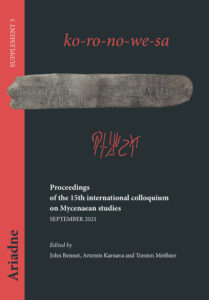
John Bennet, Artemis Karnava & Torsten Meißner (επιμέλεια)Ρέθυμνο
As editors and organisers, we were gratified to note a good number of early- and mid-career scholars among those contributing to this volume, and even more early-career scholars and students had expressed an interest in attending the meeting itself, leaving the editors in no doubt that interest in Mycenaean, and indeed Aegean studies more widely, is unbroken and continues to attract the intellectual attention of rising academics in a large number of disciplines.
Το έργο αυτό αποτελεί συστηματική μελέτη των απαρχών της οίκησης του Ελλαδικού Χώρου, από τις πρωιμότερες διαθέσιμες μαρτυρίες την Μεσολιθική έως και την Πρώιμη Εποχή του Χαλκού (9η - 3η χιλιετία π.Χ.), συνεκτιμώντας ανάλογα δεδομένα από την ευρύτερη Ανατολική Μεσόγειο (κυρίως 14η χιλιετία π.Χ. κ.ε.), Εγγύς Ανατολή, Μεσοποταμία, Ανατολία, Πόντος - Κασπία, Αίγυπτος - Αφρική.
The site of Phylakopi on Melos occupies a special place in the prehistory of the Aegean Bronze Age. The first work there by the British School at Athens in 1896–99 (there were two further campaigns, in 1911 and 1974–77) was memorably described by Carl Blegen as ‘the first really serious effort to understand stratification, the first really good excavation in Greece’. The Field Director, Duncan Mackenzie, kept detailed day-to-day records of the work, later applying methods developed on Melos to the excavation of Knossos.