ΒΙΒΛΙΟΚΡΙΣΙΕΣ | 2026
Petrakis, V.
Bryn Mawr Classical Review 2026.08.08
Διαβάστε τη βιβλιοκρισία
Petrakis, V. 2026. Βιβλιοκρισία του: S. R. Stocker, C. L. Lyons, J. L. Davis & E. Militsi-Kechagia, The Kingdom of Pylos: Warrior-princes of Mycenaean Greece (Los Angeles 2025), Bryn Mawr Classical Review 2026.08.08.
Rutter, J. B.
Bryn Mawr Classical Review 2026.04.27
Διαβάστε τη βιβλιοκρισία
Rutter, J. B., Βιβλιοκρισία του: B. P. Hallager, LM IIIB Knossos and its Relations to Kydonia (Stockholm 2026), Bryn Mawr Classical Review 2026.04.27.
Donnelly, C. M.
Bryn Mawr Classical Review 2026.01.17
Διαβάστε τηε βιβλιοκρισία
Donnelly, C. M., Βιβλιοκρισία του: Civitillo Μ., Ferrara S. & Meissner T., Cretan hieroglyphic (Cambridge 2024), Bryn Mawr Classical Review 2026.01.17.
Lepori, F.
American Journal of Archaeology 130 (2026)
Διαβάστε τη βιβλιοκρισία
Lepori, F., Βιβλιοκρισία του: M. B. Cosmopoulos, The World of Homer: Archaeology, Social Memory, and the Emergence of Greek Epic Poetry (Cambridge 2025), American Journal of Archaeology 130 (2026).
Mary Van Dyke
Bicester
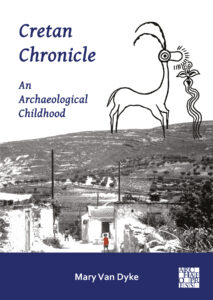 A memoir of archaeology, identity and family, Cretan Chronicle follows Mary’s childhood between Crete and England, her work with her father Sinclair Hood, and her journey through love, trauma and self‑discovery. Blending myth and memory, it reveals the secrets and complexities of a mid‑20th‑century archaeological life.
Polina Kapsali
Journal of Archaeological Science, Reports 83, 2026: 101789
Διαβάστε το άρθρο
Societal transformations in European prehistory have traditionally been examined through evolutionary frameworks that depict a unilinear development from egalitarian to hierarchical social systems. While their specific claims are often contested, these interpretations are seldom reassessed from alternative interpretative perspectives. This paper offers such an alternative by drawing on anthropological and archaeological approaches informed by Anarchist Theory.
Lavinia Giorgi, Sara Lopez
Journal of Archaeological Science, Reports 41, 2026: e00508
Διαβάστε το άρθρο
This paper aims to explore the potential of Reflectance Transformation Imaging (RTI) as applied to signs and marks engraved on hard materials, with particular focus on the writing systems of the Bronze Age Aegean (2nd millennium BC). These (para-)writing forms (the Arkhanes script, Cretan Hieroglyphic, the Phaistos Disc script, Linear A, Linear B, and Masons’ Marks) share the common feature of being incised onto hard surfaces, mainly clay and both hard and soft stones.
Symeon Gkinoudis, Trevor Van Damme, Brendan Burke, Bryan Burns, Evi Margaritis
Journal of Archaeological Science, Reports 70, 2026: 105507
Διαβάστε το άρθρο
Eleon is located in east Boeotia, on mainland Greece. Research conducted by the Eastern Boeotia Archaeological Project has revealed a long-lasting occupational sequence at the site. At the beginning of the Late Bronze Age, a monumental burial enclosure, the Blue Stone Structure, was constructed on the east side of the plateau. Settlement remains from both the Palatial and Post-Palatial periods have been documented, with the latter being more extensively explored and better understood.
Konstantinos P. Trimmis, Stavroula Fouriki, Patrick Quinn, Julie Dunne, Richard P. Evershed, Katie Faillace, Richard Madgwick, Morten Andersen, Marc-Alban Millet, Alexandra J. Nederbragt, Timothy Knowles, Paul Monaghan, Georgios Lazaridis, Christianne L. Fernée, Katerina Trantalidou
Journal of Archaeological Science, Reports 73, 2026: 105798
Διαβάστε το άρθρο
Interactions between islands and mainland has long been the subject of numerous archaeological projects in the Mediterranean and beyond. The island of Kythera in Greece has been a focal point for such studies over the last century. This paper re-visits Kythera and presents an analytical study on pottery and skeletal assemblages from the Kataphygadi cave excavations in the central west Kythera, in order to further explore insular dynamics and long-range interactions in the area, during the Bronze Age.
Angelos Hadjikoumis, Eleni Andrikou, Kerasia Douni
Journal of Archaeological Science, Reports 75, 2026: 105981
Διαβάστε το άρθρο
Current knowledge on Early Bronze Age society in Attica (Greece) is limited, especially on human-animal interactions. Large faunal samples from Early Bronze Age Koropi in southeast Attica present a unique opportunity to address this gap. Their study contributes important insights into the economic and social practices at a large Early Bronze Age settlement, as well as the adaptations to the environment, landscape and regional networks.
Valeria Tiezzi, Bartłomiej Lis, Anthi Batziou
Journal of Archaeological Science, Reports 76, 2026: 106039
Διαβάστε το άρθρο
Transport Stirrup Jars (TSJs) are emblematic maritime transport containers of the Aegean Late Bronze Age, usually associated with Cretan production places and tied to Mycenaean palatial exchange systems. Despite extensive research on palatial assemblages, TSJs from non-palatial and traditionally ‘peripheral’ regions of the Greek Mainland remain underexplored. This paper presents a petrographic provenance study of TSJs recovered from the harbour site of Pefkakia in the Pagasetic Gulf (Thessaly), contributing towards filling this research gap and assessing the site’s role within wider Aegean exchange networks.
Kyriaki Karanikola, Soultana-Maria Valamoti, Giedrė Motuzaite Matuzeviciute
PLoS One 21(3): e0344099
Διαβάστε το άρθρο
This paper explores early broomcorn millet (hereafter millet) cultivation in Greece during the Bronze Age. The primary archaeobotanical data for this study derive from the site of Skala Sotiros on the island of Thasos in northern Greece.
Frank, D.
American Journal of Archaeology 130 (2026)
Διαβάστε τη βιβλιοκρισία
Frank, D., Βιβλιοκρισία του: M. Lindblom, Lerna 10. The Shaft Graves and Other Late Helladic I and II Remains (Princeton 2025), American Journal of Archaeology 130 (2026).
Carly Henkel, Joachim Bretschneider, Jan Driessen, Athanasia Kanta & Evi Margaritis
Journal of Archaeological Science: Reports 75, 2026: 106069
Διαβάστε το άρθρο
To date, archaeobotanical records for Late Bronze Age Cyprus provide little insight into agricultural activity of the time, such as specific farming systems and cultivation practices. This paper presents the results of an archaeobotanical study for the site of Pyla-Kokkinokremos (LC IIC, c. 1230–1170 BCE): a short-lived settlement that existed towards the end of the Late Bronze Age during a time often referred to as the crisis years on account of increasing mobility of people, violence and aridity throughout the Eastern Mediterranean.
Diego Capra, Isabella Caricola, Giulio Lucarini, Giuseppina Mutri, Evi Margaritis, Michael J. Boyd, †Colin Renfrew
Journal of Archaeological Science: Reports 74, 2026: 105946
Διαβάστε το άρθρο
Dhaskalio is a small and steep-sided islet at the western end of the island of Keros in the central Cyclades. Excavations carried out between 2006–2008 and 2016–2018 brought to light the remains of extensive architecture on Dhaskalio and a ritual area of significant importance in the Kavos area of Keros, both dated to the mid-third millennium BCE.
