ΒΙΒΛΙΑ | 2009
Δέσποινα Δανιηλίδου (επιμέλεια)
Αθήνα
2009
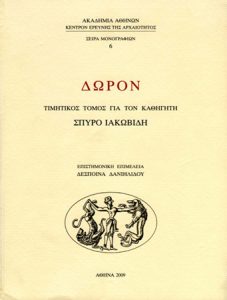
To 2008 ο καθηγητής Σπύρος Ιακωβίδης γιόρτασε τα 85 χρόνια του και το ίδιο έτος συμπληρώθηκαν 50 χρόνια ακούραστης συμμετοχής του στις ανασκαφές των Μυκηνών, αρχικά ως συνεργάτης του Γεωργίου Μυλωνά και την τελευταία 20ετία ως διευθυντής τους. Με την ευκαιρία αυτή, μαθητές, συνάδελφοι και φίλοι θέλησαν vα του προσφέρουν ένα τόμο με μελέτες πάνω σε θέματα μυκηναϊκής αρχαιολογίας, στην οποία ο Σπύρος Ιακωβίδης αφιέρωσε το μεγαλύτερο μέρος της επιστημονικής του δραστηριότητας. Μικρό δείγμα σεβασμού, εκτίμησης και αγάπης στον πανεπιστημιακό δάσκαλο και φίλο είναι αυτός ο τόμος, που ο τίτλος του - ΔΩΡΟΝ - είναι λέξη που πρωτομαρτυρείται, ταιριαστά για τον τιμώμενο, σε πινακίδα Γραμμικής Β (PΥ Τn 316) με την έννοια της προσφοράς (do-ra).
Lefèvre-Novaro, D.
Revue des Études Grecques
Lefèvre-Novaro, D., 2009. Review of O. Dickinson, The Aegean from Bronze Age to Iron Age. Continuity and Change between the Twelfth and Eighth Centuries B.C. (London: Routledge, 2006), Revue des Études Grecques 122 (juillet-décembre): 648.
Powell, B.B.
The Journal of Indo-European Studies
Powell, B.B., 2009. Review of H. Benigni & B. Carter, The Goddess and the Bull: A Study in Minoan-Mycenaean Mythology (Lanham: University Press of America, 2007), The Journal of Indo-European Studies 37: 249-251.
Vangelis D. Pantazis
Klio 91 (2009): 291-310.
A wide consensus among archaeologists and classicists today prevails that Ilios of the Homeric epics should be identified with the hill of Hisarlik. Moreover, a growing number of Hittitologists tends to believe, with less hesitance than before, that Taruisa of the Hittite texts should be identified with Troy and Wilusiya/Wilusa with (F)Ilios. A strong argument in favour of this view is, among others, the striking similarity between the names of the Wilusan ruler Alaksandu and Homeric Alexander (the second name of the unfortunate Trojan hero Paris).
Lorenc Bejko
Ocnus 17 (2009): 11-22.
The identification and description of the Mycenaean type objects found in the late Bronze Age contexts of Albanian sites has been object of several previous publications. As objects that stand out from the characteristic types of the local cultures, the finds of Mycenaean types have received particular attention. They have served extensively in the establishment of the late Bronze Age, early Iron Age chronologies as well as in the characterization of some form of contacts between the Aegean and Albanian territories in the later prehistory.
A. Ingvarsson-Sundström, M. P. Richards & S. Voutsaki
Mediterranean Archaeology and Archaeometry 9.2 (2009): 1-14.
In this paper we report the results of the stable carbon and nitrogen isotope analyses of humans from two Middle Bronze Age cemeteries at Asine, Greece: Barbouna (n=6) and the East Cemetery (n=13). In general, the dietary pattern of adults and juveniles shows a heavy reliance on mainly terrestrial foods; C3 plants and a varying amount of animal protein (meat, milk or dairy products). The high nitrogen values of some individuals from the East cemetery indicate a substantial consumption of animal protein, although the carbon values show that no detectable amounts of marine foods, or C4 plants such as millet had been consumed.
Kevin D. Fisher
Journal of Anthropological Archaeology 28.4 (December 2009): 439-457.
A growing recognition of the vital role that built space plays in social reproduction has created a need for analytical methods and interpretive frameworks with which to investigate this relationship in archaeological datasets. I address this by developing an integrative approach that emphasizes the role of the built environment as the context for interactions through which social structures are created, transformed and reproduced.
Warren, P.
Journal of Hellenic Studies
Warren, P., 2009. Review of M. Bietak, N. Marinatos & C. Palyvou, Taureador Scenes in Tell el Dab’a (Avaris) and Knossos (Vienna: Österreichische Akademie der Wissenschaften, 2007), Journal of Hellenic Studies 129: 204-206.
Shelmerdine, C.W.
Journal of Hellenic Studies
Shelmerdine, C.W., 2009. Review of L.M. Bendall, Economics of Religion in the Mycenaean World: Resources Dedicated to Religion in the Mycenaean Palace Economy (Oxford: Oxford University, 2007), JHS 129: 206-207.
Schallin, A.-L.
Journal of Hellenic Studies
Schallin, A.-L., 2009. Review of C. Renfrew, N. Brodie, C. Morris & C. Scarre, Excavations at Phylakopi in Melos 1974-77 (London: British School at Athens, 2007), JHS 129: 207-208.
Adams, E.,
Journal of Hellenic Studies
Adams, E., 2009. Review of J. Bretschneider, J. Driessen & K. van Lerberghe (eds), Power and Architecture: Monumental Public Architecture in the Bronze Age Near East and Aegean (Leuven and Dudley, MA: Peeters, 2007), JHS 129: 201-202.
Hallager, B.P.
Journal of Hellenic Studies
Hallager, B.P., 2009. Review of N. Momigliano (ed.), Knossos Pottery Handbook: Neolithic and Bronze Age (Minoan) (London: British School at Athens, 2007), JHS 129: 202-203.
Warren, P.
Journal of Hellenic Studies
Warren, P., 2009. Review of C.F. Macdonald & C. Knappett (eds), Knossos. Protopalatial Deposits in Early Magazine A and the South-West Houses (London: British School at Athens, 2007), JHS 129: 203-204.
Georgia Kourtessi-Philippakis (επιμέλεια)
Paris
 Le passé préhistorique du Sud-Est de l’Europe est à l’heure actuelle au centre de débats passionnants. Les enjeux sont, en effet, importants tant pour la péninsule balkanique elle-même, qui, entre la Méditerranée orientale et centrale, s’étire sur des latitudes importantes, que pour le vieux continent européen aux portes duquel elle se situe.
Sturt W. Manning & Mary Jaye Bruce (επιμέλεια)
Oxford
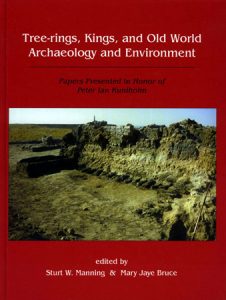 Dendrochronology, or tree-ring dating, provides a key resource for understanding archaeological sites and art historical objects and serves as a stepping stone for investigating past climate. In the Aegean and Eastern Mediterranean, Peter Ian Kuniholm is synonymous with dendrochronology and dendro-archaeology. Since 1973, he has collected wood and developed chronologies from forests, historic buildings, and archaeological sites throughout Greece, Turkey, and surrounding lands; the wood archive at Cornell houses thousands of samples, some of which extend back to 7000 BC.
