ΣΥΝΘΕΤΗ ΑΝΑΖΗΤΗΣΗ +

Αιγεύς Εταιρεία Αιγαιακής Προϊστορίας

ΑΡΘΡΑ | 2014

Mt. Lykaion Excavation and Survey Project, Part 1: The Upper Sanctuary

Hesperia 83:4 (October-December 2014), 569-652

This is the first report on the excavation and survey project at the Peloponnesian Sanctuary of Zeus on Mt. Lykaion, Arcadia. During 2004 and 2005, topographical, architectural, geological, geophysical, and historical surveys were conducted. From 2006 to 2010, survey work continued, along with the excavation of the upper and lower levels of the sanctuary.

1912-2012. Εκατό χρόνια έρευνας στην προϊστορική Μακεδονία. Πρακτικά διεθνούς συνεδρίου, Αρχαιολογικό Μουσείο Θεσσαλονίκης, 22-24 Νοεμβρίου 2012

Θεσσαλονίκη

1912-2012. Εκατό χρόνια έρευνας στην προϊστορική Μακεδονία. Πρακτικά διεθνούς συνεδρίου, Αρχαιολογικό Μουσείο Θεσσαλονίκης, 22-24 Νοεμβρίου 2012 Τα 100 χρόνια της απελευθερωμένης από τον οθωμανικό ζυγό Θεσσαλονίκης γιορτάστηκαν το 2012 με σειρά εκδηλώσεων, εκθέσεων και πολιτιστικών γεγονότων από πολλούς φορείς σε όλη την πόλη. Στο πλαίσιο του εορτασμού το Αρχαιολογικό Μουσείο Θεσσαλονίκης πέρα από την περιοδική έκθεση «Αρχαιολογία στα μετόπισθεν. Στη Θεσσαλονίκη των ταραγμένων χρόνων 1912-1922» και τον σχετικό κατάλογο της, οργάνωσε και το διεθνές συνέδριο για τα 100 χρόνια προϊστορικής έρευνας στη Μακεδονία, η επιτυχία του οποίου επικυρώθηκε με την αθρόα συμμετοχή επιστημόνων από πολλές χώρες και διάφορες ειδικότητες, οι οποίοι έχουν αφοσιωθεί στη μελέτη των πολιτισμικών χαρακτηριστικών του μακεδονικού χώρου κατά την προϊστορική εποχή.

Meditations on the Diversity of the Built Environment in the Aegean Basin and Beyond. Proceedings of a Colloquium in Memory of Frederick E. Winter, Athens 22-23 June 2012

Αθήνα

Meditations on the Diversity of the Built Environment in the Aegean Basin and Beyond. Proceedings of a Colloquium in Memory of Frederick E. Winter, Athens 22-23 June 2012 The organization of this Colloquium began in early 2011 as a fitting means to honor an individual who had contributed so much to the study of Greek architecture in Canada and in Europe. His long-standing and loyal support of the Canadian Institute in Greece and its mission reinforced the value of this plan.

Post-Prehistoric Ceramics and Chalcolithic to Iron Age Ground Stone Artefacts from the Field Survey in Northwestern Cyprus, 1992-1999

Warsaw

Post-Prehistoric Ceramics and Chalcolithic to Iron Age Ground Stone Artefacts from the Field Survey in Northwestern Cyprus, 1992-1999 The results of the Polis-Pyrgos Archaeological Project (PAP) have now been published in two volumes that present the work of an extensive field survey conducted over nearly a decade in the area of northwestern Cyprus - from the western bank of the Chrysochou River along the north coast of the island eastward to Kato Pyrgos.

Religion and Society in Middle Bronze Age Greece

New York
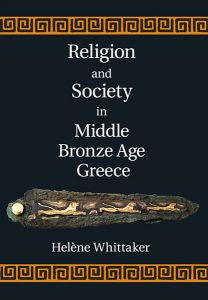
Religion and Society in Middle Bronze Age Greece The Middle Helladic period has received little attention, partially because of scholars’ view of it as merely the prelude to the Mycenaean period and partially because of the dearth of archaeological evidence from the period. In this book, Helène Whittaker demonstrates that Middle Helladic Greece is far more interesting than its material culture might at first suggest.

A Cretan Landscape through Time: Priniatikos Pyrgos and Environs

Oxford

A Cretan Landscape through Time: Priniatikos Pyrgos and Environs This book presents aspects of research on the archaeological investigations at the multi-period site of Priniatikos Pyrgos and surrounding area. Incorporating the Vrokastro Survey Project, the Istron Geoarchaeological Project, the Priniatikos Pyrgos Excavation Project and other researches, this volume presents interdisciplinary case-studies that deal with domestic, technological and mortuary practices at the site and how these relate to settlement and resource exploitation in the surrounding landscape.

The Archaeology of Mediterranean Landscapes. Human-Environment Interaction from the Neolithic to the Roman Period

New York

The Archaeology of Mediterranean Landscapes. Human-Environment Interaction from the Neolithic to the Roman Period This volume presents a comprehensive review of palaeoenvironmental evidence and its incorporation with landscape archaeology from across the Mediterranean. A fundamental aim of this book is to bridge the intellectual and methodological gaps between those with a background in archaeology and ancient history, and those who work in the palaeoenvironmental sciences.

Knossos. A Middle Minoan III Building in Bougadha Methochi

London
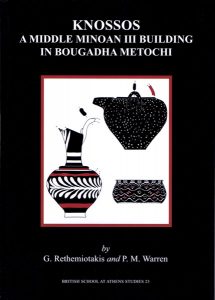
Knossos. A Middle Minoan III Building in Bougadha Methochi From at least 1700 BC, and for several centuries thereafter, a city of substantial houses flanked the palace of Knossos in north-central Crete. Those immediately adjacent to it, like the Royal Villa or the South House, excavated by Sir Arthur Evans, are well known, as are the Little Palace and Unexplored Mansion to the north-west. In fact the whole lower western hill-slope (Bougadha Metochi, the modern village) was terraced with fine, ashlar masonry buildings, served by well-engineered paved roads.

L’art égéen 2. Mycènes et le monde mycénien

Paris

L’art égéen 2. Mycènes et le monde mycénien Ce second volume de l’histoire de l’art égéen est consacré à l’art mycénien, depuis son apparition en Grèce continentale, vers 1600 av. J.-C., jusqu’à la fin du deuxième millénaire, vers 1050-1000. L’art mycénien naît, à Mycènes en particulier, avec les œuvres prestigieuses des tombes à fosse puis s’affirme et se transforme, d’abord lorsque les Mycéniens s’installent en Crète, au palais de Cnossos, après 1450, puis lorsqu’ils édifient eux-mêmes, à partir de 1350, leurs propres palais à Mycènes, Tirynthe, Pylos et Thèbes.

Dréros

Bulletin de Correspondance Hellénique 135.2 (2011) [2014], 625-646

Placée sous la responsabilité de V. Zographaki et d’A. Farnoux, la mission gréco-française de Dréros a accompli six semaines de travaux de terrain pendant l’été 2010 (19 juillet-31 août), accompagnées de deux semaines de préparatifs divers à Néapolis (apothèque, logement). Ces travaux de nettoyage et de fouilles ont porté sur cinq secteurs.

Bassin de Korçe, Kallamas

Bulletin de Correspondance Hellénique 135.2 (2011) [2014], 661-691

La campagne de 2010 a été consacrée, d’une part, aux études de matériel (celui des deux premières campagnes de fouille sur le site néolithique de Kallamas et celui des fouilles de Sovjan en vue de la publication finale) ; d’autre part, à une nouvelle campagne de prospection dans la zone du lac Maliq (projet PALM), qui a permis d’achever l’exploration de toute la partie Nord du bassin de Korçë.

Malia, Bâtiment Pi

Bulletin de Correspondance Hellénique 135.2 (2011) [2014], 601-624

La fouille du Quartier Pi a été poursuivie et trois campagnes d’étude ont été accomplies : S. Müller Celka (CNRS) a travaillé sur les données de la prospection archéologique (céramique prépalatiale, vestiges architecturaux, outillage lithique, cartes de répartition)

Aspis

Bulletin de Correspondance Hellénique 135.2 (2011) [2014], 551-566

Une seule campagne de fouilles a été menée, à l’Aspis, et trois missions ont porté sur le mobilier, les inscriptions, les monnaies. M.-Fr. Billot (IRAA, CNRS) a continué son étude des terres cuites architecturales d’Argos et de l’Héraion d’Argos; Fr. Croissant (université Paris I) et H. Aurigny (EFA) ont travaillé au classement du matériel provenant des fouilles de l’Aphrodision en vue de sa publication;