ΒΙΒΛΙΑ | 2014
Vassos Karageorghis & Athanasia Kanta
Uppsala
2014
 The volume presents a full report on excavations undertaken in 2010 and 2011 by Vassos Karageorghis and Athanasia Kanta at the 13th BC fortified settlement of Pyla-Kokkinokremos in the Larnaca Bay area of southern Cyprus; and an additional brief report on the 2012 excavations which uncovered two extremely important Cypro-Minoan clay tablets.
Galanidou N., Gaki-Papanastasiou K., Karymbalis E, Maroukian H., Koskeridou E. & Giangas C.
Κρητικά Χρονικά 34 (2014), 97-122
The Kairatos drainage basin, the modern Katsabanos, and its coastal plain in north-central Crete have yielded abundant archaeological evidence for human settlement and activity spanning the greater part of the Holocene. In c. 7000 BC this basin induced the island’s first settlers to make a permanent camp at Knossos.
Philip P. Betancourt, Thomas Brogan, Vili Apostolakou & Andrew Koh
Κρητικά Χρονικά 34 (2014), 89-96
Until recently, little evidence was available for understanding how Minoan craft-work and manufacturing was organized. Most of the workshops that have been excavated have contributed few details on whether workers were grouped together under supervisors or not, or what was allocated to workshop personnel as compensation or subsistence.
Jean-Pierre Olivier
Κρητικά Χρονικά 34 (2014), 83-88
II y a exactement quarante ans, j’ai publié un article sur la fiscalité mycénienne (Jean-Pierre Olivier, «Une loi fiscale mycenienne», BCH 98 (1974), 23-35) j’allais jusqu’à parier “dun seul et même «code des impôts»” valable à Knossos et à Pylos. Je n’allais pas encore, à cette époque jusqu’à évoquer un «empire mycénien», ce que j’ai fait par la suite.
Αθανασία Κάντα
Κρητικά Χρονικά 34 (2014), 183-190
Κατά τα φοιτητικά μου χρόνια είχα την τύχη να συνεργασθώ σε μια σειρά ανασκαφικών ερευνών με τον Στυλιανό Αλεξίου. Η συνεργασία αυτή πιστεύω ότι κατεύθυνε τη μελλοντική μου πορεία στην αρχαιολογία. Μια επίσκεψη στο εκκλησάκι της Αγίας Πελαγίας μαζί με τον συντηρητή Κωστή Νικάκη, με τη μοτοσυκλέτα του το 1970, όπου συλλέξαμε ωραία Μινωικά όστρακα που μετέφερα στο Μουσείο Ηρακλείου, οδήγησε, κάτω από την πίεση μελλοντικών εργασιών για το ξενοδοχείο Καψή στην ανασκαφική έρευνα μιας από τις σημαντικότερες θέσεις του κρητικού πολιτισμού.
Νώτα Δημοπούλου-Ρεθεμιωτάκη
Κρητικά Χρονικά 34 (2014), 191-199
Ο Στυλιανός Αλεξίου ανέσκαψε από το 1951 ώς το 1963 στον Κατσαμπά, περιοχή όπου εκτεινόταν η λιμενική πόλη της Κνωσού, μια συστάδα επτά λαξευτών θαλαμοειδών τάφων της τελικής ανακτορικής περιόδου, ΥΜ II-IIIΑ1-2 χρόνων, τους οποίους δημοσίευσε υποδειγματικά το 1967 στη μονογραφία «Υστερομινωικοί Τάφοι Λιμένος Κνωσού (Κατσαμπά)».
Mac Sweeney, N.
The Journal of Hellenic Studies
Mac Sweeney, N., 2014. Review of N. Momigliano, Bronze Age Carian Iasos. Structures and Finds from the Area of the Roman Agora (c. 3000-1500 BC) (Rome 2012), The Journal of Hellenic Studies 134 (January 2014), 239-240.
Krzyszkowska O.
The Journal of Hellenic Studies
Krzyszkowska O., 2014. Reviews of W. Müller (ed.), Die Bedeutung der minoischen und mykenischen Glyptik VI. internationales Siegel-Symposium aus Anlass des 50 jährigen Bestehens des CMS, Marburg, 9.-12. Oktober 2008 [Corpus der minoischen und mykenischen Siegel Beiheft 8] (Mainz am Rhein 2010), and M. Anastasiadou, The Middle Minoan Three-Sided Soft Stone Prism: A Study of Style and Iconography [Corpus der
Gerald Cadogan
Κρητικά Χρονικά 34 (2014), 43-54
Stylianos Alexiou's translation of Shakespeare's battle cry against time at the start of Sonnet 16 makes an apposite, if metaphorical, introduction to an essay around his pioneering paper (1979,1980,2002) on war, defence and the improbability - the “myth”, to use his word - of Minoan peace.
Krzyszkowska O.
Gnomon
Krzyszkowska O., 2014. Review of I. Pini, Aegean and Cypro-Aegean Non sphragistic Decorated Gold Finger Rings of the Bronze Age [Aegaeum 31] (Liège 2010), Gnomon 86.7, 624-628.
Traunmüller S.
Gnomon
Traunmüller S., 2014. Review of E. Hallager & B.P. Hallager (eds), The Greek-Swedish Excavations at the Agia Aikaterini Square, Kastelli, Khania 1970-1987 and 2001. Results of the excavations under the direction of Yannis Tzedakis and Carl-Gustaf Styrenius. Vol. IV.I: Text. Vol. IV.2: Plates. The Late Minoan IIIB:1 and IIIA:2 settlements (Stockholm 2011), Gnomon 86.2, 161-185.
Kistler E.
Gnomon
Kistler E., 2014. Review of S. Langdon, Art and Identity in Dark Age Greece, 1110-700 B.C.E. (Cambridge 2008), Gnomon 86.2, 187-191.
Βασίλειος Πετράκος (επιμέλεια)
Αθήνα
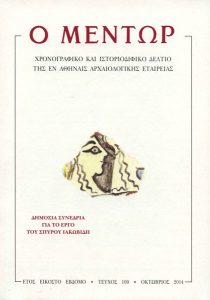 Έχει ήδη περάσει περισσότερο από χρόνος χωρίς το Σπύρο Ιακωβίδη († 16 Ιουνίου 2013). Για να τιμηθεί η μνήμη του πολύτιμου εταίρου του αφιερώθηκε δημόσια συνεδρία κατά την οποία μίλησαν για τη ζωή και το έργο του φίλοι και συνεργάτες. Η συνεδρία έγινε στις 23 Μαΐου.
Peter Warren
Κρητικά Χρονικά 34 (2014), 13-41
Within the very rich flora of Greece, the Aegean and especially Crete there are many scented plants suitable for the making of aromatics, perfumes, scented oils and unguents. The evidence for the Aegean Bronze Age is essentially of three kinds, botanical, epigraphic (Linear B) and archaeological, all interrelated.
Andrew M.T. Creekmore III & Kevin D. Fisher (επιμέλεια)
New York
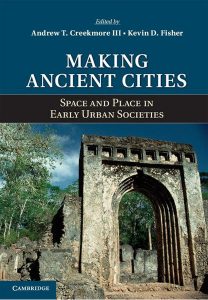 This volume investigates how the structure and use of space developed and changed in cities, and examines the role of different societal groups in shaping urbanism. Culturally and chronologically diverse case studies provide a basis to examine recent theoretical and methodological shifts in the archaeology of ancient cities.
