ΒΙΒΛΙΑ | 2014
Helen Dawson
Walnut Creek, California
2014
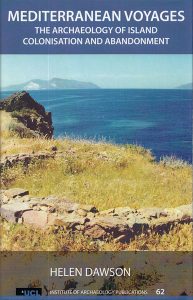 This book is a comparative study of the archaeology of colonisation, abandonment, and resettlement of the Mediterranean islands in prehistory. Presenting an extensive and up-to-date body of evidence, it provides a pan-Mediterraneanre view of island data, a task last completed in the mid-1990s.
Despina Skorda & Julien Zurbach
Bulletin de Correspondance Hellénique 135.2 (2011) [2014], 535-539
La campagne de Kirrha en 2010 a été consacrée à l’étude, après la fouille de 2009, et elle a porté sur plusieurs catégories de matériels. Une étude de la céramique issue de la fouille de l’année passée a été menée par D. Skorda et I. Mathioudaki. La céramique du secteur 1 (flanc oriental de la magoula) ayant fait l’objet d’une première analyse dès 2009, et celle du dépôt mycénien du secteur 1 ayant été restaurée pendant l’hiver, l’étude s’est concentrée sur celle des secteurs 2 et 3 (flanc occidental de la magoula) afin de préciser la chronologie des structures fouillées en 2009.
Eric H. Cline
Princeton/Oxford
 In 1177 B.C., marauding groups known only as the “Sea Peoples” invaded Egypt. The pharaoh’s army and navy managed to defeat them, but the victory so weakened Egypt that it soon slid into decline, as did most of the surrounding civilizations. After centuries of brilliance, the civilized world of the Bronze Age came to an abrupt and cataclysmic end. Kingdoms fell like dominoes over the course of just a few decades.
Pascal Darcque, Haϊdo Koukouli-Chryssanthaki, Dimitra Malamidou & Zoi Tsirtsoni
Bulletin de Correspondance Hellénique 135.2 (2011) [2014], 497-516
Après une année 2009 consacrée à l’étude, la deuxième campagne de fouille du nouveau programme de recherches sur Dikili Tash s’est déroulée entre le 24 juin et le 6 août 2010, grâce au soutien, d’une part, des institutions de tutelle: la Société archéologique d’Athènes et l’École française d’Athènes; d’autre part, du ministère français des Affaires étrangères et européennes, de l’Institute for Aegean Prehistory (INSTAP), de la National Geographic Society, de la municipalité de Philippi, de l’Agence nationale de la recherche (ANR) et du Centre national de la recherche scientifique (CNRS).
Cécile Oberweiler
Bulletin de Correspondance Hellénique 135.2 (2011) [2014], 421-491
Οι μελέτες για την παραγωγή χαλκού και μπρούντζου στον πρωτοϊστορικό αιγαιακό κόσμο ασχολούνται γενικά με τα μεταλλικά αντικείμενα εις βάρος των εργαλείων του χαλκουργού: χοάνες, συστήματα αερισμού και μήτρες. Η μελέτη τους όμως προσφέρει νέες πληροφορίες τόσο για τις τεχνικές παραγωγής ενός μεταλλικού αντικειμένου και για την εξέλιξή τους, όσο και για την ύπαρξη τεχνικών παραδόσεων και συγκεκριμένης τεχνογνωσίας των χαλκουργών.
Χρίστος Γ. Ντούμας
Αθήνα
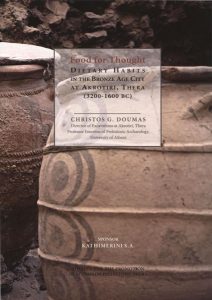 Στο βιβλίο αυτό γίνεται προσπάθεια ανάπλασης του διαιτολογίου των προϊστορικών Θηραίων πρωτίστως μέσα από τα κατάλοιπα τροφών που έχουν βρεθεί στα ερείπια του Ακρωτηρίου,αλλά και έμμεσα από τις απεικονίσεις φυτών και ζώων στην αγγειογραφία και τις τοιχογραφίες.
Angelos Tsagrakis
Studi Micenei ed Egeo-Anatolici 54 (2012) [2014], 323-341
The article deals with furniture and other wooden objects recorded in the Linear Β tablets as well as with the craftsmen specialized in their production. The social implications of these craft activities at Pylos are also discussed.
Maurizio Del Freo & Françoise Rougemont
Studi Micenei ed Egeo-Anatolici 54 (2012) [2014], 263-280
The Thebes tablets of the Of series record allocations of wool, aimed at different purposes, including the production and finishing of textiles. This paper studies the individuals involved in the textile manufacture, the production structures and the mechanisms underlying the distribution of wool.
Anna Lucia D’Agata
Studi Micenei ed Egeo-Anatolici 54 (2012) [2014], 207-247
Discovered in 2002 in the settlement of Thronos Kephala in central-western Crete - usually identified with the predecessor of ancient Sybrita - the clay figured krater presented in this paper displays the oldest scene of armed dance in Greek vase-painting, therefore constituting an outstanding document of the Cretan Early Iron Age.
Marco Bettelli
Studi Micenei ed Egeo-Anatolici 54 (2012) [2014], 185-205
In recent years the meetings, exhibitions and collections of essays on the phenomenology of the sun imagery in ancient communities have multiplied. Such initiatives include works, usually comprehensive summaries, ranging from protohistoric Europe to the ancient Near East, including in some cases even more distant areas in both space and time.
Christo Thanos & Wout Arentzen (επιμέλεια)
Leiden
 In this second part of The Schliemann Diaries we follow Heinrich Schliemann (the famous 19th century archaeologist, trader and traveller) through his diary on his second journey: his travels to America from December 1850 to March 1853. The original diary was written in English and for a small part in Spanish. This publication is a transcription and translation of Schliemann’s travel diary.
Hara Tzavella-Evjen
Αθήνα
 The pottery and figurines from the Mycenaean cemeteries at Kolonaki, Hagia Anna, Ismenion and Elektrae Gates in Thebes were first published by the excavator A. Keramopoullos in the AE 49 (1910) and AD 3 (1917) in association with the chamber tombs and also in context with the other tomb deposits.
Hollinshead, Μ.
Bryn Mawr Classical Review
Hollinshead, Μ., 2014. Review of E. Paliou, U. Lieberwirth & S. Polla (eds), Spatial Analysis and Social Spaces: Interdisciplinary Approaches to the Interpretation of Prehistoric and Historic Built Environments [Topoi 18] (Berlin/Boston 2014), Bryn Mawr Classical Review 2015.01.52
Κείμενο
Pierini, R.
Bryn Mawr Classical Review
Pierini, R., 2014. Review of C. Varias García (ed.), Actas del Simposio Internacional: 55 Años de Micenología (1952-2007) [Faventia Supplementa 1] (Bellaterra 2012), Bryn Mawr Classical Review 2015.01.42
Κείμενο
Petrakis, V.
Bryn Mawr Classical Review
Petrakis, V., 2014. Review of P. M. Steele, A Linguistic History of Ancient Cyprus: The Non-Greek Languages and their Relations with Greek, c. 1600-300 BC (Cambridge/New York 2013), Bryn Mawr Classical Review 2015.01.24
Κείμενο
