ΒΙΒΛΙΟΚΡΙΣΙΕΣ | 2014
Mikrakis, Μ.
Bryn Mawr Classical Review
Mikrakis, Μ., 2014. Review of Y.V. Andreyev, From Eurasia to Europe: Crete and the Aegean World in the Bronze and Early Iron Ages (3rd – early 1st millennia BC) [Monographs on Antiquity 6] (Louvain 2013) Bryn Mawr Classical Review 2014.12.26
Κείμενο
Kennell, S.A.H.
Bryn Mawr Classical Review
Kennell, S.A.H., 2014. Review of D. Mulliez (ed.), Στα βήματα του Wilhelm Vollgraff: Εκατό χρόνια αρχαιολογικής δραστηριότητας στο Άργος / Sur les pas de Wilhelm Vollgraff: Cent ans d’activités archéologiques à Argos [Recherches franco-helléniques, 4] (Athènes 2013), Bryn Mawr Classical Review 2014.11.23
Κείμενο
Gauthier, Ε.
Bryn Mawr Classical Review
Gauthier, Ε., 2014. Review of M.-E. Alberti & S. Sabatini (eds), Exchange Networks and Local Transformations: Interaction and Local Change in Europe and the Mediterranean from the Bronze Age to the Iron Age (Oxford, Oakville 2013), Bryn Mawr Classical Review 2014.11.09
Κείμενο
Osborne, R.
Bryn Mawr Classical Review
Osborne, R., 2014. Review of V. Parker, A History of Greece: 1300 to 30 BC (Oxford 2014), Bryn Mawr Classical Review 2014.09.11
Κείμενο
Lucia Alberti
Studi Micenei ed Egeo-Anatolici 54 (2012) [2014], 117-142
In texts produced in the palace of Mari, some tablets list as 'Cretan' certain prestigious objects, such as leather goods, weapons and metal vases. Later texts from Ugarit mention Cretan merchants receiving tin in the course of their commercial activities.
Αναστασία Δ. Αγγελοπούλου
Αθήνα
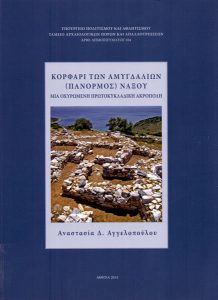 Η ακρόπολη στο Κορφάρι των Αμυγδαλιών (Πάνορμος) Νάξου συγκέντρωσε το ενδιαφέρον των μελετητών του Κυκλαδικού Πολιτισμού ήδη από την εποχή της ανακάλυψής της, το 1963 από τον τότε επιμελητή αρχαιοτήτων καθηγητή Χρίστο Γ. Ντούμα. Θεωρείται από τις χαρακτηριστικές θέσεις της περιόδου της ομάδας Καστριού, στη διάρκεια της οποίας νέοι «ανατολίζοντες» τύποι κεραμικής κάνουν την εμφάνισή τους στις Κυκλάδες μαζί με ευρύτερες αλλαγές και ανακατατάξεις, οι οποίες θεωρείται ότι ανέκοψαν την ομαλή πολιτισμική εξέλιξη κατά τους τελευταίους αιώνες της τρίτης χιλιετίας π.Χ.
Clarissa Belardelli
Studi Micenei ed Egeo-Anatolici 54 (2012) [2014], 165-184
The full evidence concerning the MH III-LH I child burial found at Tiryns inside the Unterburg (LXV 38/62) is here presented and thoroughly discussed. The grave goods include personal objects and drinking vessels; the presence of MH, matt painted miniaturistic vessels together with a wheel-made askos decorated with LH motifs and technique is emphasized.
Ελευθέριος Πλάτων
Κρητικά Χρονικά 34 (2014), 65-81
Είναι γνωστό ότι οι «βουβές» –αλλά στην πραγματικότητα «ομιλούσες»– εικόνες που μας διέσωσε η πλούσια αιγαιακή εικονογραφία της Ύστερης Εποχής του Χαλκού αποτέλεσαν έως τώρα τη μοναδική κατηγορία υποστηρικτικού πληροφοριακού υλικού στις όποιες προσπάθειές μας να «ανασυνθέσουμε» τις μινωικές θρησκευτικές τελετουργίες.
Eirini Galli
Κρητικά Χρονικά 34 (2014), 231-248
The Early Minoan tholos tomb at Krasi, thanks to the published stratigraphic data, provides a fertile ground for a narrative perspective on its sedimented sequences. It becomes feasible to trace the way the monument developed in time, spanning from its foundation in EMI to its last traced use in EMIII/MMΙA.
Σπύρος Ιακωβίδης (επιμέλεια)
Αθήνα
 O Σπυρίδων Κ. Μαρινάτος, Προϊστάμενος, Γενικός Επιθεωρητής της Αρχαιολογικής Υπηρεσίας, καθηγητής τον Πανεπιστημίου και ακαδημαϊκός, έγινε παγκοσμίως γνωστός χάρη στην ανασκαφή του Ακρωτηρίου στην Θήρα, την οποία επισκέπτονται κάθε χρόνο οι μυριάδες των περιηγητών που έρχονται στην Ελλάδα.
Michael J. Boyd
World Archaeology 46:2 (2014), 192-205
The performance of funerary ritual is one of the hallmarks of the Mycenaean period. The materiality and performative aspects have often been lost in typologies and classificatory approaches concerned with the identity and status of the dead.
Alexia Spiliotopoulou
Κρητικά Χρονικά 34 (2014), 163-182
The pottery studied and presented here is both from Nikolaos Platon’s rescue excavation in 1961 and A. Karetsou’s and G. Rethemiotakis’s excavation in 1990. During the first period the excavator was able to locate three walls of a perivolos and concentrated on cleaning the prominent rock that protruded on one side of the perivolos and served as its west wall.
Yannis Galanakis, Toby Wilkinson & John Bennet (επιμέλεια)
Oxford
 Over her career Susan Sherratt has questioned our basic assumptions in many areas of the later prehistory of the Mediterranean and Europe, deploying a canny eye for detail, but never losing sight of the big picture. Her collected works include contributions on the relationship between Homeric epic and archaeology; the economy of ceramics, metals and other materials; the status of the ‘Sea Peoples’ and other ethnic terminologies; routes and different forms of interaction; and the history of museums/collecting (especially relating to Sir Arthur Evans).
Giorgos Rethemiotakis
Κρητικά Χρονικά 34 (2014), 147-162
Kophinas, like all peak sanctuaries, has yielded large numbers of clay votive objects, particularly figurines. Genre, form and style are factors defining origin, choices, ideological background and behavioural patterns in cult of specific groups of votaries who frequented the site.
Alexandra A. Karetsou
Κρητικά Χρονικά 34 (2014), 123-146
The 1950s and 60s can, without exaggeration, be called the “heroic ages of Cretan archaeology”. The then Ephor Nikolaos Platon, with the aid of curator Kostis Davaras, followed by Ephor Stylianos Alexiou, undertook a host of rescue excavations and gathering of surface finds in inaccessible parts of Crete, with limited means but much dedication and self-sacrifice.
