
ΑΡΘΡΑ | 2014
An Architectural Perspective on Social Change and Ideology in Early Mycenaean Greece
American Journal of Archaeology 118.3 (July 2014): 369–400.
Early Mycenaean (Late Helladic [LH] II–IIIA1) Greece witnessed major changes in the built environment, including new types of mortuary architecture and the appearance of corridor buildings (a megaron-type structure with an interior corridor and subsidiary rooms).Βιβλιοκρισία του: Associated Regional Chronologies for the Ancient Near East and the Eastern Mediterranean: Cyprus
American Journal of Archaeology
Höflmayer, F., 2014. Online review of E. Peltenburg (ed.), Associated Regional Chronologies for the Ancient Near East and the Eastern Mediterranean: Cyprus (Turnhout 2013), American Journal of Archaeology 118.4 (October 2014).
Βιβλιοκρισία του: The manufacture of Minoan metal vessels: theory and practice
Antiquity
Dolfini, Α., 2014. Review of C.F. Clarke, The manufacture of Minoan metal vessels: theory and practice (Uppsala 2013), Antiquity 88:342 (December 2014), 1337-1339.
Life and Death of a Bronze Age House: Excavation of Early Minoan I Levels at Priniatikos Pyrgos
American Journal of Archaeology 118.2 (April 2014): 307-358.
In 2010, a portion of a well-preserved domestic building dating to the later part of Early Minoan (EM) I was excavated at Priniatikos Pyrgos, east Crete. Though only a small portion of this house was available to investigate, there was clear evidence for several architectural and habitation phases.Funerary Pithoi in Bronze Age Crete: Their Introduction and Significance at the Threshold of Minoan Palatial Society
American Journal of Archaeology 118.2 (April 2014): 197-222.
Toward the end of the third millennium B.C.E., Minoan funerary customs changed, and people began to favor the use of clay receptacles - pithoi or larnakes - for the bodies of the dead. This article offers a comprehensive study of the funerary pithoi of the period, comprising a review of the available material and its classification, distribution, and dating, the relation of container to tomb types, and the specific use of pithoi within funerary ritual.Σπυρίδων Μαρινάτος, 1901-1974. Η ζωή και η εποχή του
Αθήνα

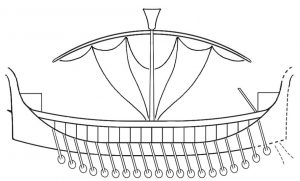
Sea Peoples, Egypt, and the Aegean: The transference of maritime technology in the Late Bronze–Early Iron transition (LH IIIB–C)
Αιγαιακές Σπουδές1, 2014, 21-56
Test of Time and A Test of Time Revisited: The Volcano of Thera and the Chronology and History of the Aegean and East Mediterranean in the Mid-Second Millennium BC
Oxford/Philadelphia

Understanding Standardization and Variation in Mediterranean Ceramics. Mid 2nd to late 1st Millennium BC
Leuven - Paris - Walpole, MA
Women in Mycenaean Greece: The Linear B Tablets from Pylos and Knossos
New York
Dating the End of the Greek Bronze Age: A Robust Radiocarbon-Based Chronology from Assiros Toumba
PLoS ONE 9(9): e106672. doi:10.1371/journal.pone.0106672
Over 60 recent analyses of animal bones, plant remains, and building timbers from Assiros in northern Greece form an unique series from the 14th to the 10th century BC. With the exception of Thera, the number of 14C determinations from other Late Bronze Age sites in Greece has been small and their contribution to chronologies minimal.Characterizing a Middle Bronze Palatial Wine Cellar from Tel Kabri, Israel
PLoS ONE 9(8): e106406. doi:10.1371/journal.pone.0106406
Scholars have for generations recognized the importance of wine production, distribution, and consumption in relation to second millennium BC palatial complexes in the Mediterranean and Near East. However, direct archaeological evidence has rarely been offered, despite the prominence of ancient viticulture in administrative clay tablets, visual media, and various forms of documentation.Space and Time in Mediterranean Prehistory
New York

In Search of Agamemnon: Early Travellers to Mycenae
Cambridge
